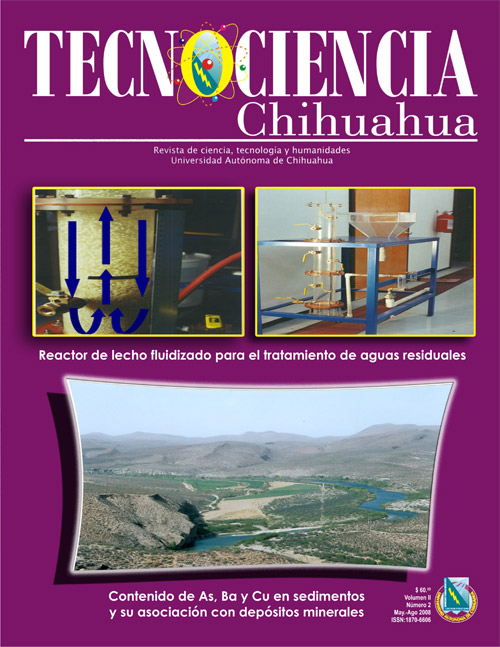
Materiales de soporte para el crecimiento de biopelícula en un reactor de lecho fluidizado
Advanced support materials for biofilm attachment in a fluidized bed reactor
DOI:
https://doi.org/10.54167/tecnociencia.v2i2.74Keywords:
Wastewater, organic matter, bed fluidizationAbstract
The effect of low density support materials on a fludized bed reactor efficiency was evaluated. Several mineral materials with specific density lower than that exhibited by the silica sand were selected. Moreover, other porous materials with a specific density similar and an appparent density significant lower in comparison to that of the silica sand were also evaluated. We found that the mixture of polyester-expanded perlite and vitrified perlite resulted to be the best as support materials. The bed fluidization for polyester expanded perlite and vitrified perlite was achieved at a recirculation velocity of 0.45 and 0.55 cm seg-1, respectively. Both recirculation rates resulted to be lower than those requiered to fluidize similar density materials. These features allowed to the reactor to operate in a continuos mode without needed to wash the bed and avoiding its clogging.
Downloads
References
Bakke, R., R. Kommendal & S. Kalvenes. 2001. Quantification of Biofilm Accumulation by an Optical Approach. Journal of Microbiological Methods 44(1): 13-26. https://doi.org/10.1016/s0167-7012(00)00236-0
Bignami, L., B. Eramo, R. Gavasci, R. Ramadori & E. Rolle. 1991. Modelling and experiments on fluidized-bed biofilm reactors. Water Science and Technology 24(7): 47-58. https://doi.org/10.2166/wst.1991.0184
Davey, M.E. & G.A. O’Toole. 2000. Microbial Biofilms: from Ecology to Molecular Genetics. Microbiological And Molecular Reviews 64 (4): 847-867. https://doi.org/10.1128/mmbr.64.4.847-867.2000
Fox, P., M.T. Suidan & J.T. Bandy. 1990. A Comparison of Media Types in Acetate Fed Expanded-Bed Anaerobic Reactors. Water Research 24 (7): 827-835. https://doi.org/10.1016/0043-1354(90)90132-P
Jiménez, B., E. Becerril & I. Scola. 1990. Denitrification in a Fluidized Bed System Using Low-Cost Packing Material. Environmental Technology 11(5): 409-420. https://doi.org/10.1080/09593339009384880
Larachi, F., I. Iliut, O. Rival & B.P.A. Grandjean. 2000. Prediction of Minimum Velocity in Three- Phase Fluidized-Bed Reactors. Industrial Engineering Chemistry Research 39 (2): 563-572. https://doi.org/10.1021/ie990435z
Massol-Deyá, A.D., J. Whallon, R.F. Hickey & J.M. Tiedje. 1995. Channel Structures in Aerobic Biofilms of Fixed Film Reactors Treating Contaminated Groundwater. Applied and Environmental Microbiology 61(2): 769-777. https://doi.org/10.1128/aem.61.2.769-777.1995
Nicolella, C., S. Chiarle, R. Di Felice & M. Rovatti. 1997. Mechanisms of biofilm detachment in fluidized bed reactors. Water Science and Technology 36(1): 229-235. https://doi.org/10.1016/S0273-1223(97)00329-6
Ochieng, A., T. Ogada, W. Sisenda & P. Wambua. 2002. Brewery wastewater treatment in a fluidized bed bioreactor. Journal of Hazardous Materials 90(3): 311-321. https://doi.org/10.1016/S0304-3894(01)00373-9
Rivas, L.B.A., G.V. Nevárez, R.A. Saucedo & R.G. Bautista. 2000. Simultaneous Aerobic and Anaerobic Degradation of Wastewater in a Fixed-Bed Reactor. En Ex situ Biological Treatment Technologies. Proceedings of the Sixth International Symposium of In Situ and On-Site Bioremediation Vol. 6 (pp. 361-368). Batelle Press.
Ramalho, R.S. 1996. Tratamiento de Aguas Residuales. Versión en Español por D.J. Beltrán, F. De Lora y R.S. Ramalho. Editorial Reverté.
Ryhner, G., S. Petrozzi & I.J. Dunn. 1988. Operation of a Three-Phase Biofilm Fluidized Sand Reactor for Aerobic Wastewater Treatment. Biotechnology and Bioengineering 32(5): 677-688. https://doi.org/10.1002/bit.260320513
Safferman, S.I. & P.L. Bishop. 1996. Aerobic Fluidized Bed Reactor with Internal Media Cleaning. Journal of Environmental Engineering 122 (4): 284-291. https://ascelibrary.org/doi/10.1061/%28ASCE%290733-9372%281996%29122%3A4%28284%29
Schreyer, H.B. & R.W. Coughlin. 1999. Effects of Stratification in a Fluidized Bed Bioreactor During Treatment of Metalworking Wastewater. Biotechnology and Bioengineering 63 (2):129-140. https://doi.org/10.1002/(SICI)1097-0290(19990420)63:2%3C129::AID-BIT1%3E3.0.CO;2-O
Shieh, W. K., P. M. Sutton & P. Kos. 1981. Predicting reactor biomass concentration in a fluidized-bed system. Journal of Water Pollution Control Federation 53(11): 1574-1584.
Tavares, C.R.G., G.L. Sant’Anna Jr. & B. Capdeville. 1995. The Effect of Air Superficial Velocity on Biofilm Accumulation in a Three-Phase Fluidized-Bed Reactor. Water Research 29 (10):2293-2298. https://doi.org/10.1016/0043-1354(95)00043-K
Trapasso, R. & G.Andrews. 1995. The optimal design of fluidized bed bioreactors. Journal of Water Pollution Control Federation 57(2):143-150.
Tsuneda, S., J. Auresenia, Y. Inoue, Y. Hashimoto & A. Hirata. 2002. Kinetic model for dynamic response of three-phase fluidized bed biofilm reactor for wastewater treatment. Biochemical Engineering Journal 10(1): 31-37. https://doi.org/10.1016/S1369-703X(01)00152-8