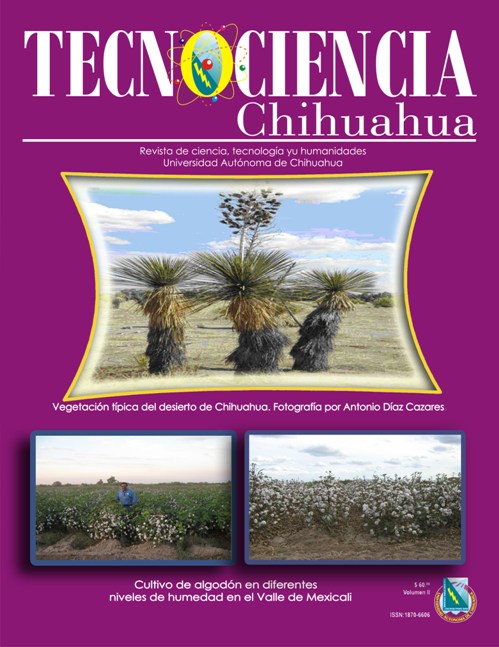
Evaluación del rendimiento de algodón (Gossypium hirsutum L) con cuatro niveles de humedad aprovechable en suelo franco en el Valle de Mexicali
Cotton (Gossypium hirsutum L) yield evaluation under four levels of soil moisture content in a loamy soil in the Mexicali Valley
DOI:
https://doi.org/10.54167/tecnociencia.v2i3.79Keywords:
irrigation, regression, moisture, yield, cottonAbstract
During the 2005 spring-summer period, at the Mexicali, Baja California Valley, 30,000 ha of cotton crop were sowed, using furrow surface irrigation. The number of irrigations was variable, and its calculation was empirical by farmers. As a result of this method, results of yields were also variable. Due to the lack of knowledge about the right moment to apply the plant water needs, in order to obtain the maximum yield, an experimental plot was designed. The main goal of this study was to evaluate four levels of soil moisture content (20, 40, 60 y 80 %), before irrigation, under the cotton crop yield. Therefore, it is necessary to establish techniques to get the highest yield for both bone and fiber cotton crop. A precocious seed were used for evaluation, Delta Pine 565, in two phenological stages (X1 y X2), where X1 goes from germination all the way through the early stage of flowering, and X2 is from start of flowering (50 % of flowered plants) until the cotton fiber formation. In order to calculate the hydrological balance the soil moisture content was measured with a neutron probe in 15 cm. layers until 105 cm. depth was reached. A factorial array was used. (42) and the data statistical analysis was made through a multiple regression model, and a variance analysis also was utilized. The best array (R2=0.72) was obtained with the Y=0.6705553+ 0.15820168 X2 – 0.0014X2 2 function. The ANOVA showed significant differences (P<0.05) among treatments. The most favourable X1 and X2 values of available soil moisture content were 35 % and 57 % respectively. The results show that the available soil moisture content on the second stage had a higher effect on the bone and cotton yield.
Downloads
References
Adkinnson, P. L., G. A. Niles, J. K. Walter, L. S. Bird & H. B. Scott. 2000. Controlling cotton insect pest: A new system. Science 216(4541):19-22. https://doi.org/10.1126/science.216.4541.19
Aujula, M. S., H. S. Thind & G. S. Buttar. 2005. Cotton yield and water use efficiency at various levels of water and N through drip irrigation under two methods of planting. Agriculture Water Manage 71(2):167-179. https://doi.org/10.1016/j.agwat.2004.06.010
Barboza, D. S., J. A. Ferreira, T. V. Rammana & V. P. Rodríguez. 2007. Crop water stress index and water-use efficiency for melon (Cucumis melo L.) on different irrigation regimes. Agricultural Journal 2(1): 31-37. https://medwelljournals.com/abstract/?doi=aj.2007.31.37
Clark, L. J. & E. W. Carpenter. 1995. Cotton irrigation scheduling trial on Pima and upland cotton using Azsched (pp. 88-92). Cotton: A College of Agriculture Report. College of Agriculture, University of Arizona. https://repository.arizona.edu/handle/10150/210860
Comisión Nacional del Agua. 2007. Organismo de cuenca Península de Baja California. Gerencia de Aguas Superficiales, Subgerencia de Evaluación y Modelación Hidrogeológica. CNA.
Doorenbos, J., W. O. Pruitt, A. Aboukhaled, J. Damagnez, N. G. Dastane, C. Van Den Berg, P. E. Rijtema, O. M. Ashford & M. Frère. 2000. Crop water requirements. Paper no. 24 (pp. 144-146). FAO. https://www.fao.org/3/s8376e/s8376e.pdf
Escoboza, L. F. 1983. Construcción y uso de una función de reserva de algodón en base a las variaciones de humedad del suelo (Tesis, Colegio de Postgraduados).
Gillham, F. E. M., T. M. Bell, T. Arin, G. A. Matthews, C. Le Rumeur & B. Hear. 2001. Cotton production prospects for the next decade. World Bank Technical Paper No. WTP287 (pp. 277-278). The World Bank. https://tinyurl.com/3hxcpfav
Godoy, S. C., E. A. García & A. Palomo. 2001. Comportamiento de la variedad de algodonero CIAN Precoz a diferentes inicios e intervalos de riegos. Ciencia Agropecuaria FAUANL 6(2): 211-214.
Longenecker, D. E. & L. J. Erie. 2000. Irrigation water management. En Advances in Production and Utilization of Quality. Cotton: Principles and Practices (pp. 321-345). The Iowa State University Press.
Machain, L. M., F. D. Legaspi & J. M. Sánchez. 2000. Determinación del momento oportuno para desfoliar al algodonero en el Valle de Mexicali, B.C. Reporte técnico. Instituto de Ciencias Agrícolas, Universidad Autónoma de Baja California.
Méndez-Natera, J. R., L. Lara & J. A. Gil-Marín. 2007. Efecto del riego por goteo en el crecimiento inicial de tres cultivares de algodón Gossypium hirsutum l. Idesia 25(2): 7-15. http://dx.doi.org/10.4067/S0718-34292007000200002
Ojeda-Bustamante, W., E. Sifuentes-Ibarra & H. Unland-Weiss. 2006. Programación integral del riego en maíz en el norte de Sinaloa, México. Agrociencia 40(1): 13-25. https://www.redalyc.org/articulo.oa?id=30240102
Palomo, A. S. & L. S. Godoy. 2001. Efecto del número de riegos en el rendimiento y calidad de la fibra de 16 genotipos de algodón. Ciencia Agropecuaria FAUANL (7): 222-223.
Reyes, V.M., D. Viramontes, N. E. Miranda, P. B. Sánchez & O. A. Viramontes. 2008. Papel hidrológico ambiental de las propiedades hidráulicas del suelo superficial de la cuenca del río Conchos. Ingeniería Hidráulica en México 22 (4): 33-46. https://dialnet.unirioja.es/servlet/articulo?codigo=4505233
Uner, N. 1995. Conferencia riego del algodonero en Israel auspiciada por Netafim. Mexicali, Baja California, México.
Wallace, J. S. 2000. Increasing agricultural water use efficiency to meet future food production. Agriculture Ecosystem Environmental 82(1-3): 105-119. https://doi.org/10.1016/S0167-8809(00)00220-6
Wanjura, D. F. & D. R. Upchurch. 2000. Canopy temperature characterizations of corn and cotton water status. Transactions of the American Society of Agricultural Engineers 43(4): 867-875. http://dx.doi.org/10.13031/2013.2982