Application of Chickpea Glutelin Hydrolysates in the Green Synthesis of Selenium Nanoparticles
DOI:
https://doi.org/10.54167/tch.v20i1.2172Keywords:
nanoparticles, chickpea, selenio orgánico e inorgánico, antioxidant activityAbstract
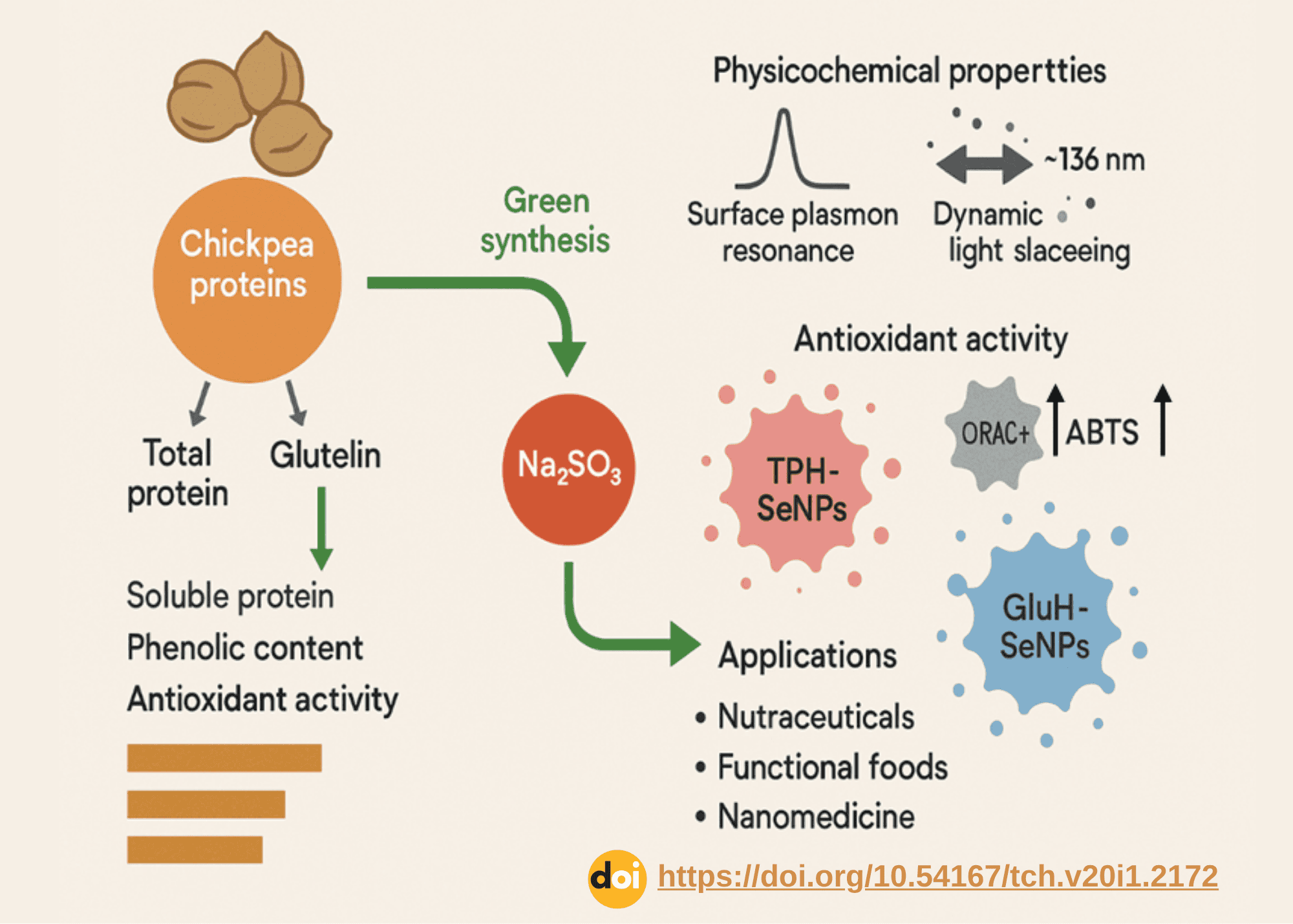
This study evaluated the potential of total chickpea protein (TP), the glutelin fraction (Glu), and their <10 kDa hydrolysates (TPH and GluH) as functionalizing agents in the green synthesis of selenium nanoparticles (SeNPs). Physicochemical parameters, including particle size, zeta potential, polydispersity index, surface plasmon resonance (SPR), and antioxidant activity, were analyzed using ORAC and ABTS assays. The results showed that the hydrolysates interacted more efficiently with SeNPs than the intact proteins, generating more defined spectral profiles. SeNPs functionalized with TP and Glu did not exhibit higher antioxidant activity than their parent proteins. In contrast, SeNPs functionalized with GluH and TPH displayed significantly greater antioxidant activity (+53 % and +21 % in ORAC and ABTS, respectively) compared to the hydrolysates. GluHSeNPs reached a particle size of 136 nm, while TPHSeNPs formed aggregates larger than 1 µm, demonstrating low colloidal stability. Both systems exhibited low zeta potentials (-9 to -13 mV). These findings indicate that <10 kDa chickpea glutelin hydrolysates are promising materials for the synthesis of nanostructures with high antioxidant activity, with potential applications in functional foods and biomedicine.
Downloads
References
Alagesan, V., & Venugopal, S. (2019). Green synthesis of selenium nanoparticle using leaves extract of Withania somnifera and its biological applications and photocatalytic activities. BioNanoScience, 9(1), 105–116. https://doi.org/10.1007/s12668-018-0566-8
Alhawiti, A. S. (2022). Citric acid-mediated green synthesis of selenium nanoparticles: Antioxidant, antimicrobial, and anticoagulant potential applications. Biomass Conversion and Biorefinery. 14(5), 6581-6590. https://doi.org/10.1007/s13399-022-02798-2
EFSA Panel on Nutrition, Novel Foods and Food Allergens (NDA), Turck, D., Bohn, T., Castenmiller, J., de Henauw, S., Hirsch‐Ernst, K. I., ... & Naska, A. (2023). Scientific opinion on the tolerable upper intake level for selenium. EFSA Journal, 21(1), e07704. https://efsa.onlinelibrary.wiley.com/doi/full/10.2903/j.efsa.2023.7704
Ghribi, A. M., Sila, A., Przybylski, R., Nedjar-Arroume, N., Makhlouf, I., Blecker, C., Attia, H., Dhulster, P., Bougatef, A., & Besbes, S. (2015). Purification and identification of novel antioxidant peptides from enzymatic hydrolysate of chickpea (Cicer arietinum L.) protein concentrate. Journal of functional foods, 12, 516-525. https://doi.org/10.1016/j.jff.2014.12.011
Guardado-Félix, D., Serna-Saldivar, S. O., Cuevas-Rodríguez, E. O., Jacobo-Velázquez, D. A., & Gutiérrez-Uribe, J. A. (2017). Effect of sodium selenite on isoflavonoid contents and antioxidant capacity of chickpea (Cicer arietinum L.) sprouts. Food chemistry, 226, 69-74. https://doi.org/10.1016/j.foodchem.2017.01.046
Hernández-Grijalva, M. I., Serrano-Sandoval, S. N., Gutiérrez-Uribe, J. A., Serna-Saldívar, S. O., Milán-Carrillo, J., Antunes-Ricardo, M., Villela-Castrejón, J., & Guardado-Félix, D. (2022). Application of protein fractions from selenized sprouted chickpeas as emulsifying agents and evaluation of their antioxidant properties. Food and Bioproducts Processing, 136, 59–66. https://doi.org/10.1016/j.fbp.2022.09.010
Hernández-Jabalera, A., Cortés-Giraldo, I., Dávila-Ortíz, G., Vioque, J., Alaiz, M., Girón-Calle, J., Megías, C., & Jiménez-Martínez, C. (2015). Influence of peptides–phenolics interaction on the antioxidant profile of protein hydrolysates from Brassica napus. Food chemistry, 178, 346-357. https://doi.org/10.1016/j.foodchem.2014.12.063
Kumar, N., Hong, S., Zhu, Y., Garay, A., Yang, J., Henderson, D., Zhang, X., Xu, Y., & Li, Y. (2025). Comprehensive review of chickpea (Cicer arietinum): Nutritional significance, health benefits, techno‐functionalities, and food applications. Comprehensive Reviews in Food Science and Food Safety, 24(2), e70152. https://doi.org/10.1111/1541-4337.70152
Milán-Noris, A. K., Rábago-Monzón, Á. R., Castro-Quintero, M. G., Antunes-Ricardo, M., Montoya-Rodríguez, Á., Montes-Ávila, J., Reyes-Moreno, C., & Guardado-Félix, D. (2025). Antioxidant, photoprotective, and in vitro antiaging assessment of optimized water/oil emulsions of selenized chickpea glutelin with rosehip oil or grapeseed oil. Macromol, 5(4), 59. https://doi.org/10.3390/macromol5040059
Munteanu, I. G., and Apetrei, C. (2021). Analytical methods used in determining antioxidant activity: A review. International journal of molecular sciences, 22(7), 3380. https://doi.org/10.3390/ijms22073380
Osman, A. I., Zhang, Y., Farghali, M., Rashwan, A. K., Eltaweil, A. S., Abd El-Monaem, E. M., Badr, M. M., Ihara, I., Rooney, D. W., & Yap, P. S. (2024). Synthesis of green nanoparticles for energy, biomedical, environmental, agricultural, and food applications: A review. Environmental Chemistry Letters, 22(2), 841-887. https://doi.org/10.1007/s10311-023-01682-3
Ou, B., Hampsch-Woodill, M., & Prior, R. L. (2001). Development and validation of an improved oxygen radical absorbance capacity assay using fluorescein as the fluorescent probe. Journal of agricultural and food chemistry, 49(10), 4619-4626. https://doi.org/10.1021/jf010586o
Re, R., Pellegrini, N., Proteggente, A., Pannala, A., Yang, M., & Rice-Evans, C. (1999). Antioxidant activity applying an improved ABTS radical cation decolorization assay. Free radical biology and medicine, 26(9-10), 1231-1237. https://doi.org/10.1016/S0891-5849(98)00315-3
Rezvankhah, A., Yarmand, M. S., Ghanbarzadeh, B., & Mirzaee, H. (2021). Generation of bioactive peptides from lentil protein: Degree of hydrolysis, antioxidant activity, phenol content, ACE-inhibitory activity, molecular weight, sensory, and functional properties. Journal of Food Measurement and Characterization, 15(6), 5021-5035. https://doi.org/10.1007/s11694-021-01077-4
Serrano-Sandoval, S. N., Guardado-Félix, D., & Gutiérrez-Uribe, J. A. (2019). Changes in digestibility of proteins from chickpeas (Cicer arietinum L.) germinated in presence of selenium and antioxidant capacity of hydrolysates. Food Chemistry, 285, 290-295. https://doi.org/10.1016/j.foodchem.2019.01.137
Shimada, B. K., Alfulaij, N., & Seale, L. A. (2021). The impact of selenium deficiency on cardiovascular function. International journal of molecular sciences, 22(19), 10713. https://doi.org/10.3390/ijms221910713
Shi, X. D., Tian, Y. Q., Wu, J. L., & Wang, S. Y. (2021). Synthesis, characterization, and biological activity of selenium nanoparticles conjugated with polysaccharides. Critical Reviews in Food Science and Nutrition, 61(13), 2225-2236. https://doi.org/10.1080/10408398.2020.1774497
Spicer, C. D., Jumeaux, C., Gupta, B., & Stevens, M. M. (2018). Peptide and protein nanoparticle conjugates: versatile platforms for biomedical applications. Chemical Society Reviews, 47(10), 3574-3620. https://doi.org/10.1039/c7cs00877e
Tang, H. Y., Huang, Q., Wang, Y. L., Yang, X. Q., Su, D. X., He, S., Tan, J. C., Zeng, Q. Z., & Yuan, Y. (2020). Development, structure characterization and stability of food grade selenium nanoparticles stabilized by tilapia polypeptides. Journal of Food Engineering, 275, 109878. https://doi.org/10.1016/j.jfoodeng.2019.109878
Tugarova, A. V., Mamchenkova, P. V., Dyatlova, Y. A., & Kamnev, A. A. (2018). FTIR and Raman spectroscopic studies of selenium nanoparticles synthesised by the bacterium Azospirillum thiophilum. Spectrochimica Acta Part A: Molecular and Biomolecular Spectroscopy, 192, 458–463. https://doi.org/10.1016/j.saa.2017.11.050
Ullah, A., Yin, X., Wang, F., Xu, B., Mirani, Z. A., Chan, M. W. H., Ali, A., Usman, M., Ali, N., & Naveed, M. (2021). Biosynthesis of selenium nanoparticles (via Bacillus subtilis BSN313), and their isolation, characterization, and bioactivities. Molecules, 26(18), 5559. https://doi.org/10.3390/molecules26185559
Waqar, M. A. (2025). A comprehensive review on recent advancements in drug delivery via selenium nanoparticles. Journal of Drug Targeting, 33(2), 157-170. https://doi.org/10.1080/1061186X.2024.2412142
Xu, Y., Galanopoulos, M., Sismour, E., Ren, S., Mersha, Z., Lynch, P., & Almutaimi, A. (2020). Effect of enzymatic hydrolysis using endo-and exo-proteases on secondary structure, functional, and antioxidant properties of chickpea protein hydrolysates. Journal of Food Measurement and Characterization, 14(1), 343-352. https://doi.org/10.1007/s11694-019-00296-0
Ye, M. J., Xu, Q. L., Tang, H. Y., Jiang, W. Y., Su, D. X., He, S., Zeng, Q. Z., & Yuan, Y. (2020). Development and stability of novel selenium colloidal particles complex with peanut meal peptides. LWT, 126, 109280. https://doi.org/10.1016/j.lwt.2020.109280
Zhang, J., Teng, Z., Yuan, Y., Zeng, Q.-Z., Lou, Z., Lee, S.-H., & Wang, Q. (2018). Development, physicochemical characterization, and cytotoxicity of selenium nanoparticles stabilized by beta-lactoglobulin. International Journal of Biological Macromolecules, 107(Part B), 1406–1413. https://doi.org/10.1016/j.ijbiomac.2017.09.117
Zhou, Q., Xue, S., Zhang, L., & Chen, G. (2022). Trace elements and the thyroid. Frontiers in endocrinology, 13, 904889. https://doi.org/10.3389/fendo.2022.904889
Published
Issue
Section
License
Copyright (c) 2026 TECNOCIENCIA Chihuahua

This work is licensed under a Creative Commons Attribution-NonCommercial 4.0 International License.