Physicochemical and nutraceutical characterization of enriched cookies with germinated-extruded amaranth
DOI:
https://doi.org/10.54167/tch.v20i1.2171Keywords:
cookies, physicochemical attributes, germination, extrusion, functional foodsAbstract
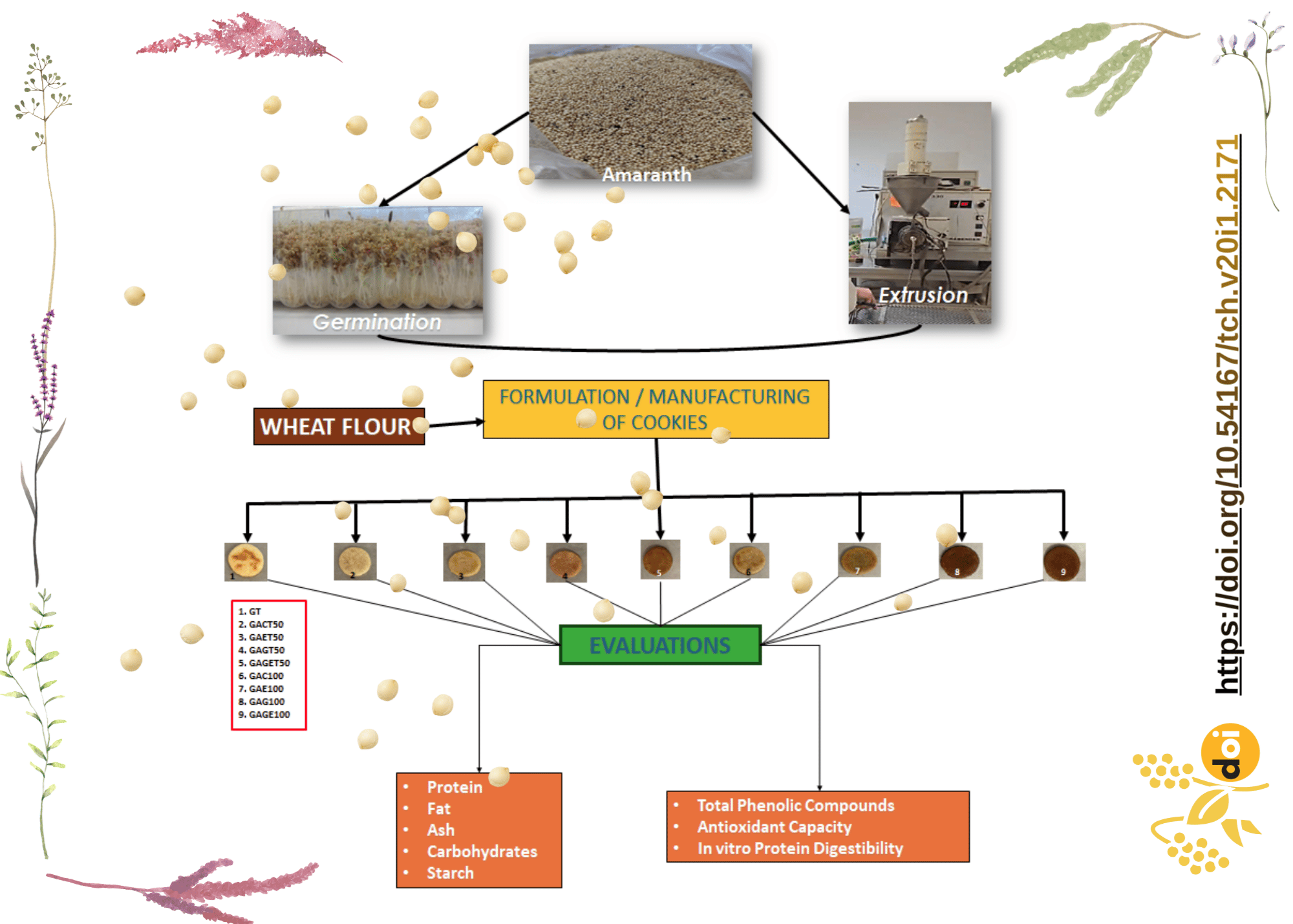
Amaranth has a high potential to be incorporated into the food industry due to its nutritional value, its nutraceutical characteristics and it is a gluten-free grain. Processing methods as extrusion and germination modify its biochemical characteristics. The aim of this work was to characterize the physicochemical, nutritional and nutraceutical properties of cookies of raw, extruded, germinated and germinated-extruded amaranth. The cookies were manufactured only with amaranth (100 %) or supplemented (50 %) with wheat. Proximate composition, color, water activity, total phenolic content (CFT), antioxidant capacity (CAoX) and in vitro protein digestibility were determined. The supplementation with processed amaranth (germinated and extruded at 50 %) produced changes (p < 0.05) in cookies color and water activity was maintained at adequate levels to prevent the growth of microorganism. The cookies with amaranth showed higher values in protein content (1.06 to 1.26 times plus), CFT (1.50 to 10 times plus) and CAoX (1.32 to 9.0 times plus), compared to control wheat cookie. The cookie of germinated amaranth (GAG100) has the highest CFT and CAoX levels. The cookie of extruded amaranth, supplemented with wheat at 50 % (GAET50) showed the best in vitro protein digestion value among cookies. In conclusion, processed amaranth, extruded, germinated or extruded-germinated, is a very interesting ingredient for the development of functional foods or gluten free cookies.
DOI: https://doi.org/10.54167/tch.v20i1.2171
Downloads
References
Alegbejo, J. (2014). Nutritional Value and Utilization of Amaranthus (Amaranthus spp.) – A Review. Bayero Journal of Pure and Applied Sciences, 6(1), 136-143. https://doi.org/10.4314/bajopas.v6i1.27
Almirudis-Echeverria, S. J., Ramírez-Wong, B., Medina-Rodríguez, C. L., Magaña-Barajas, E., Torres-Chávez, P. I., & Ledesma-Osuna, A. I. (2020). Actividad antioxidante de harinas de amaranto obtenidas por extrusión y análisis parcial de su calidad proteica in vivo. Biotecnia, 22(1), 24-31. https://doi.org/10.18633/biotecnia.v22i1.1121
Al-Tarifi, B. Y., Mahmood, A., Assaw, S., & Sheikh, H. I. (2020). Application of astaxanthin and its lipid stability in bakery product. Current Research in Nutrition and Food Science Journal, 8(3), 962-974. https://dx.doi.org/10.12944/CRNFSJ.8.3.24
Alvídrez-Morales, A., González-Martínez, B. E., & Jiménez-Salas Z. (2002). Tendencias en la producción de alimentos: alimentos funcionales. Revista salud pública y Nutrición, 3(3). https://respyn.uanl.mx/index.php/respyn/article/view/91
AOAC. Association of Official Analytical Chemists. (1999). Official methods of analysis. 16th Edition, 5th Revision, Association of Official Analytical Chemists, Washington, DC.
Aragón-Gutiérrez, C., Ramírez-Valverde, B., Montero-Simó, M. J., Araque-Padilla, R. Á., & Pérez-Barea, J. J. (2018). Valoración por el consumidor de las características hedónicas, nutritivas y saludables del amaranto. Entreciencias: diálogos en la sociedad del conocimiento, 6(16), 1-14. https://doi.org/10.22201/enesl.20078064e.2018.16.62956
Bressani, R. (1994). Composition and nutritional properties of amaranth. In: Paredes-Lopez, O. (Ed.) Amaranth—Biology, Chemistry, and Technology (pp. 185–206). London: CRC Press.
Carter, B. P., Galloway, M. T., Campbell, G. S., & Carter, A. H. (2015). The critical water activity from dynamic dewpoint isotherms as an indicator of crispness in low moisture cookies. Journal of Food Measurement and Characterization, 9(3), 463–470. https://doi.org/10.1007/s11694-015-9254-3
Cavieres, E., Piñeira, M. B., & Negrete, C. (2016). Impacto de la incorporación de harina de amaranto en las propiedades físicas y sensoriales en galletas. Contribuciones científicas y tecnologícas, 41, 41-47. https://revistaschilenas.uchile.cl/handle/2250/133274
Chaparro-Rojas, D. C., Pismag-Portilla, R. Y., Elizalde-Correa, A., Vivas-Quila, N. J., & Erazo-Caicedo C. A. (2010). Efecto de la germinación sobre el contenido y digestibilidad de proteína en semillas de amaranto, quinua, soya y guandul. Biotecnología en el sector agropecuario y agroindustrial, 9(1), 51-59. https://www.redalyc.org/articulo.oa?id=380878962008
Chauhan, A., Saxena, D. C., & Singh S. (2015). Total dietary fibre and antioxidant activity of gluten free cookies made from raw and germinated amaranth (Amaranthus spp.) flour. LWT - Food Science and Technology, 63(2), 939–945. https://doi.org/10.1016/j.lwt.2015.03.115
Chauhan, A., Saxena, D. C., & Singh, S. (2016). Physical, textural, and sensory characteristics of wheat and amaranth flour blend cookies. Cogent Food & Agriculture, 2(1). https://doi.org/10.1080/23311932.2015.1125773
Cirkovic Velickovic, T. D., & Stanic-Vucinic, D. J. (2018). The Role of Dietary Phenolic Compounds in Protein Digestion and Processing Technologies to Improve Their Antinutritive Properties. Comprehensive Reviews in Food Science and Food Safety, 17(1), 82-103. https://doi.org/https://doi.org/10.1111/1541-4337.12320
Cornejo, F., Novillo, G., Villacrés, E., & Rosell, C. M. (2019). Evaluation of the physicochemical and nutritional changes in two amaranth species (Amaranthus quitensis and Amaranthus caudatus) after germination. Food Research International, 121, 933-939. https://doi.org/10.1016/j.foodres.2019.01.022
De la Barca, A. M. C., Rojas-Martínez, M. E., Islas-Rubio, A. R., & Cabrera-Chávez, F. (2010). Gluten-Free Breads and Cookies of Raw and Popped Amaranth Flours with Attractive Technological and Nutritional Qualities. Plant Foods for Human Nutrition, 65(3), 241–246. https://doi.org/10.1007/s11130-010-0187-z
Desalegn, B. B. (2015). Effect of soaking and germination on proximate composition, mineral bioavailability and functional properties of chickpea flour. Food and Public Health, 5 (4), 108-113. http://article.sapub.org/10.5923.j.fph.20150504.02.html
Díaz, S. O. & Hernández, G. M. S. (2012). Elaboración de galletas como alternativa para la soberanía alimentaria en la región amazónica colombiana. Vitae, 19(1), s273-s275. chrome-extension://efaidnbmnnnibpcajpcglclefindmkaj/https://www.redalyc.org/pdf/1698/Resumenes/Resumen_169823914083_1.pdf
Dupuis, J. H., Liu, Q., & Yada, R. Y. (2014). Methodologies for Increasing the Resistant Starch Content of Food Starches: A Review. Comprehensive Reviews in Food Science and Food Safety, 13(6), 1219–1234. https://doi.org/10.1111/1541-4337.12104
Emire, S. A., & Arega, M. (2012). Value added product development and quality characterization of amaranth (Amaranthus caudatus L.) grown in East Africa. African Journal of Food Science and Technology, 3(6), 129-141. https://www.interesjournals.org/archive/ajfst-volume-3-issue-6-year-2012.html
Fontana, A. J. (2000). Understanding the importance of water activity in food. Cereal Foods World. 45(1), 7–10. https://scispace.com/papers/understanding-the-importance-of-water-activity-in-food-1pksznw46y
Gámez-Valdez, L., Gutiérrez-Dorado, R., Gómez-Aldapa, C. A., Perales-Sánchez, J. X. K., Milán-Carrillo, J., Cuevas-Rodríguez, E. O., Mora-Rochín, S., & Reyes-Moreno, C. (2021). Effect of the extruded amaranth flour addition on the nutritional, nutraceutical and sensory quality of tortillas produced from extruded creole blue maize flour. Biotecnia, 23(2), 103-112. https://doi.org/10.18633/biotecnia.v23i2.1385
Guardianelli, L. M., Salinas, M. V., & Puppo M. C. (2019). Chemical and thermal properties of flours from germinated amaranth seeds. Journal of Food Measurement and Characterization, 13, 1078–1088. https://doi.org/10.1007/s11694-018-00023-1
Hall, P. A. (2016). Executive-Control Processes in High-Calorie Food Consumption. Current Directions in Psychological Science, 25(2), 9198. https://doi.org/10.1177/0963721415625049
Hsu, H. W., Vavak, D. L., Satterlee, L. D., & Miller, G. A. (1977). A multienzyme technique for estimating protein digestibility. Journal of Food Science, 42(5), 1269–1273. https://doi.org/10.1111/j.1365-2621.1977.tb14476.x
Inglett, G. E., Chen, D., & Liu S. X. (2015). Physical properties of gluten-free sugar cookies made from amaranth–oat composites. LWT - Food Science and Technology, 63(1), 214–220. https://doi.org/10.1016/j.lwt.2015.03.056
Jan, R., Saxena, D. C., & Singh S. (2017). Effect of storage conditions and packaging materials on the quality attributes of gluten-free extrudates and cookies made from germinated chenopodium (Chenopodium album) flour. Journal of Food Measurement and Characterization, 11(3), 1071–1080. https://doi.org/10.1007/s11694-017-9484-7
Liu, S. X., & Chen, D. (2023). Novel gluten-free amaranth and oat flour cookies fortified with soybean hulls. Food and Nutrition Sciences, 14(8), 699-719. https://doi.org/10.4236/fns.2023.148046
Luis, G. M., Hernández, B. R. H., Caballero, V. P., López, N. G. T., Espinoza, V., & Pacheco L. R. (2018). Usos actuales y potenciales del Amaranto (Amaranthus spp.). Journal of Negative and No Positive Results: JONNPR, 3(6), 423-436. https://doi.org/10.19230/jonnpr.2410
Madrigales-Reátiga, L. F., Castro-Montoya, Y. A., Reyes-Moreno, C., Gutiérrez-Dorado, R., Salas-López, F., & Peráles-Sánchez, J. X. K. (2024). Chia seed germination and extrusion to increase nutritional value, phenolic compounds, gaba, antioxidant activity, and in vitro antihypertensive potential. Agrociencia, 58(4): 1-15. https://doi.org/10.47163/agrociencia.v58i4.3043
Makowska, A., Cais-Sokolińska, D., & Lasik, A. (2014). Effect of Technological Factors on Water Activity of Extruded Corn Product with an Addition of Whey Proteins. Acta Sci. Pol., Technol. Aliment. 13(3), 243-247. https://doi.org/10.17306/J.AFS.2014.3.2
McGuire, R. G. (1992). Reporting of Objective Color Measurements. HortScience, 27(12): p. 1254-1255. https://doi.org/10.21273/HORTSCI.27.12.1254
Man, S., Păucean, A., Muste, S., ChiÈ, M.S., Pop A., & Călian, I. D. (2017). Assessment of amaranth flour utilization in cookies production and quality. Journal of Agroalimentary Processes and Technologies, 23(2), 97-103. https://journal-of-agroalimentary.ro/journal-of-agroalimentary-processes-and-technologies-2017-23-2/assessment-of-amaranth-flour-utilization-in-cookies-production-and-quality
Martínez, N. S., Ruíz, O. C., Castillejos, G. R., Perales-Torres, A., & Pérez, A. L. G. (2017). Análisis proximal, de textura y aceptación de las galletas de trigo, sorgo y frijol. Archivos Latinoamericanos de Nutrición, 67(3), 227-234. https://www.alanrevista.org/ediciones/2017/3/art-8
Menegassi, B., Pilosof, A. M. R., & Arêas, J. A. G. (2011). Comparison of properties of native and extruded amaranth (Amaranthus cruentus L. – BRS Alegria) flour. LWT - Food Science and Technology, 44(9), 1915–1921. https://doi.org/10.1016/j.lwt.2011.04.008
Miguel, M.G. (2018). Betalains in Some Species of the Amaranthaceae Family: A Review. Antioxidants, 7(4), 53. https://doi.org/10.3390/antiox7040053
Milán-Noris, A. K., Gutiérrez-Uribe, J. A., Santacruz, A., Serna-Saldívar S. O., & Martínez-Villaluenga, C. (2018). Peptides and isoflavones in gastrointestinal digests contribute to the anti-inflammatory potential of cooked or germinated desi and kabuli chickpea (Cicer arietinum L.). Food Chemistry, 268, 66–76. https://doi.org/10.1016/j.foodchem.2018.06.068
Mlakar, G. S., Turinek, M., Jakop, M., Bavec, M., & Bavec, F. (2009). Nutrition value and use of grain amaranth potential future application in bread making. Agricultural and Food Sciences, 6, 43-53. https://www.semanticscholar.org/paper/Nutrition-value-and-use-of-grain-amaranth%3A-future-Mlakar-Turinek/b28f73042370dd0de5a1cf4919a8a5fd55e79504
Montoya-Rodríguez, A. (2011). Nuevos Productos Alimenticios a Partir de Amaranto (Amaranthus hypochondriacus) Integral. Efecto del Proceso Extrusión / Cocción Sobre la Capacidad Antioxidante y Niveles de Fitoquímicos (Tesis de Maestría, Facultad de Ciencias Químico-Biológicas. Universidad Autónoma de Sinaloa. Culiacán, Sinaloa, México).
Montoya-Rodríguez, A., Milán-Carrillo, J., Dia, V. P., Reyes-Moreno, C., & González de Mejía, E. (2014). Pepsin-pancreatin protein hydrolysates from extruded amaranth inhibit markers of atherosclerosis in LPS-induced THP-1 macrophages-like human cells by reducing expression of proteins in LOX1 signaling pathway. Proteome Science, 12(1), 30. https://doi.org/10.1186/1477-5956-12-30
Montoya-Rodríguez, A., Gómez-Favela, M. A., Reyes-Moreno, C., Milán-Carrillo, J. & González de Mejía, E. (2015). Identification of Bioactive Peptide Sequences from Amaranth (Amaranthus hypochondriacus) Seed Proteins and Their Potential Role in the Prevention of Chronic Diseases. Comprehensive Reviews in Food Science and Food Safety, 14(2): 139-158. https://doi.org/10.1111/1541-4337.12125
Mubarak, A. E. (2005). Nutritional composition and antinutritional factors of mung bean seeds (Phaseolus aureus) as affected by some home traditional processes. Food Chemistry, 89(4), 489–495. https://doi.org/10.1016/j.foodchem.2004.01.007
Mudgil, D., Barak, S., & Khatkar, B. S. (2017). Cookie texture, spread ratio and sensory acceptability of cookies as a function of soluble dietary fiber, baking time and different water levels. LWT-Food Science and Technology, 80, 537–542. https://doi.org/10.1016/j.lwt.2017.03.009
Narsih, N., Yunianta, Y., & Harijono, H. (2012). The study of germination and soaking time to improve nutritional quality of sorghum seed. International Food Research Journal, 19 (4), 1429-1432. https://scispace.com/papers/the-study-of-germination-and-soaking-time-to-improve-3gm2k78b4c
Nayak, B., Berrios, J. D. J., Powers, J. R., & Tang, J. (2011). Effect of Extrusion on the Antioxidant Capacity and Color Attributes of Expanded Extrudates Prepared from Purple Potato and Yellow Pea Flour Mixes. Journal of Food Science, 76(6), C874-C883. https://doi.org/10.1111/j.1750-3841.2011.02279.x
Olawoye, B. T., & Gbadamosi, S. O. (2017). Effect of different treatments on in vitro protein digestibility, antinutrients, antioxidant properties and mineral composition of Amaranthus viridis seed. Cogent Food & Agriculture, 3(1): 1296402. https://doi.org/10.1080/23311932.2017.1296402
Patrignani, M., & Lupano, C. E. (2016). Incorporación de saborizantes naturales a galletitas: efecto sobre el poder antioxidante del producto final. En: Análisis físico-químicos y sensoriales de los alimentos: trabajos completos. Pp. 345-354. VI Congreso Internacional de Ciencia y Tecnología de los Alimentos 2016. http://sedici.unlp.edu.ar/handle/10915/90752
Perales-Sánchez, J. X. K., Reyes-Moreno, C., Gómez-Favela, M. A., Milán-Carrillo, J., Cuevas-Rodríguez, E. O., Valdez-Ortiz, A., & Gutiérrez-Dorado, R. (2014). Increasing the Antioxidant Activity, Total Phenolic and Flavonoid Contents by Optimizing the Germination Conditions of Amaranth Seeds. Plant Foods for Human Nutrition, 69(3), 196–202. https://doi.org/10.1007/s11130-014-0430-0
Poutanen, K. S., Kårlund, A. O., Gómez-Gallego, C., Johansson, D. P., Scheers, N. M., Marklinder, I. M., Eriksen, A. K., Silventoinen, P. C., Nordlund, E., Sozer, N., Hanhineva, K. J., Kolehmainen, M., & Landberg, R. (2022). Grains - a major source of sustainable protein for health. Nutrition Reviews. 80(6), 1648-1663. https://doi.org/10.1093/nutrit/nuab084
Quintero-Soto, M. F., Chávez-Ontiveros, J., Garzón-Tiznado, J. A., Salazar-Salas, N. Y., Pineda-Hidalgo, K. V., Delgado-Vargas, F., & López-Valenzuela, J. A. (2021). Characterization of peptides with antioxidant activity and antidiabetic potential obtained from chickpea (Cicer arietinum L.) protein hydrolyzates. Journal of Food Science, 86(7), 2962-2977. https://doi.org/10.1111/1750-3841.15778
Ramos-Pacheco, B. S., Choque-Quispe, D., Ligarda-Samanez, C. A., Solano-Reynoso, A. M., Palomino-Rincón, H., Choque-Quispe, Y., Peralta-Guevara, D. E., Moscoso-Moscoso, E., & Aiquipa-Pillaca, Á. S. (2024). Effect of Germination on the Physicochemical Properties, Functional Groups, Content of Bioactive Compounds, and Antioxidant Capacity of Different Varieties of Quinoa (Chenopodium quinoa Willd.) Grown in the High Andean Zone of Peru. Foods, 13(3), 417. https://doi.org/10.3390/foods13030417
Rastogi, A., & Shukla, S. (2013). Amaranth: A New Millennium Crop of Nutraceutical Values. Critical Reviews in Food Science and Nutrition, 53(2), 109–125. https://doi.org/10.1080/10408398.2010.517876
Re, R., Pellegrini, N., Proteggente, A., Pannala, A., Yang, M., & Rice-Evans, C. (1999). Antioxidant activity applying an improved ABTS radical cation decolorization assay. Free radical biology and medicine, 26(9-10), 1231-1237. https://doi.org/10.1016/S0891-5849(98)00315-3
Sánchez-Osuna, M. F., Gutiérrez-Dorado, R., Cuevas-Rodríguez, E. O., Milán-Carrillo, J., Perales-Sánchez, J., & Reyes-Moreno, C. (2018). Propiedades Fisicoquímicas y Nutracéuticas de Granos Integrales (Amaranto/Chía) Procesados en Condiciones Óptimas de Germinación. Investigación y Desarrollo en Ciencia y Tecnología de Alimentos, 3, 639-644.
Sandoval-Sicairos, E. S., Domínguez-Rodríguez M., Montoya-Rodríguez A., Milán-Noris A. K., Reyes-Moreno C., & Milán-Carrillo J. (2020). Phytochemical Compounds and Antioxidant Activity Modified by Germination and Hydrolysis in Mexican Amaranth. Plant Foods for Human Nutrition, 75: 192-199. https://doi.org/10.1007/s11130-020-00798-z
Segura-Nieto, M., Barba de la Rosa, A. P., & Paredes-López, O. (1994). Biochemistry of Amaranth Proteins. In: Paredes-López, O. (Ed.), Amaranth: Biology, Chemistry and Technology, (pp. 75-106). Boca Raton: CRC Press.
Shelar, G. A., & Gaikwad, S. T. (2019). Extrusion in food processing: An overview. The Pharma Innovation Journal, 8(2), 562-568. https://www.thepharmajournal.com/archives/?year=2019&vol=8&issue=2&ArticleId=3076
Sindhuja, A., Sudha, M. L., & Rahim, A. (2005). Effect of incorporation of amaranth flour on the quality of cookies. European Food Research and Technology, 221(5), 597–601. https://doi.org/10.1007/s00217-005-0039-5
Singleton, V. L., Orthofer, R., & Lamuela-Raventós, R. M. (1999). [14] Analysis of total phenols and other oxidation substrates and antioxidants by means of folin-ciocalteu reagent. Methods in Enzymology, 299: 152–178. https://doi.org/10.1016/s0076-6879(99)99017-1
Suarez, P. A., Martínez, J. G., & Hernández, J. R. (2016). El amaranto y sus efectos terapéuticos. Tlatemoani: revista académica de investigación, 7(21), 55-73. https://dialnet.unirioja.es/servlet/articulo?codigo=7298394
Shukla, U., Sehar, M., Tongbram, T., Yaseen, M., & Bora, J. (2020). Physical and sensory characteristics of cookies from rice and amaranth flour blends. European Food Science and Engineering, 1(1), 24-29. https://izlik.org/JA64ZH74KW
Singh, M., & Liu, S. X. (2021). Evaluation of amaranth flour processing for noodle making. Journal of Food Processing and Preservation, 45(4): e15270. https://doi.org/10.1111/jfpp.15270
Thakur, P., Kumar, K., Ahmed, N., Chauhan, D., Rizvi, Q. U. E. H., Jan, S., Singh, P. T., & Dhaliwal, H. S. (2021). Effect of soaking and germination treatments on nutritional, anti-nutritional, and bioactive properties of amaranth (Amaranthus hypochondriacus L.), quinoa (Chenopodium quinoa L.), and buckwheat (Fagopyrum esculentum L.). Current Research in Food Science, 4, 917-925. https://doi.org/10.1016/j.crfs.2021.11.019
Tovar-Hernández, C. E., Perafán-Gil, E. A., Enríquez-Collazos, M. G., Pismag-Portilla, Y., & Ceron-Fernandez, L. (2017). Evaluación del efecto del proceso de extrusión en harina de quinua (Chenopodium quinoa Willd) normal y germinada. Biotecnología en el Sector Agropecuario y Agroindustrial, 15(2), 30-38. https://revistas.unicauca.edu.co/index.php/biotecnologia/article/view/560
Uwaegbute, A. C., Iroegbu, C. U., & Eke, O. (2000). Chemical and sensory evaluation of germinated cowpeas (Vigna unguiculata) and their products. Food Chemistry, 68(2), 141–146. https://doi.org/10.1016/S0308-8146(99)00134-X
Xu, B., & Chang, S. K. C. (2008). Total Phenolics, Phenolic Acids, Isoflavones, and Anthocyanins and Antioxidant Properties of Yellow and Black Soybeans As Affected by Thermal Processing. Journal of Agricultural and Food Chemistry, 56(16), 7165–7175. https://doi.org/10.1021/jf8012234
Ye, J., Hu, X., Luo, S., Liu, W., Chen, J., Zeng, Z., & Liu, C. (2018). Properties of starch after extrusion: A review. Starch‐Stärke, 70(11-12), 1700110. https://doi.org/10.1002/star.201700110
Downloads
Published
Issue
Section
License
Copyright (c) 2026 TECNOCIENCIA Chihuahua

This work is licensed under a Creative Commons Attribution-NonCommercial 4.0 International License.