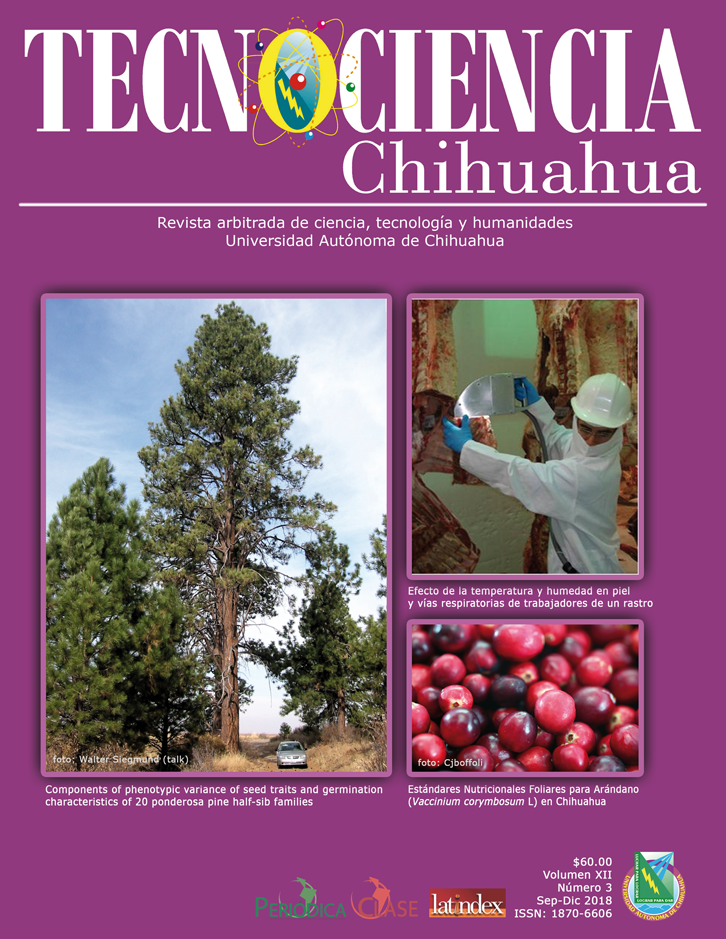
Efecto de la temperatura y humedad en piel y vías respiratorias de trabajadores de un rastro
Effect of temperature and moisture on the skin and respiratory tract of a slaughterhouse worker
DOI:
https://doi.org/10.54167/tch.v12i3.188Keywords:
allergy, dermatitis, eczema, slaughterhouse, low temperaturesAbstract
Health risks related to exposure to low temperature and humidity are frequent in the workers of slaughterhouses, where prevail cold environments and humidity conditions, which represent an additional effort for their work. The objective was to determine the relationship between temperature and humidity in the work environment, with affections in different areas of the skin and respiratory conditions in workers of a cattle slaughter. Temperature and humidity measurements were made in the different departments of the slaughterhouse, and these values were related to the result of the assessment of skin lesions and airway conditions in 44 workers from the following departments: Slaughter, Beef boning, Processes, Shipments, Sales and Maintenance. The instrument used was the NOSQ-2002: Nordic Occupational Skin Questionnaire, adapted for our country. The workers of the beef boning department, where they work at low temperatures, had a greater incidence of allergies and eczema (62 %) in relation to the rest of the areas, where the conditions are more favorable. Exposure to low temperatures is a factor for the appearance of skin eczema, as well as a tendency to develop damage to the respiratory system as allergies in the workers.
Downloads
References
Barnham, M. & J. Kerby. 1981 Skin sepsis in meat handlers: observations on the causes of injury whit special reference to bone. Journal of Hygiene 87(3): 465-476. https://doi.org/10.1017%2Fs0022172400069710
British Meat Processors Association. 2011. Health and Safety Guidance Notes for the Meat Industry. Rev. 1. BMPA. https://bit.ly/3TbJBIf
Chang Muñoz, F. R. 2015. Identificación de las variables que inciden en la salud ocupacional en una empresa productora de alimentos ecuatoriana, propuesta de un sistema de gestión de salud ocupacional (Tesis, Universidad de Guayaquil). http://repositorio.ug.edu.ec/handle/redug/21073
Flyvholm, M. A., K. Mygind, L. Sell, A. Jensen & K. F. Jepsen. 2005 A randomized controlled intervention study on prevention of work related skin problems among gut cleaners in swine slaughterhouses. Occupational & Environmental Medicine 62(9): 642-649. http://dx.doi.org/10.1136/oem.2004.016576
González Rico, M., A. Casique Guerrero & F. J. López Chánez. 2015. Estudio de los riesgos de trabajo en el rastro municipal de Tarimoro, Gto. Revista RAITES 1(2):10–24. https://pistaseducativas.celaya.tecnm.mx/index.php/raites/article/view/141
Heller, E. & N. H. Shear. 1988. Temperature-dependent skin disorders. Journal of the American Academy of Dermatology 18(5):1003–1019. https://doi.org/10.1016/S0190-9622(88)70098-5
Hernández Calleja, A. 2009. Agentes biológicos. Enfermedades de la piel. Notas Técnicas de Prevención 822. Instituto Nacional de Seguridad e Higiene en el Trabajo. https://bit.ly/3EO6zRm
Humphreys, C. P., S. J. Morgan, M. Walapu, G. A. Harrison, A. P. Keen, A. Efstratiou, S.E. Neal & R.L. Salmon. 2007. Group A streptococcal skin infection outbreak in an abattoir: lessons for prevention. Epidemiology and Infection 135(2) :321-327. https://doi.org/10.1017/s0950268806006819
Iturregui, E. L. & Y. M. Gómez. 2017. Desatención a la exposición de agentes biológicos como factor de riesgo de sus colaboradores en sectores como el educativo y algunas industrias. Universidad Libre Seccional Pereira. https://hdl.handle.net/10901/16099
Lillington, T. & E. M. Shanahan. 1997. Cutaneous infection in meatworkers. Occupational Medicine 47(4):197-202. https://doi.org/10.1093/occmed/47.4.197
Mäkinen, T. M. & J. Hassi. 2009. Health problems in cold work. Industrial Health 47(3): 207–220. https://doi.org/10.2486/indhealth.47.207
Márquez-Gómez, M. & M. Márquez-Robledo. 2015. Factores de riesgo biomecánicos y psicosociales presentes en la industria venezolana de la carne. Ciencia & Trabajo 17(54): 171–176. https://doi.org/10.4067/S0718-24492015000300003
Mygind, K., V. Borg, M. A. Flyvholm, L. Sell, & K. F. Jepsen. 2006. A study of the implementation process of an intervention to prevent work-related skin problems in wet-work occupations. International Archives of Occupational and Environmental Health 79(1):66-74. https://doi.org/10.1007/s00420-005-0016-0
Organización Mundial de la Salud. 1978. Atención primaria de salud. Declaración Alma-Ata. ISBN 9243541358. https://bit.ly/3eImwhd
Organización Mundial de la Salud. 2001. Occupational health: A manual for primary health care workers. WHO-EM/OCH/85/E/L. Regional Office for the Eastern Mediterranean. OMS. https://bit.ly/3sfgiZf
Organización Mundial de la Salud. 2007. Salud de los trabajadores: proyecto de plan de acción mundial. Informe de la Secretaría. EB120/28 Rev.1. https://apps.who.int/iris/handle/10665/25419
Organización Mundial de la Salud. 2009. Global Health Risks: Mortality and burden of disease attributable to selected major risks. ISBN 9789241563871. https://apps.who.int/iris/handle/10665/44203
Reinikainen, L. M. & J. J. K. Jaakkola. 2003. Significance of humidity and temperature on skin and upper airway symptoms. Indoor Air 13(4):344-352. https://doi.org/10.1111/j.1600-0668.2003.00155.x
Sala-Sastre, N., M. Herdman, L. Navarro, M. de la Prada, R. Pujol, C. Serra, J. Alonso, M.A. Flyvholm & A.M. Giménez-Arnau. 2009. Dermatosis profesionales. Adaptación transcultural del cuestionario Nordic Occupational Skin Questionnaire (NOSQ-2002) del inglés al castellano y al catalán. Actas Dermo-Sifiliográficas 100(8):685–692. https://doi.org/10.1016/S0001-7310(09)72281-1
Secretaría del Trabajo y Previsión Social. 2017. Evolución de Accidentes, Enfermedades, Incapacidades y Defunciones de Trabajo 2005-2016. STPS. https://autogestionsst.stps.gob.mx/Proyecto/Content/pdf/2016/Nacional%202005-2016.pdf
Signorini-Porchietto, M., S. Civit-Gual, M. Bonilla-Padilla, M. E. Cervantes-Ramírez, M. Calderón-Vázquez, A. Pérez Montecillo, M. P. Espejel-Maya & C. Almanza-Rodríguez. 2006. Evaluación de riesgos de los rastros y mataderos municipales. https://tinyurl.com/4ubjt5rd
Suárez-González, G., A. Pérez-Sánchez & R. Guzmán-Plazola. 2017. Incidencia de brucelosis en la población humana de México. Un panorama general durante el periodo de 2008 a 2013. Revista Regiones y desarrollo sustentable 32:85–98. https://bit.ly/3CMSKjB
Susitaival, P., M. A. Flyholm, B. Meding, L. Kanerva, M. Lindberg, A. Svensson & J. H. Ólafsson. 2003. Nordic Occupational Skin Questionnaire (NOSQ-2002): a new tool for surveying occupational skin diseases and exposure. Contact Dermatitis 49(2): 70–76. https://doi.org/10.1111/j.0105-1873.2003.00159.x
Varghese, B. M., A. G. Barnett, A. L. Hansen, P. Bi, S. Hanson-Easey, J. S. Heyworth, M. R. Sim & D. L. Pisaniello. 2019. The effects of ambient temperatures on the risk of work-related injuries and illnesses: Evidence from Adelaide, Australia 2003–2013. Environmental Research 170:101–109. https://doi.org/10.1016/j.envres.2018.12.024