Structure and diversity of tree species in the Submontane Scrubland of northeast Mexico
DOI:
https://doi.org/10.54167/tch.v20i1.2336Keywords:
Fabaceae, Importance Value Index, floristic diversity, ecosystem, forest structure, diversity index, Nahuatlea hypoleuca, disturbanceAbstract
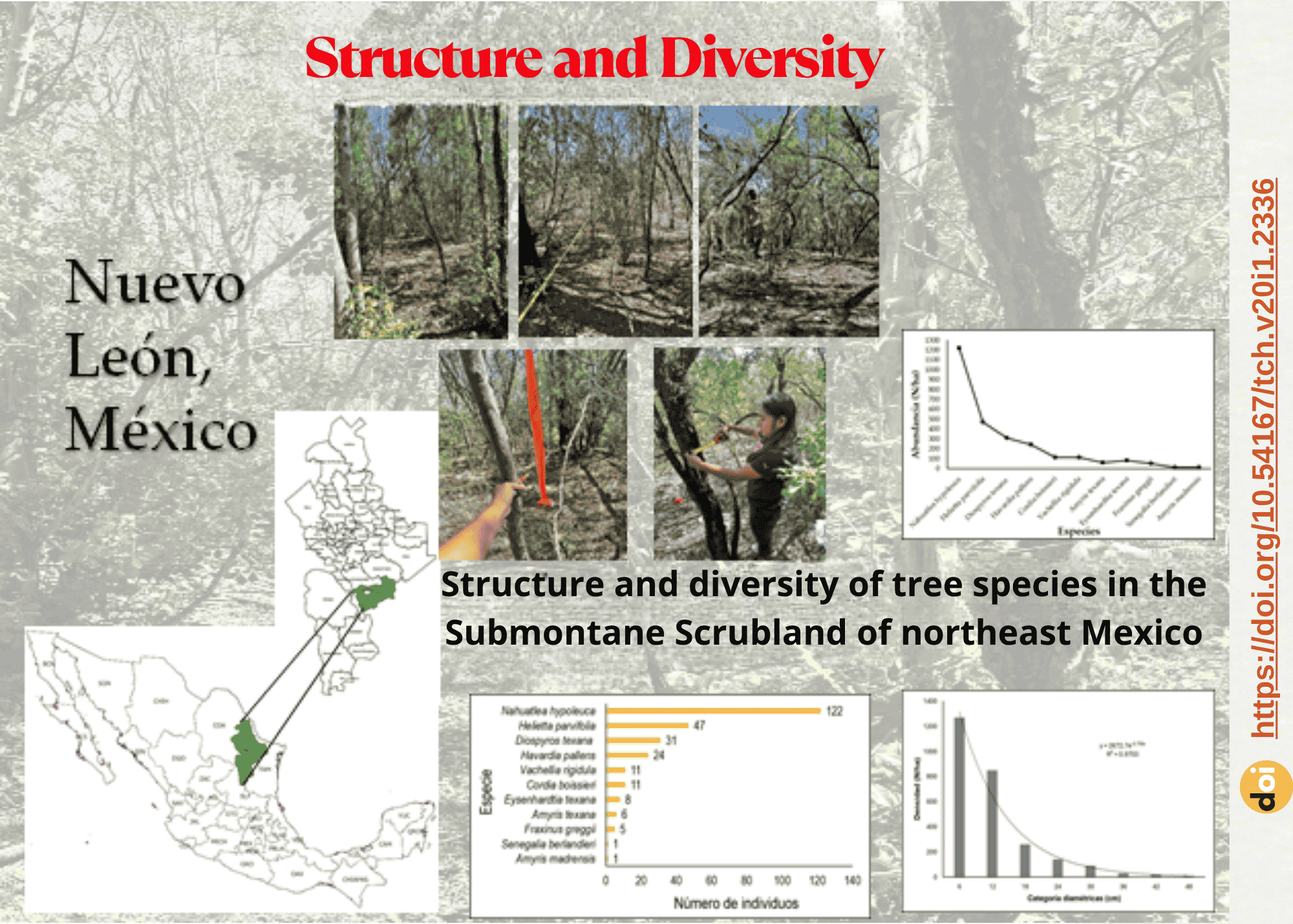
The Submontane Scrubland (SS) is a plant community characterized by a high richness of species adapted to semiarid conditions. For this reason, the present study aims to compare the floristic composition, structure, and diversity of woody species in an area of SS in northeastern Mexico with undisturbed reference communities. Four 250 m² sampling sites were established, covering a total sampled area of 1000 m². The following dasometric variables were quantified: normal diameter (nD), total height (h), and crown diameter (dcrown) in individuals with nD > 5 cm. Abundance, dominance, frequency, and Importance Value Index (IVI) data per species were analyzed, along with diversity indices for the studied plant community. A total of 267 individuals were registered, belonging to six families, 10 genera and 11 species. The Fabaceae and Rutaceae families were the most dominant. The species Nahuatlea hypoleuca acquired the highest IVI (36.74 %) and crown cover (52.77 %) values. The undisturbed sites showed greater richness (up to 55 species) and diversity (H’ 1.7-2.4), with dominance distributed between the Fabaceae and Rutaceae families, recording a crown area of 47,257.30 m²/ha, a basal area of 29.04 m²/ha and a density of 2,670 N/ha. The Margalef (Dmg) and Shannon-Wiener (H´) diversity indices were considered as low, indicating lower diversity than those documented in reference communities, with a geometric abundance distribution dominated by N. hypoleuca. These results reveal patterns in the structure and composition of the local ecosystem that are consistent with conditions associated with livestock-related disturbance.
DOI: https://doi.org/10.54167/tch.v20i1.2336
Downloads
References
Alanís Rodríguez, E., Jiménez Pérez, J., González Tagle, M., Yerena Yamallel, J. I, Cuellar Rodríguez, G., & Mora Olivo, A. (2013). Análisis de la vegetación secundaria del matorral espinoso tamaulipeco, México. Phyton, 82(2):185-191. https://www.scielo.org.ar/scielo.php?script=sci_arttext&pid=S1851-56572013000200005
Alanís-Rodríguez, E., Jiménez-Pérez, J., Mora-Olivo, A., Martínez-Ávalos, J. G., Mata-Balderas, J. M., Chávez-Costa, A., & Rubio-Camacho, E. A. (2015). Estructura y diversidad del matorral submontano contiguo al área metropolitana de Monterrey, Nuevo León, México. Acta Botánica Mexicana, (113):01-19. https://doi.org/10.21829/abm113.2015.1093
Alanís-Rodríguez, E., Mora-Olivo, A., & Marroquín, J. (2020). Muestreo ecológico de la vegetación. Editorial Universitaria de la Universidad Autónoma de Nuevo León. Monterrey, México. 245 p. ISBN: 978-607-27-1307-9. https://libros.uat.edu.mx/index.php/librosuat/catalog/book/221
Alanís-Rodríguez, E., Patiño-Flores, A. M., Collantes-Chávez-Costa, A., Molina-Guerra, V. M., Rubio-Camacho, E., & Mora Olivo, A. (2025). Variabilidad estructural de una comunidad de referencia del Matorral Espinoso Tamaulipeco. Polibotánica, 59. https://polibotanica.mx/index.php/polibotanica/article/view/1175
Canizales-Velázquez, P. A., Alanís-Rodríguez, E., Aranda-Ramos, R., Mata-Balderas, J. M., Jiménez-Pérez, J., Alanís-Flores, G., Uvalle-Sauceda, J. I., & Ruiz-Bautista, M. G. (2009). Caracterización estructural del matorral submontano de la Sierra Madre Oriental, Nuevo León, México. Revista Chapingo Serie Ciencias Forestales y del Ambiente, 15(2):115-120. https://www.scielo.org.mx/scielo.php?script=sci_arttext&pid=S2007-40182009000200005
Corral-Rivas, J. J., Calderón-Aguirre, Ó. A., Jiménez-Pérez, J., & Corral-Rivas, S. (2005). An analysis of the forest utilization effect on the structural diversity in El Cielo cloud forest, Tamaulipas, México. Forest Systems, 14(2):217-228. https://doi.org/10.5424/srf/2005142-00885
Domínguez-Gómez, T. G., González-Rodríguez, H., Ramírez-Lozano, R. G., Estrada-Castillón, A. E., Cantú-Silva, I., Gómez-Meza, M. V., Villarreal-Quintanilla, J. A., Alvarado, M. del S., & Alanís-Flores, G. (2013). Diversidad estructural del matorral espinoso tamaulipeco durante las épocas seca y húmeda. Revista Mexicana de Ciencias Forestales, 4(17):106-123. https://doi.org/10.29298/rmcf.v4i17.425
Estrada-Castillón, E., Villarreal-Quintanilla, J. A., Jurado-Ybarra, E., Cantú-Ayala, C., García-Aranda, M. A., Sánchez-Salas, J., Jiménez-Pérez, J., & Pando-Moreno, M. (2012). Clasificación, estructura y diversidad del matorral submontano adyacente a la planicie costera del Golfo Norte en el Noreste de México. Botanical Sciences, 90(1):37-52. https://doi.org/10.17129/botsci.384
Gadow, K. V., Zhang, C. Y., Wehenkel, C., Pommerening, A., Corral-Rivas, J., Korol, M., Myklush, S., Hui, G. Y., Kiviste, A., & Zhao, X. H. (2012). Forest structure and diversity. In, Pukkala, T., & von Gadow, K. (Eds.). Vol. 23, pp. 29-83). Continuous Cover Forestry, Managing Forest Ecosystems, 23. https://doi.org/10.1007/978-94-007-2202-6
García-Hernández, J., & Jurado, E. (2008). Caracterización del matorral con condiciones prístinas en Linares, Nuevo León, México. Ra Ximhai, 4(1):1–21. https://www.redalyc.org/articulo.oa?id=46140101
Graciano-Ávila, G., Aguirre-Calderón, O. A., Alanís-Rodríguez, E., & Lujan-Soto, José E. (2017). Composición, estructura y diversidad de especies arbóreas en un bosque templado del Noroeste de México. Ecosistemas y Recursos Agropecuarios, 4(12):535-542. https://doi.org/10.19136/era.a4n12.1114
INEGI. (2007). Conjunto de datos vectorial Edafológico. Escala 1: 250 000 Serie II (Continuo Nacional Mexicali). https://www.inegi.org.mx/app/biblioteca/ficha.html?upc=702825236557
International Plant Names Index. (2026). International Plant Names Index. Royal Botanic Gardens, Kew; Harvard University Herbaria & Libraries; Australian National Herbarium. https://www.ipni.org/
Leal-Elizondo, N. A., Alanís-Rodríguez, E., Mata-Balderas, J. M., Treviño-Garza, E. J., & Yerena-Yamallel, J. I. (2018). Estructura y diversidad de especies leñosas del matorral espinoso tamaulipeco regenerado postganadería en el noreste de México. Polibotánica, 45(23): 75-88. https://doi.org/10.18387/polibotanica.45.6
Magurran, A. (2004). Measuring Biological Diversity. Blackwell Science. 256 pp. http://www.bio-nica.info/Biblioteca/Magurran2004MeasuringBiological.pdf
Magurran, A.E. (2021). Measuring biological diversity. Current Biology, 31(19):PR1174-R1177. https://doi.org/10.1016/j.cub.2021.07.049
Margalef, R. (1972). Homage to Evelyn Hutchinson or why is there an upper limit to diversity. Transactions of the Connecticut Academy of Arts and Sciences, (44):211-235. http://hdl.handle.net/10261/166281
Marroquín-Castillo, J. J., Alanís-Rodríguez, E., Jiménez-Pérez, J., Aguirre-Calderón, O. A., Mata-Balderas, J. M. & Chávez-Costa, A. C. (2016). Composición florística y diversidad de un área restaurada Post-minería en el matorral espinoso tamaulipeco. Polibotánica, 42:1-17. https://doi.org/10.18387/polibotanica.42.1
Molina-Guerra, V. M., Pando-Moreno, M., Alanís-Rodríguez, E., Canizales-Velázquez, P. A., Rodríguez, H. G., & Jiménez-Pérez, J. (2013). Composición y diversidad vegetal de dos sistemas de pastoreo en el matorral espinoso tamaulipeco del Noreste de México. Revista Mexicana de Ciencias Pecuarias, 4(3):361-371. https://cienciaspecuarias.inifap.gob.mx/index.php/Pecuarias/article/view/3193
Mora-Donjuán, C. A., Alanís-Rodríguez, E., Jiménez-Pérez, J., González-Tagle, M. A., Yerena-Yamallel, J. I. & Cuellar-Rodríguez, L. G. (2013). Estructura, composición florística y diversidad del matorral espinoso tamaulipeco, México. Ecología Aplicada, 12(1):29-34. http://www.scielo.org.pe/scielo.php?script=sci_arttext&pid=S1726-22162013000100004&lng=es&tlng=es
Moreno, C. E. (2001). Métodos para medir la biodiversidad. M&T–Manuales y Tesis SEA, vol. 1. Zaragoza, 84 pp. https://www.scielo.sa.cr/scielo.php?script=sci_arttext&pid=S0034-77442001000300090
Moreno, P., & Warner, B. G. (2009). Breviario para describir, observar y manejar humedales. Instituto de Ecología. Xalapa, Veracruz. https://sib.cicy.mx/cgi-bin/koha/opac-detail.pl?biblionumber=6385
Rzedowski, J. (2006). Vegetación de México. 1ª Edición digital, Comisión Nacional para el Conocimiento y Uso de la Biodiversidad. México. 504 Pp. https://bioteca.biodiversidad.gob.mx/janium-bin/detalle.pl?Id=20260824135949
Shannon, C. (1948). A mathematical theory of communication. En: The mathematical theory of communication. Shannon C.E. y Weaver W. (Ed). University of Illinois Press Urbana. Pp. 29-125. https://people.math.harvard.edu/~ctm/home/text/others/shannon/entropy/entropy.pdf
Valdez M., C. G., Guzmán L., M. A., Valdés G., A., Forougbakhch P., R., Alvarado V., M. A., & Rocha E., A. (2018). Estructura y diversidad de la vegetación en un matorral espinoso prístino de Tamaulipas, México. Revista de Biología Tropical, 66(4):1674-1682. http://dx.doi.org/10.15517/rbt.v66i4.32135
Villalón-Mendoza, H., Carrillo-Parra A. & Soto-Ramos, J. M. (1991). Comparación de dos longitudes de líneas de muestreo para estimar cobertura en el matorral tamaulipeco mediante el método de puntos modificado. Reporte Científico N° 23 Facultad de Ciencias Forestales, U.A.N.L. Linares, México. 20 pp.
Whittaker, R. (1972). Evolution and measurement of species diversity. Taxon, 21, 213251. https://doi.org/10.2307/1218190
Downloads
Published
Issue
Section
License
Copyright (c) 2026 TECNOCIENCIA Chihuahua

This work is licensed under a Creative Commons Attribution-NonCommercial 4.0 International License.