Design and Evaluation of an Electrical Conductivity Lab-on-a-Chip for the Detection of Automotive Oil in Distilled Water
DOI:
https://doi.org/10.54167/tch.v20i1.2241Keywords:
Lab-on-a-Chip, oil in water, electrical conductivity, Arduino NanoAbstract
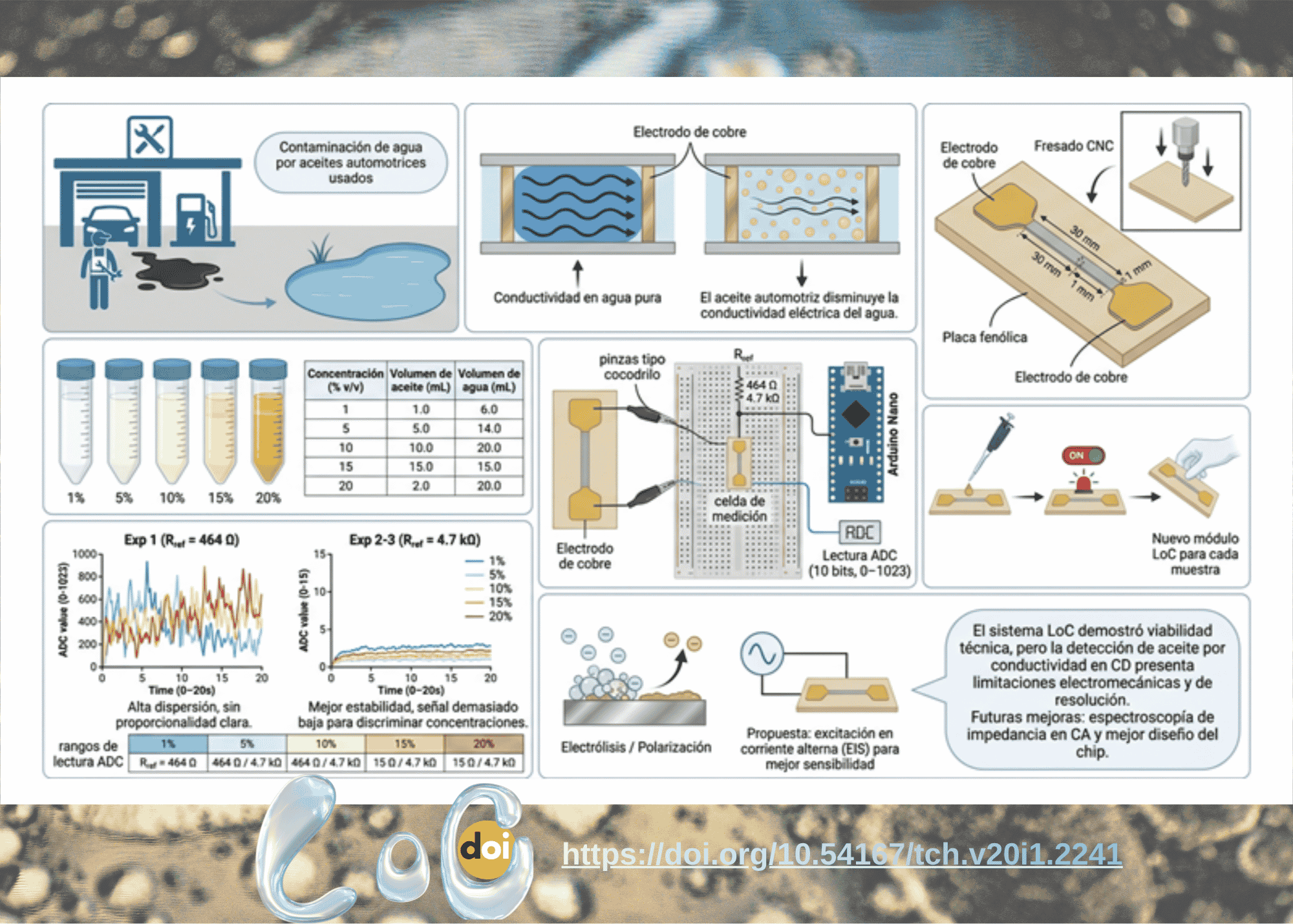
This paper describes the design, manufacture, and experimental evaluation of a system for detecting used automotive oil in distilled water, using disposable lab-on-a-chip (LoC) modules manufactured on phenolic plates by CNC milling and a voltage divider-based measurement circuit with an Arduino Nano microcontroller. SAE 20W-50 motor oil emulsions were prepared in distilled water at concentrations of 1, 5, 10, 15, and 20 % v/v, using vortex agitation and centrifugation. Three experiments were performed by modifying the resistance value of the voltage divider (464 Ω and 4.7 kΩ) in order to evaluate the stability of the signal and the relationship between the oil concentration and the analog-to-digital converter (ADC) reading. The results showed that the presence of oil modifies the conductivity of the medium; however, no direct proportional relationship was observed between the concentration and the signal obtained, which is attributed to the heterogeneous nature of the emulsions, electrolysis effects generated by direct current, and limitations of the ADC resolution in the presence of very low amplitude signals. The work provides experimental evidence on the limitations of the direct current method for this type of application and guides the development of future work based on alternating current excitation and impedance spectroscopy.
DOI: https://doi.org/10.54167/tch.v20i1.2241
Downloads
References
Gawad, S., Schild, L., & Renaud, Ph. (2001). Micromachined impedance spectroscopy flow cytometer for cell analysis and particle sizing. Lab on a Chip, 1(1), 76. https://doi.org/10.1039/b103933b
Ghafar-Zadeh, E., Sawan, M., & Therriault, D. (2007). Novel direct-write CMOS-based laboratory-on-chip: Design, assembly and experimental results. Sensors and Actuators A: Physical, 134(1), 27–36. https://doi.org/10.1016/j.sna.2006.05.022
Ishai, P. B., Talary, M. S., Caduff, A., Levy, E., & Feldman, Y. (2013). Electrode polarization in dielectric measurements: A review. Measurement Science and Technology, 24(10), 102001. https://doi.org/10.1088/0957-0233/24/10/102001
Mark, D., Haeberle, S., Roth, G., Von Stetten, F., & Zengerle, R. (2010). Microfluidic lab-on-a-chip platforms: Requirements, characteristics and applications. Chemical Society Reviews, 39(3), 1153-1182. https://doi.org/10.1039/b820557b
Riboldi, C., Castillo, D. A. C., Crafa, D. M., & Carminati, M. (2023). Contactless Sensing of Water Properties for Smart Monitoring of Pipelines. Sensors, 23(4), 2075. https://doi.org/10.3390/s23042075
Shi, H., Zhang, H., Ma, L., & Zeng, L. (2019). A multi-function sensor for online detection of contaminants in hydraulic oil. Tribology International, 138, 196–203. https://doi.org/10.1016/j.triboint.2019.05.025
Strugała-Wilczek, A., Kapusta, K., & Pankiewicz-Sperka, M. (2022). Pollutants release from the residues remaining after underground gasification (UCG) of ortho- and meta-lignites. Fuel, 327, 125126. https://doi.org/10.1016/j.fuel.2022.125126
Zhang, H., Zeng, L., Teng, H., & Zhang, X. (2017). A Novel On-Chip Impedance Sensor for the Detection of Particle Contamination in Hydraulic Oil. Micromachines, 8(8), 249. https://doi.org/10.3390/mi8080249
Downloads
Published
Issue
Section
License
Copyright (c) 2026 TECNOCIENCIA Chihuahua

This work is licensed under a Creative Commons Attribution-NonCommercial 4.0 International License.