Prevalence of musculoskeletal disorders and their association with ergonomic risk in administrative staff: A cross-sectional study
DOI:
https://doi.org/10.54167/tch.v20i1.2046Keywords:
musculoskeletal disorders, ergonomic risk, administrative workers, occupational health, Nordic Kuorinka Questionnaire, ROSAAbstract
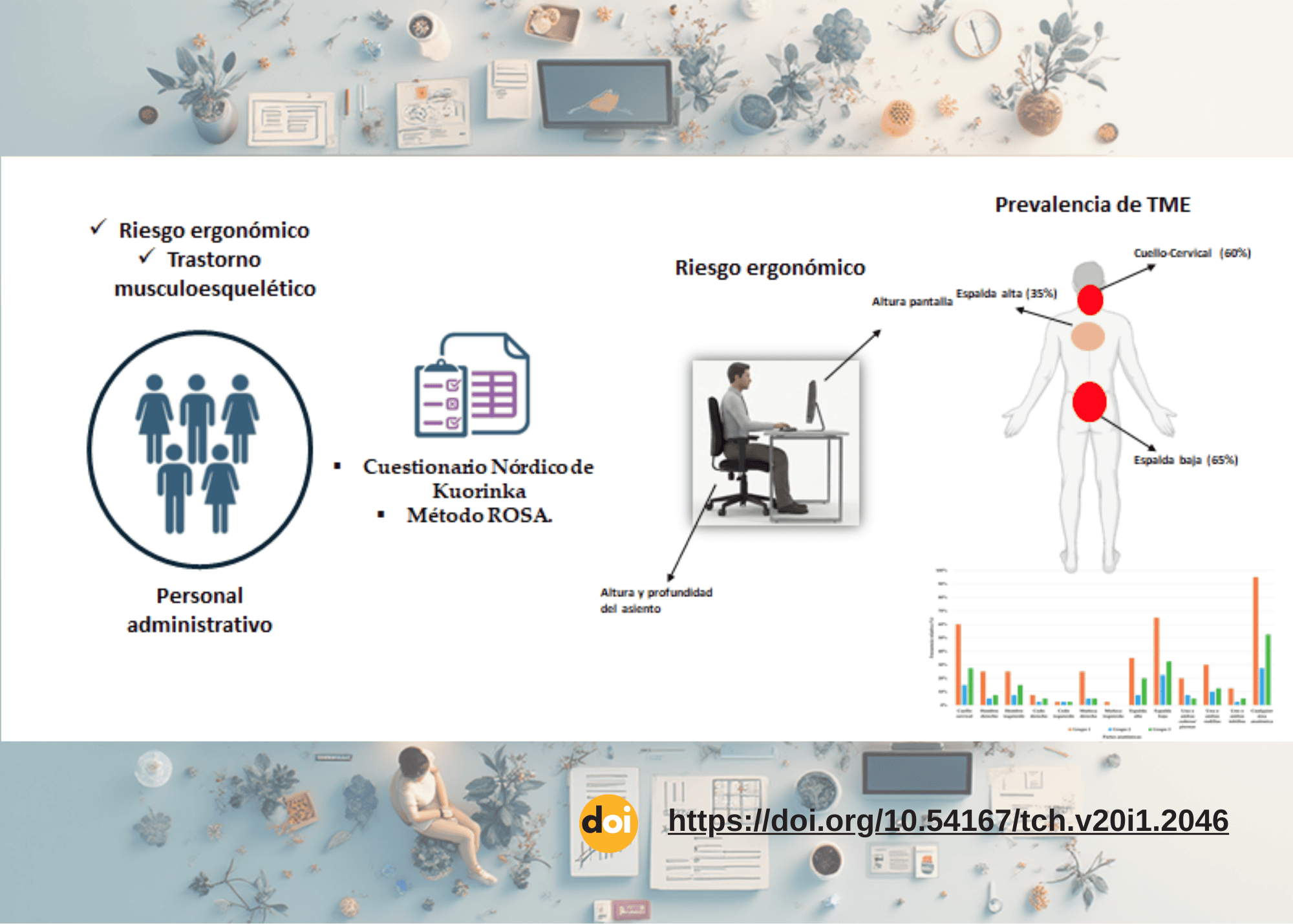
Musculoskeletal disorders (MSDs) represent a growing occupational health problem in administrative workers, associated with inadequate static postures and poor ergonomic conditions. The objective was to evaluate the prevalence of MSDs and their association with ergonomic risk in university administrative workers. An observational, exploratory, and descriptive cross-sectional study was carried out with 40 administrative workers. The evaluation of MSDs was performed using the Nordic Questionnaire and the ROSA method to assess ergonomic risk. The normality of the sociodemographic and anthropometric data was verified using the Shapiro-Wilk test (α=0.05). Chi-square was used to analyze the association between MSDs and anatomical regions, and ordinal logistic regression was used to evaluate the association with independent variables (sex, age, BMI, and ergonomic risk) with significance of α=0.05 and 95 % confidence intervals. The results showed an overall prevalence of MSDs of 95 %, with the lumbar region being the most affected (65 %), followed by the cervical region (60 %) and the upper back (35 %). Ergonomic risk analysis revealed that 62.5 % of workers presented a very high risk, 22.5 % a high risk, and 15 % an extreme risk. There was no statistically significant association between MSDs and ergonomic workstation hazards, except in the right shoulder. These findings provide scientific evidence to identify workers who require priority ergonomic intervention, contributing to the implementation of specific preventive strategies in the work environment of university administrative staff.
Downloads
References
AlOmar, R. S., AlShamlan, N. A., Alawashiz, S., Badawood, Y., Ghwoidi, B. A., & Abugad, H. (2021). Musculoskeletal symptoms and their associated risk factors among Saudi office workers: A cross-sectional study. BMC Musculoskeletal Disorders, 22: 763. https://doi.org/10.1186/s12891-021-04652-4
Asociación Médica Mundial. (2024, octubre). Declaración de Helsinki de la AMM: Principios éticos para las investigaciones médicas con participantes humanos. https://www.wma.net/es/policies-post/declaracion-de-helsinki-de-la-amm-principios-eticos-para-las-investigaciones-medicas-en-seres-humanos/
Bagheri, S., & Ghaljahi, M. (2019). Ergonomic evaluation of musculoskeletal disorders with Rapid Office Strain Assessment and its association with occupational burnout among computer users at Zabol University of Medical Sciences in 2017. Asian Journal of Water, Environment and Pollution, 16(1), 91–96. https://doi.org/10.3233/AJW190010
Besharati, A., Daneshmandi, H., Zareh, K., Fakherpour, A., & Zoaktafi, M. (2020). Work-related musculoskeletal problems and associated factors among office workers. International Journal of Occupational Safety and Ergonomics, 26(3), 632–638. https://doi.org/10.1080/10803548.2018.1501238
Castro García, S. R., Yandún Burbano, E. D., Freire Constante, L. F., & Albán Álvarez, M. G. (2021). Gestión del talento humano: Diagnóstico y sintomatología de trastornos musculoesqueléticos evidenciados a través del Cuestionario Nórdico de Kuorinka. INNOVA Research Journal, 6(1), 251–264. https://doi.org/10.33890/innova.v6.n1.2021.1583
Clark, P., Contreras, D., Ríos-Blancas, M. J., Steinmetz, J. D., Ong, L., Culbreth, G. T., Lenox, H., Mendoza, C. F., & Razo, C. (2023). Análisis de la discapacidad por trastornos musculoesqueléticos en México de 1990 a 2021. Gaceta Médica de México, 159(6), 517-526. https://doi.org/10.24875/GMM.23000394
de Barros, F. C., Moriguchi, C. S., Chaves, T. C., Andrews, D. M., Sonne, M., & de Oliveira Sato, T. (2022). Usefulness of the Rapid Office Strain Assessment (ROSA) tool in detecting differences before and after an ergonomics intervention. BMC Musculoskeletal Disorders, 23, 526. https://doi.org/10.1186/s12891-022-05490-8
Echezuría Marval, L., Fernández-Silano, R., Rísquez, A., Rodríguez-Morales, A., & Caraballo-Arias, Y. (2013). Temas de epidemiología y salud pública. Tomo II. Universidad Central de Venezuela, 1ª. ed., Venezuela: EBUC. Ediciones de la Biblioteca. https://searchworks.stanford.edu/view/10328186
European Agency for Safety and Health at Work. (2019). Work-related musculoskeletal disorders: Prevalence, costs and demographics in the EU – Executive summary. https://osha.europa.eu/en/publications/work-related-musculoskeletal-disorders-prevalence-costs-and-demographics-eu
Gallagher, K. M., Chambers, A. J., Lin, J.-H., Jacobs, K., & Robertson, M. M. (2023). Ergonomics advances in office work and work-from-home. Proceedings of the Human Factors and Ergonomics Society Annual Meeting, 67(1), 346–349. https://doi.org/10.1177/21695067231192577
Gobierno de México. (1984, 7 de febrero). Ley General de Salud. [Secretaría de Salubridad y Asistencia]. Diario Oficial de la Federación. https://www.dof.gob.mx/nota_to_imagen_fs.php?codnota=4652777&fecha=07/02/1984&cod_diario=200301
Gobierno de México. (2018, 23 de noviembre). NOM-036-1-STPS-2018, Factores de riesgo ergonómico en el Trabajo-Identificación, análisis, prevención y control. [Secretaría del Trabajo y Previsión Social]. Diario Oficial de la Federación. https://dof.gob.mx/nota_detalle.php?codigo=5544579&fecha=23/11/2018
Habibi, E., Ebrahimi, H., Barakat, S., & Maghsoudian, L. (2017). Ergonomic assessment of musculoskeletal disorders risk factors in office staff using ROSA method and its relation with efficiency. Journal of Military Medicine, 19(1), 31–39404-412. https://militarymedj.bmsu.ac.ir/article_1000655.html?lang=en
Iram, H., Kashif, M., Sattar, M., Bhatti, Z. M., Dustgir, A., & Mehdi, Z. (2022). Ergonomic risk factors among computer office workers for complaints of arm, neck and shoulder and workstation evaluation. WORK: A Journal of Prevention, Assessment & Rehabilitation, 73(1), 321–326. https://doi.org/10.3233/WOR-211029
Kim, M. G., Kim, Y. W., & Ahn, Y. S. (2020). Does low lead exposure affect blood pressure and hypertension? Journal of Occupational Health, 62(1), e12107. https://doi.org/10.1002/1348-9585.12107
Kuorinka, I., Jonsson, B., Kilbom, A., Vinterberg, H., Biering-Sørensen, F., Andersson, G., & Jørgensen, K. (1987). Standardised Nordic questionnaires for the analysis of musculoskeletal symptoms. Applied ergonomics, 18(3), 233–237. https://doi.org/10.1016/0003-6870(87)90010-x
Liebregts, J., Sonne, M., & Potvin, J. R. (2016). Photograph-based ergonomic evaluations using the Rapid Office Strain Assessment (ROSA). Applied Ergonomics, 52, 317–324. https://doi.org/10.1016/j.apergo.2015.07.028
Mardi, G., Kouhnavard, B., Ahmadipanah, V., & Aghanasab, M. (2015). An investigation of Rapid Office Strain Assessment and Rapid Upper Limb Assessment in visual display terminal users. Journal of Health Research in Community, 1(3), 25-32. http://jhc.mazums.ac.ir/article-1-73-en.html
Matos, M., & Arezes, P. M. (2015). Ergonomic evaluation of office workplaces with Rapid Office Strain Assessment (ROSA). Procedia Manufacturing, 3, 4689–4694. https://doi.org/10.1016/j.promfg.2015.07.562
Mohammadipour, F., Pourranjbar, M., Naderi, S., & Rafie, F. (2018). Work-related musculoskeletal disorders in Iranian office workers: Prevalence and risk factors. Journal of Medicine and Life, 11(4), 328–333. https://doi.org/10.25122/jml-2018-0054
Molina Aragonés, J. M., Medina Lavela, J. A., Miranda Villalba, I., Vizcarro Sanagustín, D., & López Pérez, C. (2023). Estudio transversal. Dolor lumbar y medidas ergonómicas en puestos de trabajo en oficinas. Revista de la Asociación Española de Especialistas en Medicina del Trabajo, 32(4), 323-329. http://scielo.isciii.es/scielo.php?script=sci_arttext&pid=S3020-11602023000400006&lng=es&tlng=es
Montoya Domínguez, D. R., & Cetre Palacios, A. (2022). Estrategias para la gestión del riesgo biomecánico y las condiciones de salud musculoesquelética de los trabajadores del sector administrativo en Latinoamérica. (Trabajo de grado). Institución Universitaria Antonio José Camacho. https://repositorio.uniajc.edu.co/handle/uniajc/889
Nurul Fajria, M. D. S., & Ismiyah, E. (2025). Analysis of work posture using the Rapid Office Strain Assessment (ROSA) and Rapid Upper Limb Assessment (RULA) methods in office administration employees. Jurnal Teknik Industri: Jurnal Hasil Penelitian dan Karya Ilmiah Dalam Bidang Teknik Industri, 10(2), 524. https://doi.org/10.24014/jti.v10i2.33569
Pramono, T., Sayuti, A. M., Gaffar, M. R., & Puspitaningrum, R. A. (2022). Penilaian risiko ergonomi pada entorno de trabajo perkantoran menggunakan metode Rapid Office Strain Assessment (ROSA). Jurnal Pendidikan Administrasi Perkantoran (JPAP), 10(3), 246–255. https://doi.org/10.26740/jpap.v10n3.p246-255
Putsa, B., Jalayondeja, W., Mekhora, K., Bhuanantanondh, P., & Jalayondeja, C. (2022). Factors associated with reduced risk of musculoskeletal disorders among office workers: A cross-sectional study, 2017 to 2020. BMC Public Health, 22, 1503. https://doi.org/10.1186/s12889-022-13940-0
Ridhosari, B., Rahman, A., & Rozan, N. M. R. (2024). Reducing the risk level of working posture of office workers in PT X through redesigning the workstation based on Rapid Office Strain Assessment (ROSA) method. AIP Conference Proceedings, 2891(1), 050007. https://doi.org/10.1063/5.0201068
Rodrigues, M. S.A, Sonne, M., Andrews, D. M., Tomazini, L. F., T. de Oliveira Sato, & Chaves, T. C. (2019). Rapid Office Strain Assessment (ROSA): Cross-cultural validity, reliability and structural validity of the Brazilian-Portuguese version. Applied Ergonomics, 75, 143–154. https://doi.org/10.1016/j.apergo.2018.09.009
Salehi Sahlabadi, A., Karim, A., Khatabakhsh, A., & Soori, H. (2020). Ergonomic evaluation of office staff by Rapid Office Strain Assessment method and its relationship with the prevalence of musculoskeletal disorders. Journal of Health, 11(2), 223–234. https://doi.org/10.29252/j.health.11.2.223
Sánchez Medina, A. F. (2018). Prevalencia de desórdenes musculoesqueléticos en trabajadores de una empresa de comercio de productos farmacéuticos. Revista Ciencias de la Salud, 16(2), 203–218. https://doi.org/10.12804/revistas.urosario.edu.co/revsalud/a.6766
Santos, W., Rojas, C., Isidoro, R., Lorente, A., Dias, A., Mariscal, G., Benlloch, M., & Lorente, R. (2025). Efficacy of ergonomic interventions on work-related musculoskeletal pain: A systematic review and meta-analysis. Journal of Clinical Medicine, 14(9), 3034. https://doi.org/10.3390/jcm14093034
Sonne, M., Villalta, D. L., & Andrews, D. M. (2012). Development and evaluation of an office ergonomic risk checklist: ROSA – Rapid Office Strain Assessment. Applied Ergonomics, 43(1), 98–108. https://doi.org/10.1016/j.apergo.2011.03.008
Stefane, C. A., Gonçalves, R. C., Albertini, B. B., & dos Santos, E. C. B. (2024). Saúde no ambiente de trabalho: Postura, ergonomia e distúrbios osteomusculares. Aracê, 6(3), 5281–5296. https://doi.org/10.56238/arev6n3-060
Vernaza-Pinzón, P., & Sierra-Torres, C. H. (2005). Dolor músculo-esquelético y su asociación con factores de riesgo ergonómicos en trabajadores administrativos. Revista de Salud Pública, 7(3), 317–326.
Wicaksono, R. A., Zulfa, K. I., & Wiratmoko, A. (2024). Analisis postur kerja con metode Nordic Body Map (NBM) dan Rapid Office Strain Assessment (ROSA) untuk mengurangi risiko cedera pada departemen FAC dan MIS di PT XYZ. Koloni, 3(3), 123–135. https://doi.org/10.31004/koloni.v3i3.669
Downloads
Published
Issue
Section
License
Copyright (c) 2026 TECNOCIENCIA Chihuahua

This work is licensed under a Creative Commons Attribution-NonCommercial 4.0 International License.