Lean Practices in Mexico: An Analysis of Adoption in Multinational Plants
DOI:
https://doi.org/10.54167/tch.v19iEspecial.1975Keywords:
Lean Manufacturing, Manufacturing Performance, Multinational Companies, Toyota Production System, Sector AnalysisAbstract
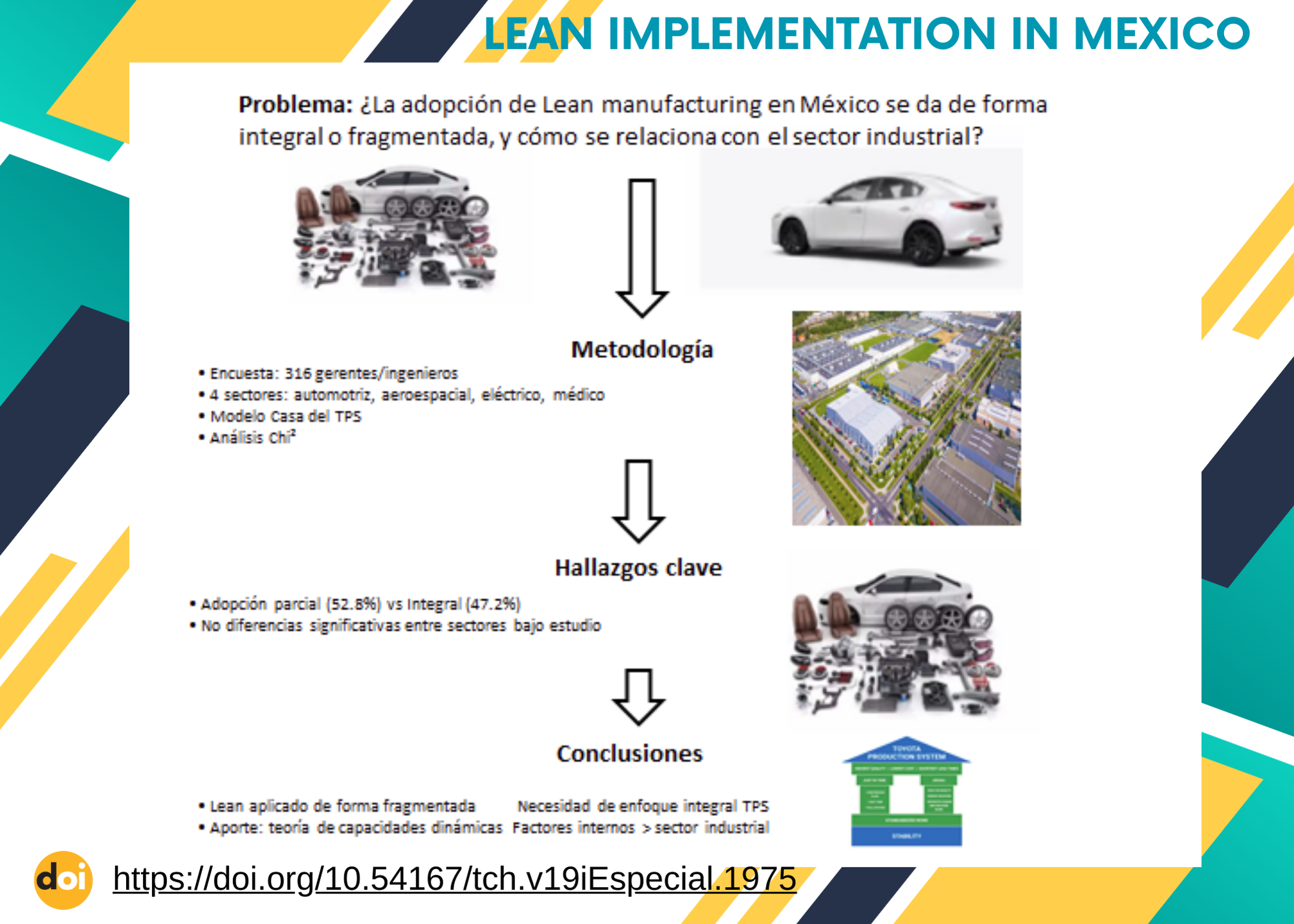
The concept of Lean manufacturing is a methodology for optimizing companies' production processes. The objective was to analyze the adoption of lean techniques in multinational manufacturing plants (MMPs) in Mexico. A non-probability sampling was used to select participating companies, and a survey was administered to 316 managers and engineering-level personnel in the automotive, aerospace, electrical/electronic, and medical sectors. A questionnaire was designed with 13 items, and the study variable was the adoption of lean techniques based on the level of implementation and type of adoption (partial or full). Statistical analysis used a five-level Likert scale. The results reveal that the lean techniques most commonly implemented by companies are related to operational stability, such as 5S, standardized work, and total productive maintenance (TPM). It was also observed that the core pillars of the Toyota Production System, such as just-in-time and Jidoka, have low levels of adoption. Furthermore, although percentage differences were observed between sectors regarding the types of adoption (partial vs. comprehensive), these were not statistically significant. It is concluded that the adoption of Lean techniques does not strictly depend on the industrial sector, but rather on internal organizational factors, contributing to an understanding of the fragmented implementation of Lean in Latin American contexts.
DOI: https://doi.org/10.54167/tch.v19iEspecial.1975
Downloads
References
Abdallah, A. B., Dahiyat, S. E., & Matsui, Y. (2019). Lean management and innovation performance: Evidence from international manufacturing companies. Management Research Review, 42(2), 239-262. https://doi.org/10.1108/mrr-10-2017-0363
Ar, A. Y. (2025). Leaning towards resilience: mapping and exploring the literature on lean management. Production & Manufacturing Research, 13(1), 2512753. https://doi.org/10.1080/21693277.2025.2512753
Baker, B. (2016). Why a Lean Transformation is Like Competing in the Olympics. Industry Week. Insights, news and information for manufacturing leaders. https://n9.cl/26zxd
Baruch, Y., & Holtom, B. C. (2008). Survey response rate levels and trends in organizational research. Human Relations, 61(8), 1139–1160. https://doi.org/10.1177/0018726708094863
Belhadi, A., Touriki, F. E., & Fezazi, S. E. (2017). Prioritizing the solutions of lean implementation in SMEs to overcome its barriers: An integrated fuzzy AHP-TOPSIS approach. Journal Of Manufacturing Technology Management, 28(8), 1115-1139. https://doi.org/10.1108/jmtm-04-2017-0066
Belekoukias, I., Garza-Reyes, J. A., & Kumar, V. (2014). The impact of lean methods and tools on the operational performance of manufacturing organisations. International Journal of Production Research, 52(18), 5346–5366. https://doi.org/10.1080/00207543.2014.903348
Bicheno, J., & Holweg, M. (2009). The Lean Toolbox: The Essential Guide to Lean Transformation. Production and Inventory Control. 290 pp. Systems and Industrial Engineering (PICSIE). https://es.scribd.com/document/228944438/2733
Chávez-Pineda, J. (2021a). Grado de implementación de las prácticas del sistema técnico de administración esbelta en la industria maquiladora de manufactura de México. RECAI Revista de Estudios en Contaduría, Administración e Informática, 10(28), 41- 68. https://doi.org/10.36677/recai.v10i28.15295
Chávez Pineda, J. (2021b). Adopción parcial e integral de las prácticas del sistema técnico de Lean en la industria maquiladora de manufactura en México. RECAI Revista De Estudios En Contaduría, Administración e Informática, 11(30), 28-50. https://doi.org/10.36677/recai.v11i30.16919
Chávez-Pineda J. (2022). Adopción parcial e integral de la filosofía lean en la industria de manufactura eléctrica y electrónica en México. TECNOCIENCIA Chihuahua, 16(3): e1048. https://doi.org/10.54167/tch.v16i3.1048
Chávez Pineda, J. A., García Ramírez, S., Vallejo Navarrete, G. V., & Ceja Silva, E. G. (2023). Grado de madurez en programas de mejora Lean en compañías multinacionales de manufactura automotriz en México. TECNOCIENCIA Chihuahua, 17(3), e1286. https://doi.org/10.54167/tch.v17i3.1286
Costa, F., Alemsan, N., Bilancia, A., Tortorella, G. L., & Portioli Staudacher, A. (2024). Integrating Industry 4.0 and Lean Manufacturing for a sustainable green transition: A comprehensive model. Journal of Cleaner Production, 451, 142728. https://doi.org/10.1016/j.jclepro.2024.142728
Fortuny-Santos, J., Ruiz-de-Arbulo-López, P., Zubeltzu-Jaka, E., & Lujan-Blanco, I. (2025). Lean manufacturing and environmental performance: A meta-analytic approach. International Journal of Lean Six Sigma. 16 (4), 848–889. https://doi.org/10.1108/IJLSS-11-2023-0190
Gutierrez, L., Lameijer, B. A., Anand, G., Antony, J., & Vijaya Sunder, M. (2022). Beyond efficiency: The role of lean practices and cultures in developing dynamic capabilities microfoundations. International Journal of Operations & Production Management, 42(13), 506–536. https://doi.org/10.1108/IJOPM-02-2022-0086
Csíki, O., Demeter, K., & Losonci, D. (2023). How to improve firm performance? – The role of production capabilities and routines. International Journal of Operations & Production Management, 43(13), 1–26. https://doi.org/10.1108/IJOPM-03-2022-0221
Hardcopf, R., Liu, G. J., & Shah, R. (2021). Lean production and operational performance: The influence of organizational culture. International Journal of Production Economics, 235, 108060. https://doi.org/10.1016/j.ijpe.2021.108060
Hernández-Matías, J. C., & Vizán Idoipe, A. (2013). Lean manufacturing: conceptos, técnicas e implantación. 178 pp. Escuela de Organización Industrial. https://www.eoi.es/sites/default/files/savia/documents/EOI_LeanManufacturing_2013.pdf
Hernandez-Matias, J., Ocampo, J. R., Hidalgo, A., & Vizan, A. (2020). Lean manufacturing and operational performance: Interrelationships between human-related lean practices. Journal of Manufacturing Technology Management, 31(2), 217–235. https://doi.org/10.1108/JMTM-04-2019-0140
Jamari, S., & Fedouaki, F. (2025). Industry 4.0 enablers and lean manufacturing tools in respect of human resources. Engineering Proceedings, 97(1), 43. https://doi.org/10.3390/engproc2025097043
Japan Management Association. (2018). Kanban just-in time at Toyota: Management begins at the workplace. 212 pp. Routledge.
Jasti, N. V. K., & Kodali, R. (2014). A literature review of empirical research methodology in lean manufacturing. International Journal of Operations & Production Management, 34(8), 1080-1122. https://doi.org/10.1108/ijopm-04-2012-0169
Kong, R. W. M., Kong, T. H. T., & Huang, T. (2024). Lean methodology for garment modernization. International Journal of Engineering Development and Research, 12(3), 1–13. https://arxiv.org/abs/2410.07705
Komkowski, T., Sony, M., Antony, J., Lizarelli, F. L., Garza-Reyes, J. A., & Tortorella, G. L. (2024). Operational practices for integrating lean and industry 4.0 – A dynamic capabilities perspective. International Journal of Production Research, 63(4), 1517-1537. https://doi.org/10.1080/00207543.2024.2381127
Komkowski, T., Antony, J., Garza-Reyes, J. A., Tortorella, G. L., & Pongboonchai-Empl, T. (2023). Integrating Lean Management with Industry 4.0: An explorative Dynamic Capabilities theory perspective. Production Planning & Control, 36(5), 607–625. https://doi.org/10.1080/09537287.2023.2294297
Kuo, S.-Y., & Chen, L.-B. (2021). Applying sociotechnical systems theory to examine the values of lean practices in the context of container shipping. IEEE Access, 9, 146921-146937. https://doi.org/10.1109/access.2021.3123448
Lander, E., & Liker, J. K. (2007). The Toyota Production System and art: making highly customized and creative products the Toyota way. International Journal of Production Research, 45(16), 3681-3698. https://doi.org/10.1080/00207540701223519
Liker, J.K (2004). The Toyota Way. 14 Management Principles from the World's Greatest Manufacturer. 352 pp. Mc Graw-Hill, New York. https://www.accessengineeringlibrary.com/content/book/9780071392310?implicit-login=true
Lean Certification Alliance. (s. f.). SME. https://www.sme.org/training/lean-certification/about-the-lean-certification-alliance/
Liker, J. K., & Morgan, J. M. (2006). The Toyota Way in Services: The Case of Lean Product Development. Academy of Management Perspectives, 20(2), 5-20. https://doi.org/10.5465/amp.2006.20591002
Liu, C., Wang, M., Niu, Z., & Mo, X. (2024). Moderating effect of dynamic capabilities on the relationship between lean practices and operational performance. International Journal of Lean Six Sigma, 15(7), 1343-1364. https://doi.org/10.1108/IJLSS-02-2022-0034
Maware, C., & Adetunji, O. (2019). Lean manufacturing implementation in Zimbabwean industries: Impact on operational performance. International Journal of Engineering Business Management, 11, 1–12. https://doi.org/10.1177/1847979019859790
Monge, C., Cruz, J., & López, F. (2013). Impacto de la Manufactura Esbelta, Manufactura Sustentable y Mejora Continua en la Eficiencia Operacional y Responsabilidad Ambiental en México. Información Tecnológica, 24(4), 15-32. https://doi.org/10.4067/s0718-07642013000400003
Negrão, L. L. L., Godinho Filho, M., & Marodin, G (2016). Lean practices and their effect on performance: a literature review. Production Planning & Control, 28(1), 33-56. https://doi.org/10.1080/09537287.2016.1231853
Netland, T. H., & Ferdows, K. (2016). The S‐curve effect of lean implementation. Production and Operations Management, 25(6), 1106-1120. https://doi.org/10.1111/poms.12539
Ohno, T. (1988). The Toyota production system: Beyond large scale production. Productivity press. Productivity press. Portland OR. https://www.almendron.com/tribuna/wp-content/uploads/2021/12/toyota-production-system-beyond-large-scale-production.pdf
Olufemi, T. (2024). Lean manufacturing practices and organizational performance: A literature review. International Journal of Innovative Science and Research Technology, 9(9), 611–619. https://doi.org/10.38124/ijisrt/IJISRT24SEP443
Podsakoff, P. M., MacKenzie, S. B., Lee, J. Y., & Podsakoff, N. P. (2003). Common method biases in behavioral research: A critical review of the literature and recommended remedies. Journal of Applied Psychology, 88(5), 879–903. https://doi.org/10.1037/0021-9010.88.5.879
Prabhushankar, G., Kruthika, K., Pramanik, S., & Kadadevaramath, R. S. (2015). Lean manufacturing system implementation in Indian automotive components manufacturing sector - an empirical study. International Journal of Business and Systems Research, 9(2), 179. https://doi.org/10.1504/ijbsr.2015.069442
Rahardjo, B., Wang, F.-K., Yeh, R.-H., & Chen, Y.-P. (2023). Lean manufacturing in Industry 4.0: A smart and sustainable manufacturing system. Machines, 11(1), 72. https://doi.org/10.3390/machines11010072
Rossini, M., Costa, F., Portioli-Staudacher, A., & Tortorella, G. (2019). The interrelation between Industry 4.0 and lean production: An empirical study on European manufacturers. The International Journal of Advanced Manufacturing Technology, 102, 3963-3976. https://doi.org/10.1007/s00170-019-03441-7
Setianto, P., & Haddud, A. (2016). A maturity assessment of lean development practices in manufacturing industry. International Journal of Advanced Operations Management, 8(4), 294. https://doi.org/10.1504/ijaom.2016.084150
Shah, R., & Ward, P. T. (2003). Lean manufacturing: context, practice bundles, and performance. Journal of Operations Management, 21(2), 129-149. https://doi.org/10.1016/s0272-6963(02)00108-0
Singh, T., Smith, A., Oladele, S., & Coadic, K. (2025). Cross-industry comparison of Lean Six Sigma applications: Insights for engineering project management. https://www.researchgate.net/publication/387832626_Cross-Industry_Comparison_of_Lean_Six_Sigma_Applications_Insights_for_Engineering_Project_Management
Sony, M. (2018). Industry 4.0 and lean management: A proposed integration model and research propositions. Production & Manufacturing Research, 6(1), 416–432. https://doi.org/10.1080/21693277.2018.1540949
Suroso, E., & Santosa, A. D. (2024). Effects of lean manufacturing practices on operational performance. Journal of Research in Social Science and Humanities, 4(1), 174–179. https://doi.org/10.47679/jrssh.v4i1.121
Suprayitno, D. (2024). The role of lean manufacturing in enhancing operational efficiency and waste reduction. Management Studies and Business Journal (Productivity), 1(11), 1470–1482. https://ppipbr.com/index.php/productivity/article/view/422
Syamil, A., Ichsan, M., Syahrazly, M., Fadjar, M. P., & Revidia, I. R. (2023). Enhancing quality across industries: A systematic literature review on the impact of six sigma. Global Business & Finance Review, 28(7), 59–74. https://doi.org/10.17549/gbfr.2023.28.7.59
Taj, S., & Morosan, C. (2011). The impact of lean operations on the Chinese manufacturing performance. Journal of Manufacturing Technology Management, 22(2), 223-240. https://doi.org/10.1108/17410381111102234
Teece, D. J., Pisano, G., & Shuen, A. (1997). Dynamic capabilities and strategic management. Strategic Management Journal, 18(7), 509–533. https://doi.org/10.1002/(SICI)1097-0266(199708)18:7<509::AID-SMJ882>3.0.CO;2-Z
Downloads
Published
Issue
Section
License
Copyright (c) 2025 TECNOCIENCIA Chihuahua

This work is licensed under a Creative Commons Attribution-NonCommercial 4.0 International License.