Effect of incorporation of candelilla wax oleogel on the structural properties of cake-type bread
DOI:
https://doi.org/10.54167/tch.v19iEspecial.1919Keywords:
oleogel, hydrogenated fat, cake-like bread, functional properties, technological qualityAbstract
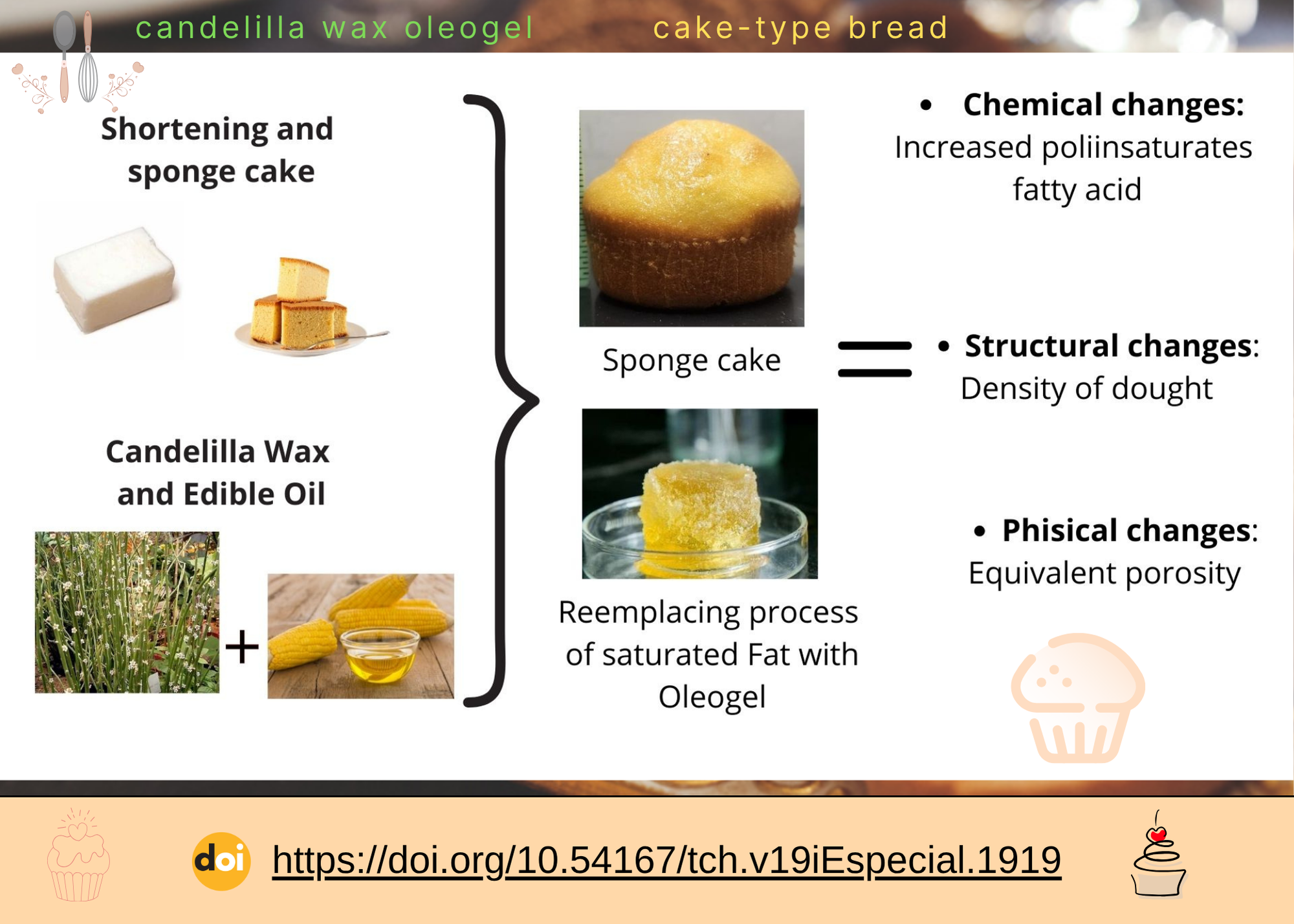
The negative health effects associated with foods containing saturated and trans fats have prompted the search for healthier alternatives that preserve both sensory and technological quality. This study evaluated the use of candelilla wax-structured oleogels as substitutes for hydrogenated fats in cake-type bread, with emphasis on batter structure and crumb texture. The iodine value of the edible oils and the one with the most favorable unsaturation profile was selected to formulate the oleogel used and the oil and water adsorption capacity of three selected flours were determined. Among them, flour H2 exhibited consistent oil adsorption across the three types of oil tested, with no significant differences compared to the water control, suggesting a more stable interaction with lipid components. Therefore, it was used for cake-type bread. Formulations were assessed for batter density, baking yield, total porosity, mean pore size, and instrumental texture parameters (hardness, cohesiveness, elasticity, adhesiveness, stickiness, and chewiness). Oleogel-based batters showed higher density (0.90 g/cm³) and lower baking yield (13 %), indicating a more compact structure. No significant differences were observed in total porosity (≈ 0.3–0.8 %) or mean pore size (8.4–17.5 mm) compared to those made with shortening. However, the presence of smaller (≈ 8.4 mm) and more uniform pores in oleogel formulations reinforced the internal crumb structure and reduced susceptibility to deformation, thereby preserving mechanical integrity. Regarding texture, oleogel formulations exhibited a more cohesive and elastic crumb, supporting their use as a functional alternative in baked goods.
Downloads
References
Alvarez-Ramirez, J., Vernon-Carter, E. J., Carrera-Tarela, Y., Garcia, A., & Roldan-Cruz, C. (2020). Effects of candelilla wax/canola oil oleogel on the rheology, texture, thermal properties and in vitro starch digestibility of wheat sponge cake bread. LWT, 130, 109701. https://doi.org/10.1016/j.lwt.2020.109701
Anjali, P. N., Bosco, S. J. D., Navaf, M., & Sunooj, K. V. (2023). Physical Properties of Cereal Grains. In G. A. Nayik, T. Tufail, F. M. Anjum, & M. J. Ansari (Eds.), Cereal Grains (1 st editi, pp. 25–47). CRC Press. https://doi.org/10.1201/9781003252023-3
Awuchi, C. G., Igwe, V. S., & Echeta, C. K. (2019). The functional properties of foods and flours. International Journal of Advanced Academic Research | Sciences, 5(11), 2488–9849.
Buehler, E. (2021). Bread Science: The Chemistry and Craft of Making Bread (T. B. Books (ed.)). https://books.google.com.mx/books?id=RZuczgEACAAJ
Chandra, S., & Samsher. (2013). Assessment of functional properties of different flours. African Journal of Agricultural Research, 8(38), 4849–4852. https://doi.org/10.5897/AJAR2013.6905
Demirkesen, I., & Mert, B. (2020). Recent developments of oleogel utilizations in bakery products. Critical Reviews in Food Science and Nutrition, 60(14), 2460–2479. https://doi.org/10.1080/10408398.2019.1649243
Farooq, Z., & Boye, J. (2011). Novel Food and Industrial Applications of Pulse Flours and Fractions. In B. M. Brijesh K. Tiwari, Aoif Gowen (Ed.), Pulse Foods Processing, Quality and Nutraceutical Applications (Issue September, pp. 283–323). Oxford: Academic Press. https://doi.org/10.1016/B978-0-1238-2018-1.00007-0
García-Ortega, M. L., Toro-Vazquez, J. F., & Ghosh, S. (2021). Development and characterization of structured water-in-oil emulsions with ethyl cellulose oleogels. Food Research International, 150, 110763. https://doi.org/10.1016/j.foodres.2021.110763
Giacomozzi, A. S., Carrín, M. E., & Palla, C. A. (2018). Muffins Elaborated with Optimized Monoglycerides Oleogels: From Solid Fat Replacer Obtention to Product Quality Evaluation. Journal of Food Science, 83(6), 1505–1515. https://doi.org/10.1111/1750-3841.14174
Iwe, M. O., Onyeukwu, U., & Agiriga, A. N. (2016). Proximate, functional and pasting properties of FARO 44 rice, African yam bean and brown cowpea seeds composite flour. Cogent Food & Agriculture, 2(1). https://doi.org/10.1080/23311932.2016.1142409
Jung, D., Oh, I., Lee, J., & Lee, S. (2020). Utilization of butter and oleogel blends in sweet pan bread for saturated fat reduction: Dough rheology and baking performance. LWT, 125, 109194. https://doi.org/10.1016/j.lwt.2020.109194
Kim, J. Y., Lim, J., Lee, J., Hwang, H., & Lee, S. (2017). Utilization of Oleogels as a Replacement for Solid Fat in Aerated Baked Goods: Physicochemical, Rheological, and Tomographic Characterization. Journal of Food Science, 82(2), 445–452. https://doi.org/10.1111/1750-3841.13583
Kim, S.-H., Jo, Y.-J., Lee, S. H., & Park, S.-H. (2024). Development of Oleogel-Based Fat Replacer and Its Application in Pan Bread Making. Foods, 13(11), 1678. https://doi.org/10.3390/foods13111678
Lin, M. J. Y., Humbert, E. S., & Sosulki, F. W. (1974). CERTAIN FUNCTIONAL PROPERTIES OF SUNFLOWER MEAL PRODUCTS. Journal of Food Science, 39(2), 368–370. https://doi.org/10.1111/j.1365-2621.1974.tb02896.x
Meng, Z., Keyu, Q., Guo, Y., Wang, Y., & Liu, Y. (2018). Effects of thickening agents on the formation and properties of edible oleogels based on hydroxypropyl methyl cellulose. Food Chemistry, 246, 137–149. https://doi.org/10.1016/j.foodchem.2017.10.154
Mert, B., & Demirkesen, I. (2016). Reducing saturated fat with oleogel/shortening blends in a baked product. Food Chemistry, 199, 809–816. https://doi.org/10.1016/j.foodchem.2015.12.087
Oh, I. K., & Lee, S. (2018). Utilization of foam structured hydroxypropyl methylcellulose for oleogels and their application as a solid fat replacer in muffins. Food Hydrocolloids, 77, 796–802. https://doi.org/10.1016/j.foodhyd.2017.11.022
Okaka, J. C., & Potter, N. N. (1977). Functional and Storage Properties of Cowpea Powder‐Wheat Flour Blends in Breadmaking. Journal of Food Science, 42(3), 828–833. https://doi.org/10.1111/j.1365-2621.1977.tb12614.x
Patel, A. R., Nicholson, R. A., & Marangoni, A. G. (2020). Applications of fat mimetics for the replacement of saturated and hydrogenated fat in food products. Current Opinion in Food Science, 33, 61–68. https://doi.org/10.1016/j.cofs.2019.12.008
Patel, A. R., Rajarethinem, P. S., Grędowska, A., Turhan, O., Lesaffer, A., De Vos, W. H., Van de Walle, D., & Dewettinck, K. (2014). Edible applications of shellac oleogels: spreads, chocolate paste and cakes. Food Funct., 5(4), 645–652. https://doi.org/10.1039/C4FO00034J
Pavlovich-Abril, A., Salazar-Garcia, M. G., Moroyoqui, F. J. C., Ramirez, R. O., & Meza, N. G. (2009). Efectos de una mezcla de estearina de palma y aceite de canola sobre los parámetros reológicos de la masa de trigo y características del pan. Interciencia, 34(8), 577–582. https://www.redalyc.org/pdf/339/33913144009.pdf
Petrusha, O., Daschynska, O., & Shulika, A. (2017). Development of the measurement method of porosity of bakery products by analysis of digital image. Technology Audit and Production Reserves, 2(3(40)), 61–66. https://doi.org/10.15587/2312-8372.2018.129520
Pușcaș, A., Mureșan, V., Socaciu, C., & Muste, S. (2020). Oleogels in food: A review of current and potential applications. Foods, 9(1), 1–27. https://doi.org/10.3390/foods9010070
Quiles Chuliá, M. D., Larrea Santos, V., Hernando Hernando, M. I., & Morell Esteve, P. (2022). Oleogeles, una alternativa saludable a las grasas sólidas tradicionales. Universidad Politécnica de Valencia. https://riunet.upv.es/handle/10251/181711
Raghavendra, S., Alvita, P., Hampana, N., & Mahalakshmi, D. (2022). Effect of fats and oils on different properties of flours used in bakery products: A review. Journal of Nutrition & Food Sciences, 12, 1000p353. https://doi.org/10.35248/2155-9600.22.12.1000838
Rathnayake, H. A., Navaratne, S. B., & Navaratne, C. M. (2018). Porous Crumb Structure of Leavened Baked Products. International Journal of Food Science, 2018, 1–15. https://doi.org/10.1155/2018/8187318
Sanders, T. H. (2003). GROUND NUT OIL. In Encyclopedia of Food Sciences and Nutrition (pp. 2967–2974). Elsevier. https://doi.org/10.1016/B0-12-227055-X/01353-5
Seena, S., & Sridhar, K. R. (2005). Physicochemical, functional and cooking properties of under explored legumes, Canavalia of the southwest coast of India. Food Research International, 38(7), 803–814. https://doi.org/10.1016/j.foodres.2005.02.007
Sunil, Chauhan, N., Samsher, Chandra, S., Singh, J., & Singh, S. (2019). Assessment of functional properties of composite flours. Progressive Agriculture, 19(1), 161. https://doi.org/10.5958/0976-4615.2019.00001.2
Tabara, A., Nakagawa, M., Ushijima, Y., Matsunaga, K., & Seguchi, M. (2015). Effects of heat treatment on oil-binding ability of rice flour. Bioscience, Biotechnology, and Biochemistry, 79(10), 1629–1634. https://doi.org/10.1080/09168451.2015.1039479
Thirumdas, R. (2023). Partial hydrogenation of oils using cold plasma technology and its effect on lipid oxidation. Journal of Food Science and Technology, 60(6), 1674–1680. https://doi.org/10.1007/s13197-022-05434-z
Tiefenbacher, K. F. (2017). Technology of Main Ingredients—Sweeteners and Lipids. In Wafer and Waffle (pp. 123–225). Elsevier. https://doi.org/10.1016/B978-0-12-809438-9.00003-X
Vázquez-Chávez, L., & Hernández -López, C. (2023). Características Físicas y Sensoriales de Pastel elaborado con Margarina, Aceite y su mezcla. Investigación y Desarrollo En Ciencia y Tecnología de Alimentos, 8(1), 62–67. https://doi.org/10.29105/idcyta.v8i1.13
Yılmaz, E., & Öğütcü, M. (2015). The texture, sensory properties and stability of cookies prepared with wax oleogels. Food & Function, 6(4), 1194–1204. https://doi.org/10.1039/C5FO00019J
Zou, X., Wang, X., Li, L., Peng, P., Ma, Q., Hu, X., & Appels, R. (2022). Effects of Composition and Strength of Wheat Gluten on Starch Structure, Digestion Properties and the Underlying Mechanism. Foods, 11(21), 3432. https://doi.org/10.3390/foods11213432
Published
License
Copyright (c) 2025 TECNOCIENCIA Chihuahua

This work is licensed under a Creative Commons Attribution-NonCommercial 4.0 International License.