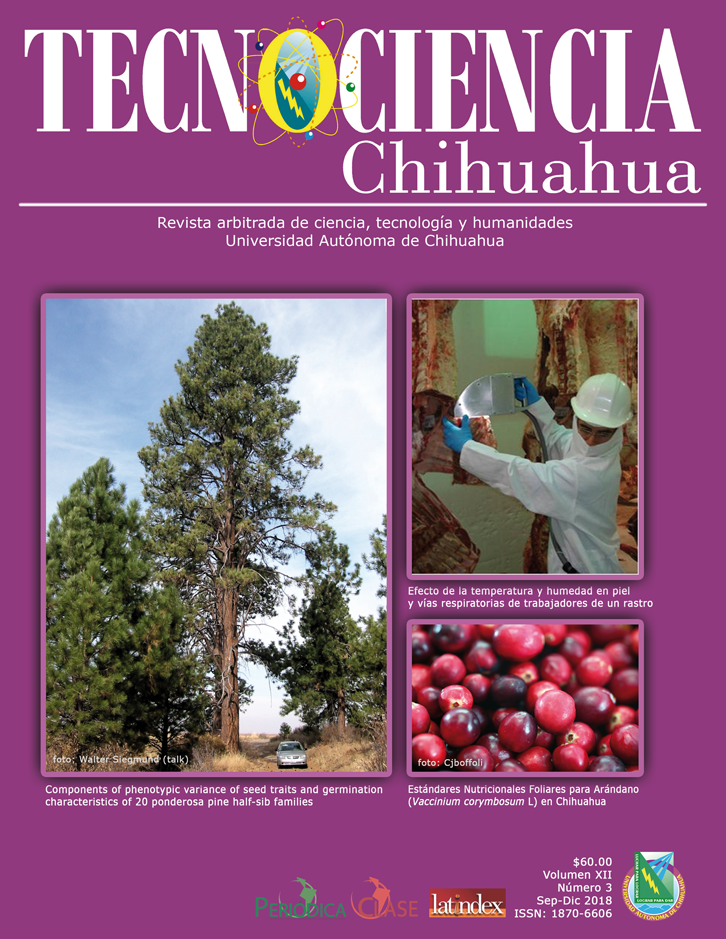
Components of phenotypic variance of seed traits and germination characteristics of 20 ponderosa pine half-sib families
Componentes de varianza fenotípica de características de semilla y germinación de 20 familias de medios hermanos de pino ponderosa
DOI:
https://doi.org/10.54167/tch.v12i3.189Keywords:
tiempo para germinación, valor pico, parámetros Weibull, variación dentro de familiasAbstract
Se realizó un estudio para estimar componentes de varianza de características y vigor de 20 lotes de semilla de pino ponderosa. En familias de hermanos completos y medios hermanos la varianza dentro de grupos es elevada para la germinación y crecimiento de plántulas de coníferas. Algunas características de semilla pueden influir en la calidad del lote y la supervivencia de plántulas. Diez conos de polinización abierta fueron colectados de cada uno de 20 árboles madre, en una población localizada en Fort Defiance, Arizona. Semillas secadas al aire fueron sembradas en el laboratorio, en un diseño completamente aleatorizado, para estimar las componentes de varianza fenotípica de: peso (SW) y cubierta de la semilla (SCW); imbibición de la semilla (IMB), cinco características germinativas y tres parámetro de Weibull (a, b y c). Un 80 % de la semilla tuvo peso e» 41 mg y germinación e» 97 %. La varianza dentro de progenie/dentro de familia para las características SW (64.5 %) e IMB (70.4 %) fue mayor que la varianza entre familias (35.3 y 24.8 %, respectivamente). La varianza entre familias varió de 35.1 % (parámetro a de Weibull) a 62.3 % (Peak Value). Los resultados sugieren contribución materna y componente genética alta dentro de familias que influyen en la calidad y características germinativas de la semilla. Semillas con SW e» 60 mg y TOG=3, incrementaron 38.3 % de su peso por agua absorbida para alcanzar 50 % de germinación. Las semillas cuyo SW fue e» 45 mg and TOG = 7, mostraron un incremento de 102.2 % en SW antes de completar 50 % de germinación.
Downloads
References
Ager, A.A. & R.F. Stettler. 1983. Local variation in seeds of ponderosa pine. Canadian Journal of Botany 61(5):1337-1344. https://doi.org/10.1139/b83-141
Bahler, C., R.R. Hill, Jr. & R.A. Byers. 1989. Comparison of logistic and Weibull functions: The effect of temperature on cumulative germination of alfalfa. Crop Science 29(1):142-146. https://doi.org/10.2135/cropsci1989.0011183X002900010032x
Bai, Y., D. Thompson & K. Broersma. 2004. Douglas fir and ponderosa pine seed dormancy as regulated by grassland seedbed conditions. Journal of Range Management 57(6):661-667. http://dx.doi.org/10.2307/4004025
Banerjee, S. & J. Maze. 1988. Variation in growth within and among families of Douglas-fir through a single season. Canadian Journal of Botany 66(12):2452-2458. https://doi.org/10.1139/b88-333
Barnett, J.P. 1997. Relating pine seed coat characteristics to speed of germination, geographic variation, and seedling development. Tree Planters´ Notes 48(1&2):38-42. https://www.fs.usda.gov/research/treesearch/1478
Benjamin, L.R. 1990. Variation in time of seedling emergence within populations: A feature that determines individual growth and development. Advances in Agronomy 44:1-25. https://doi.org/10.1016/S0065-2113(08)60816-0
Bonner, F.T. & T.R. Dell. 1976. The Weibull function: A new method of comparing seed vigor. Journal of Seed Technology 1:96-103.
Bramlett, D.L., R.R. Dell & W.D. Pepper. 1983. Genetic and maternal influences on Virginia pine seed germination. Silvae Genetica 32:1-4. https://www.thuenen.de/media/institute/fg/PDF/Silvae_Genetica/1983/Vol._32_Heft_1-2/32_1-2_01.pdf
Davidson, R.H., D.G.W. Edwards, O. Sziklai & Y.A. El-Kassaby. 1996. Genetic variation in germination parameters among populations of pacific silver fir. Silvae Genetica 45(2-3):165-171. https://treegenesdb.org/Publication/53086
Durzan, D.J. 1983. Metabolism of tritiated water during imbibition and germination of jack pine seeds. Canadian Journal of Forest Research 13(6):1204-1218. https://doi.org/10.1139/x83-159
Gosling, P.G. 1988. The effect of moist chilling on the subsequent germination of some temperate conifer seeds over a range of temperatures. Journal of Seed Technology 12(1):90-98. https://www.cabi.org/ISC/abstract/19920661011
Gummerson, R.J. 1989. Seed-bed cultivations and sugar-beet seedling emergence. The Journal of Agricultural Science 112(2): 159–169. http://doi.org/10.1017/S0021859600085051
Heidmann, L.J. & S.M. Haase. 1989. Causes of mortality in outplanted ponderosa pine container seedlings in the southwest. Tree Planters´ Notes 40(3):16-19. https://bit.ly/3Sme59k
Hoff, R.J. 1987. Dormancy in Pinus monticola seed related to stratification time, seed coat, and genetics. Canadian Journal of Forest Research 17(4):294-298. https://doi.org/10.1139/x87-049
King, J.E. & D.J. Gifford. 1997. Amino acid utilization in seeds of loblolly pine during germination and early seedling growth (I. Arginine and Arginase Activity). Plant Physiology 113(4):1125-1135. https://doi.org/10.1104/pp.113.4.1125
Ky-Dembele, C., M. Tigabu, J. Bayala, & P.C. Odén. 2014. Inter- and intra-provenances variations in seed size and seedling characteristics of Khaya senegalensis A. Juss in Burkina Faso. Agroforestry Systems 88:311-320. https://doi.org/10.1007/s10457-014-9684-7
Kuehl, R.O. 1994. Statistical principles of research design and analysis. Duxbury Press. ISBN 978-0534188047.
Larson, M.M. 1963. Initial root development of ponderosa pine seedlings as related to germination date and size of seed. Forest Science 9(4):456-460. https://academic.oup.com/forestscience/article-abstract/9/4/456/4746638
Long, T.J. & R.H. Jones. 1996. Seedling growth strategies and seed size effects in fourteen oak species native to different soil moisture habitats. Trees 11:1-8. https://doi.org/10.1007/s004680050051
Matziris, D. 1998. Genetic variation in cone and seed characteristics in a clonal seed orchard of Aleppo pine grown in Greece. Silvae Genetica 47(1):17-41.
Maze, J., S. Banerjee & Y.A. El-Kassaby. 1989. Variation in growth rate within and among full-sib families of Douglas-fir (Pseudotsuga menziesii). Canadian Journal of Botany 67(1):140-145. https://doi.org/10.1139/b89-021
Maze, J. & S. Banerjee. 1989. A comparison of variation Pseudotsuga menziesii seedlings from genetically defined and undefined sources. Canadian Journal of Botany 67(3):945-947. https://doi.org/10.1139/b89-125
McLemore, B.F. 1966. Temperature effects on dormancy and germination of loblolly pine seed. Forest Science 12(3):284-289. https://academic.oup.com/forestscience/article-abstract/12/3/284/4709437?redirectedFrom=fulltext
Mexal, J.G. & J.T. Fisher. 1987. Size hierarchy in conifer seedbeds. 1. Time of emergence. New Forest 1:187-196. https://doi.org/10.1007/BF00118756
Moore, M.B. & F.A. Kidd. 1982. Seed source variation in induced moisture stress germination of ponderosa pine. Tree Planters´ Notes 33(1):12-14. https://rngr.net/publications/tpn/33-1/33_1_12_14.pdf
Mtambalika, K., C. Munthali, D. Gondwe & E. Missanjo. 2014. Effect of seed size of Afzelia quanzensis on germination and seedling growth. International Journal of Forestry Research 2014:1-5. https://doi.org/10.1155/2014/384565
Parker, W.C., T.L. Noland, & A.E. Morneault. 2006. The effect of seed mass on germination, seedling emergence, and early seedling growth of eastern white pine (Pinus strobus L.). New Forests 32:33-49. https://doi.org/10.1007/s11056-005-3391-1
Pasquini, N.M. & G.E. Defossé. 2012. Effects of storage conditions and pre-chilling periods on germinability of Pinus ponderosa seeds from Patagonia, Argentina: preliminary study. Bosque 33(1):99-103. https://doi.org/10.4067/S0717-92002012000100012
Perry, T.O. 1976. Maternal effects on the early performance of trees progenies. En Tree physiology and yield improvement (pp. 474-481). Academy Press. ISBN 9780121587505
Perry, T.O. and W.L. Hafley. 1981. Variation in seedling growth rates: Their genetic and physiological bases. En Proceedings: Southern Forest Tree Improvement Conference (pp. 288-301). Louisiana State University, Division of Continuing Education in Cooperation with Southern Forest Experiment Station, USDA, Forest Service.
Ranal, M. & D. Garcia de Santana. 2006. How and why to measure the germination process? Brazilian Journal of Botany 29(1):1-11. https://doi.org/10.1590/S0100-84042006000100002
Rink, G., R.R. Dell, G. Swuitzer & F.T. Bonner. 1979. Use of the Weibull function to quantify sweetgum germination data. Silvae Genetica 7:319-329. https://www.thuenen.de/media/institute/fg/PDF/Silvae_Genetica/1979/Vol._28_Heft_1/28_1_09.pdf
Roach, D. & R. Wulff. 1987. Maternal effects in plants. Annual Review of Ecology and Systematics 18:209-235. https://doi.org/10.1146/annurev.es.18.110187.001233
Silen, R. & C. Osterhaus. 1979. Reduction of genetic base by sizing of bulked Douglas-fir seed lots. Tree Planters´ Notes 30(1):24-30. https://rngr.net/publications/tpn/30-1/30_1_24_30.pdf
Sorensen, F.C. & R.K. Campbell. 1985. Effect of seed weight on height growth of Douglas-fir [Pseudotsuga menziesii (Mirb.) Franco var. menziesii] seedlings in a nursery. Canadian Journal of Forest Research 15(6):1109-1115. https://doi.org/10.1139/x85-180
Sorensen, F.C. & D.W. Cress. 1994. Effects of sib mating on cone and seed traits in coastal Douglas-fir. Silvae Genetica 43(5-6):338-345.
St. Clair, J.B. & W.T. Adams. 1993. Family composition of Douglas-fir nursery stock as influenced by seed characters, mortality, and culling practices. New Forests 7:319-329. https://www.fs.usda.gov/research/treesearch/4959
Tillman-Sutela, E. & A. Kauppi. 1995. The morphological background to imbibition in seeds of Pinus sylvestris L. of different provenances. Trees 9: 123-133. https://doi.org/10.1007/BF02418201
Timonin, M.I. 1964. Interaction of seed-coat microflora and soil microorganisms and its effects on pre- and post-emergence of some conifer seedlings. Canadian Journal of Microbiology. 10(1):17-22. https://doi.org/10.1139/m64-003
Terskikh, V.V., J.A. Feurtado, C. Ren, S.R. Abrams & A.R. Kermode. 2005. Water uptake and oil distribution during imbibition of seeds of western white pine (Pinus monticola Dougl. Ex D. Don) monitored in vivo using magnetic resonance imaging. Planta 221(5):17-27. https://doi.org/10.1007/s00425-004-1426-z
Weber, J.C. & F.C. Sorensen. 1992. Geographic variation in speed of seed germination in central Oregon ponderosa pine (Pinus ponderosa Dougl. Ex Laws.). Pacific Norwest Forest & Range Experiment Station. Research Paper PNW-RP-444. USDA, Forest Service. https://doi.org/10.2737/PNW-RP-444
Woodstock, L.W. 1988. Seed imbibition: A critical period for successful germination. Journal of Seed Technology 12(1):1–15.