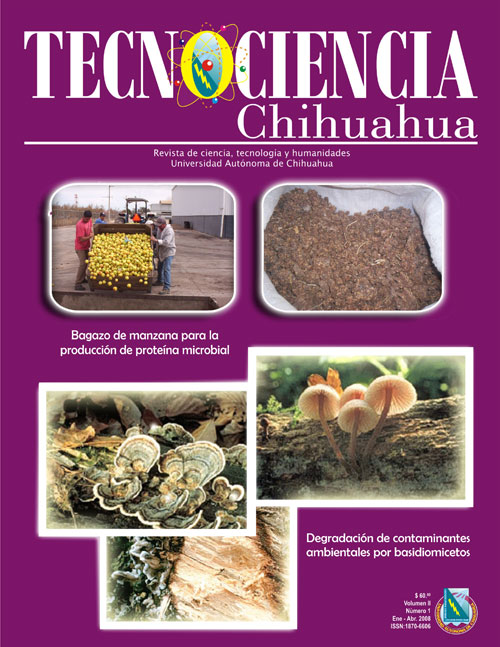
Urea y maíz en la fermentación aeróbica de bagazo de manzana para la producción de proteína microbíal
Urea and corn on aerobic fermentation from apple pomace to produce microbial protein
DOI:
https://doi.org/10.54167/tecnociencia.v2i1.63Keywords:
apple byproducts, yeasts, fermentationAbstract
Two experiments for microbial protein production (PM) by solid state fermentation (SSF) of apple pomace (BM) were carried out. In the first experiment a complete random design with factorial arrangement of 2x3, BM was mixed with two percentages of urea (1.5 and 2.0 %) and three levels of grinding corn (MM) (0, 10 and 20 %). In the second experiment a complete random design with factorial arrangement of 4 x 3 using BM mixed with 0, 10 and 20 % of MM under four times of preparation (1, 2, 3 and 4 d). The results found in the first study showed interaction (P<0.05) in the production of crude protein (PC) and of true protein (PV) (P<0.01) with a decrease of the values of these variables upon adding MM. The biggest optic density of yeasts (10.66 UFC*1000) was observed in the processing with 1.5 % of urea in comparison to 7.29 UFC*1000 with 2 % of urea (P<0.05). Optic density of yeast was reduced (P<0.01) when level of MM was incremented with values of 12.86, 7.52 and 6.55 UFC*1000 for 0 %, 10 % and 20 % of MM. The organic matter digestibility was favored (P<0.01) with the increment of urea, with values of 62.21 % and 73.45 % for 1.5 and 2 % of urea in the mixture, respectively. It was logged off that the increase of urea in the SSF of BM generates greater quantity of PV and diminished with the addition of MM to the mixture, although improved the organic matter digestibility.
Downloads
References
Altaf, M., B. J. Naveena, M. Venkateshwar, E. Vijay & G. Reddy. 2006 Single step fermentation of starch to L (+) lactic acid by Lactobacillus amylophilus GV6 in SSF using inexpensive nitrogen sources to replace peptone and yeast extract-Optimization by RSM. Process Biochemistry 41(2):465-472. https://doi.org/10.1016/j.procbio.2005.07.011
Anrique, R. & C. Dossow. 2003. Efectos de la pulpa de manzana ensilada en la ración de vacas lecheras sobre el consumo, tasa de sustitución y producción de leche. Archivos de Medicina Veterinaria 35(1):13-22. http://dx.doi.org/10.4067/S0301-732X2003000100002
Anrique, R. & M. P. Viveros. 2002. Efecto del ensilado sobre la composición química y degradabilidad ruminal de la pomasa de manzana. Archivos de Medicina Veterinaria 34(2):189-197. https://www.redalyc.org/articulo.oa?id=173013743005
Association of Official Analytical Chemists. 1984. Official Methods of Analysis. 14th Ed. AOAC. ISBN 0935584242, 9780935584240.
Becerra, A. 1998. Elaboración de bloques proteicos para suplementación de ganado en agostadero utilizando un subproducto de manzana con cuatro tipos de secante (Tesis, Universidad Autónoma de Chihuahua).
Chesson, A. & C.W. Forsberg. 1997. Polysaccharide degradation by rumen microorganisms. En The rumen microbial ecosystem (pp.329-381). Springer Dordrecht. ISBN 9780751403664, 9789401071499, 9789400914537. https://doi.org/10.1007/978-94-009-1453-7
Elías, A, O. Fundora, P. C. Martín & R. Llerandi. 1996. Efecto de la suplementación proteica de raciones basadas en Saccharina rústica para bovinos en crecimiento-ceba. Rev. Cubana de Ciencia. Agric. 30(2):163-168.
Hang, Y.D., C. Y. Lee, E.E. Woodams & H. J. Cooley. 1981. Production of Alcohol from Apple Pomace. Applied and Environmental Microbiology 42(6):1128-1129. https://doi.org/10.1128/aem.42.6.1128-1129.1981
Hours, R. A., C. E. Voget & R. J. Ertola. 1988. Some Factories Affecting Pectinase Production from Apple Pomace in Solid States Cultures. Biological Wastes 24(2):147-157. https://doi.org/10.1016/0269-7483(88)90057-2
Joshi, V. K. & D. K. Sandhu. 1996. Preparation and evaluation of an animal fed by-product produced by solid-estate fermentation of apple pomace. Bioresource Technology 56(2-3):251-255. https://doi.org/10.1016/0960-8524(96)00040-5
Manterola, H., G. Casanova, D. Cerda, E. Porte & L. Shiran. 1998. Comportamiento productivo de toritos Hereford alimentados con altos niveles de pomasa de manzana en raciones de engorda. Avances en Producción animal 23 (1-2):73-79.
Meir, H. 1986. Laborpralictikure. Tierernah rung und juttermitle hunde fur tierproduzenten. Verlag. D. D. R.
Ramos, J., A. Elías & F. Herrera.2005. Efecto de cuatro fuentes energéticas en la fermentación en estado sólido (FES) de la caña de azúcar. En I Congreso Internacional de Producción Animal (pp. 298-302). La Habana, Cuba.
Rodríguez, C., A. Becerra, A. Elías, J. Jiménez, A. Ramírez & O. Ruiz,. 2005. Niveles de urea y maíz en la fermentación aerobia de manzana de desecho para la producción de proteína microbial. En I Congreso Internacional de Producción Animal (pp. 317-320). La Habana, Cuba.
SAS. Institute. 2002. SAS. User’s Guide. Version 8, 6th Edition. SAS Institute Inc.
Soccol, C. R. & L. P. S. Vandenberghe. 2003. Overview of applied solid–state fermentation in Brazil. Biochemical Engineering Journal 13(2-3):205-218. https://doi.org/10.1016/S1369-703X(02)00133-X
Tilley, J. M. A. & R. A. Terry. 1963. A two-stage technique for the in vitro digestion of forage crops. Grass and Forage Science 18(2):104-111. https://doi.org/10.1111/j.1365-2494.1963.tb00335.x
Unión de Fruticultores del Estado de Chihuahua. 2004.
Valiño, E., A. Elías, E. Álvarez, E. Regalado & J. Cordero. 1992. Dynamics of growth of sugar cane microbiotes in Saccharina production. Cuban Journal of Agricultural Science 26(3):299-305.