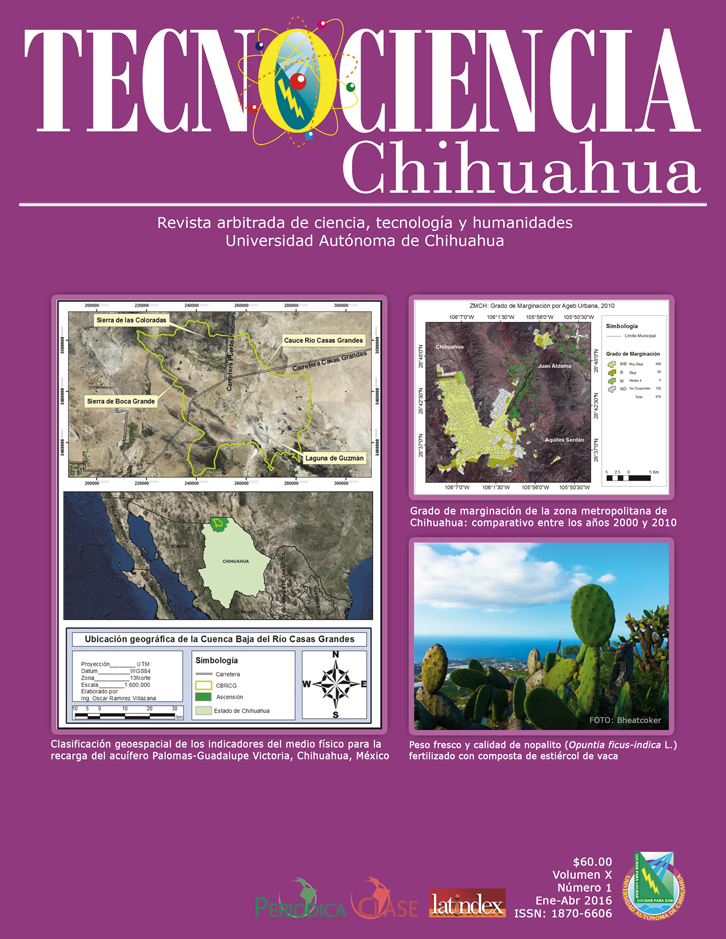
Peso fresco y calidad de nopalito (Opuntia ficus-indica L.) fertilizado con composta de estiércol de vaca
Fresh weight and quality of nopalito (Opuntia ficus-indica L.) fertilized with cow manure compost
DOI:
https://doi.org/10.54167/tch.v10i1.581Keywords:
compost lixiviate, organic production, enzymatic browning, shelf-life qualityAbstract
Cactus crop as a tender leaf at Milpa Alta, D.F., Mexico, has depended for more than 40 years in the use of high doses of fresh cow manure (600 t.ha-1) and this could be a source for greenhouse gases such as methane and nitrous oxide; friendly nutrition alternatives are needed to the environment. To compare different sources of fertilizing on cactus plant yield, cladode quality and cladode shelf-life, three-year-old cactus plants were treated with compost, compost lixiviate applied to the soil or as a foliar spray, fresh cow manure and synthetic fertilizer; plants treated with water applied to the soil or as a foliar spray served as checks. Regarding to the plant yield, there was no statistical difference among treatments. Cladodes of plants treated with compost and fresh manure showed a lower pH (4.7) than those of plants treated with water applied to the soil (5.1; p ≤ 0.007). Cladodes from plants treated with synthetic fertilizer showed higher resistance to cutting (6.9 Nw) than those from plants treated with manure (5.2 Nw), foliar sprayed with compost lixiviate (5.1 Nw) and water applied to the soil (5.1 Nw; p ≤ 0.002). Cladodes of plants treated with synthetic fertilizer and foliar sprayed with compost lixiviate took more days to show darkening on shelf (4.6 and 4.4 days, respectively) than cladodes from plants treated with water applied to the soil (1.2 days; p≤0.001). It is concluded that compost manure could be a suitable substitute for fresh cow manure in fertilizing cactus tender leaf crops.
Downloads
References
Aguilar-Sánchez, L., M.T. Martínez-Damián, A.F. Barrientos-Priego, N. Aguilar-Gallegos & C. Gallegos-Vásquez. 2007. Potencial de oscurecimiento enzimático de variedades de nopalitos. Journal of the Professional Association for Cactus Development 9:165-184. https://tinyurl.com/2p3b5xoz
Acosta-Martínez, V, M.M. Mikha, K.R. Sistani, P.W. Stahlman, J.G. Benjamin, M.F. Vigil, & R. Erickson. 2011. Multi-location study of soil enzyme activities as affected by types and rates of manure application and tillage practices. Agriculture 1(1): 4-21. https://doi.org/10.3390/agriculture1010004
Betancourt-Domínguez, M.A., T. Hernández-Pérez, P. García-Saucedo, A. Cruz-Hernández & O. Paredes-López. 2006. Physico-chemical changes in cladodes (nopalitos) from cultivated and wild cacti (Opuntia spp.). Plant Foods for Human Nutrition 61(3):115-119. https://doi.org/10.1007/s11130-006-0008-6
Chanduví, F. 1993. Riego con aguas servidas en Xochimilco, México DF, México. En: Prevención de la Contaminación del Agua por la Agricultura y Actividades Afines (pp. 139-150). Anales de la Consulta de Expertos. Organización de las Naciones Unidas para la Agricultura y la Alimentación. Santiago, Chile 20-23 de octubre de 1992.
Chen, R., Y. Wang, S. Wei, W. Wang, & X. Lin. 2014. Windrow composting mitigated CH4 emissions: characterization of methanogenic and methanotrophic communities in manure management. FEMS Microbiology Ecology 90(3): 575-586. https://doi.org/10.1111/1574-6941.12417
Karami, A., M. Homaee, S. Afzalinia, H. Ruhipour & S. Basirat. 2012. Organic resource management: impacts on soil aggregate stability and other soil physico-chemical properties. Agriculture, Ecosystems and Environment 148(15): 22-28. https://doi.org/10.1016/J.AGEE.2011.10.021
Kariyapperuma, K.A., A. Furon, & C. Wagner-Riddle. 2012. Non-growing season nitrous oxide fluxes from an agricultural soil affected by application of liquid and composted swine manure. Canadian Journal of Soil Science 92:315-327. https://doi.org/10.4141/cjss2011-059
Liang, Q., H. Chen, Y. Gong, M. Fan, H. Yang, R. Lal & Y. Kuzyakov. 2012. Effects of 15 years of manure and inorganic fertilizers on soil organic carbon fractions in a wheat-maize system in the north China plains. Nutrient Cycling in Agroecosystems 92(1): 21-33. https://doi.org/10.1007/s10705-011-9469-6
Murillo-Amador, B., A. Flores-Hernández, J.L. García-Hernández, R.D. Valdez-Cepeda, N.Y. Ávila-Serrano, E. Troyo-Diéguez & F.H. Ruiz-Espinoza. 2005. Soil amendment with organic products increases the production of prickly pear cactus as a green vegetable (nopalitos). Journal of the Professional Association for Cactus Development 7: 97-109. https://doi.org/10.56890/jpacd.v7i.290
Lynch, D.H., R.P. Voroney & P.R. Warman. 2005. Soil Physical properties and organic matter fractions under forages receiving compost, manure or fertilizer. Compost Science & Utilization 13(4): 252-261. http://dx.doi.org/10.1080/1065657X.2005.10702249
Martínez, F., M.A. Casermeiro, D. Morales, G. Cuevas & I. Walter. 2003. Effects on run-off water quantity and quality of urban organic waste applied in a degraded semi-arid ecosystem. The Science of the Total Environment 305(1-3): 13-21. https://doi.org/10.1016/s0048-9697(02)00472-2
Massé, D.I., F. Croteau, N.K. Patni & L. Masse. 2003. Methane emissions from dairy cow and swine manure slurries stored at 10oC and 15oC. Canadian Biosystems Engineering 45: 61-66. https://tinyurl.com/2nxdhmqh
Riahi, A., C. Hdider, M. Sanaa, N. Tarchoun, M. Ben Kheder & I. Guezal. 2009. Effect of conventional and organic production systems on the yield and quality of field tomato cultivars grown in Tunisia. Journal of Science of Food and Agriculture 89(13): 2275-2282. https://doi.org/10.1002/JSFA.3720
Rivera, G., J. Cortés, R. Soriano, H. Losada, J. Morales & E. Arias. 2006. Edaphical characteristics of three vegetable cactus pear orchards (Opuntia ficus-indica) fertilized with high amounts of dairy manure at Milpa Alta, Mexico. Acta Horticulturae 728: 159-163. http://dx.doi.org/10.17660/ActaHortic.2006.728.21
Rodríguez-Felix, A. & M. Cantwell. 1988. Developmental changes in composition and quality of prickly pear cactus cladodes (nopalitos). Plant Foods for Human Nutrition 38(1): 83-93. https://doi.org/10.1007/BF01092314
Silva, H., S. Sagardia, M. Ortiz, N. Franck, M. Opazo, M. Quiroz, C. Baginsky & C. Tapia. 2014. Relationships between leaf anatomy, morphology, and water use efficiency in Aloe vera (L.) Burm f. as a function of water availability. Revista Chilena de Historia Natural 87: 13. http://dx.doi.org/10.1186/S40693-014-0013-3
Sistani, K.R., M. Jn-Baptiste, N. Lovanh & K.L. Cook. 2011. Atmospheric emissions from of nitrous oxide, methane and carbon dioxide from different nitrogen fertilizers. Journal of Environmental Quality 40(6): 1797-1805. https://doi.org/10.2134/jeq2011.0197
Sistema de Información Agroalimentaria y Pesquera. 2014. Producción Anual. Cierre de la Producción Agrícola por Estado. SIAP. https://www.gob.mx/siap/acciones-y-programas/produccion-agricola-33119
Tavera-Cortes, M.E., P.E. Escamilla-García, H. Alvarado-Raya, E. Salinas-Callejas & S. Galicia-Villanueva. 2014. Regional development model based on organic production of nopal. Modern Economy 5(3): 239-249. http://dx.doi.org/10.4236/me.2014.53025
Vázquez-Alvarado, R.E., E. Olivarez-Sáenz, F. Zavala-Gracía & R.D. Valdez-Cepeda. 2006. Utilization of manure and fertilizers to improve the production of cactus pear (Opuntia spp.) a Review. Acta Horticulturae 728: 151-158.
https://doi.org/10.17660/ActaHortic.2006.728.20
Withers, P.J.A., C. Neal, H.P. Jarvie & D.G. Doody. 2014. Agriculture and eutrophication: where do we go from here? Sustainability 6(9): 5853-5875. https://doi.org/10.3390/su6095853
Zhong, W., T. Gu, W. Wang, B. Zhang, X. Lin, Q. Huang, & W. Shen. 2010. The effects of mineral fertilizer and organic manure on soil microbial community and diversity. Plant and Soil 326(1): 511-522. https://tinyurl.com/yzt9kkfr