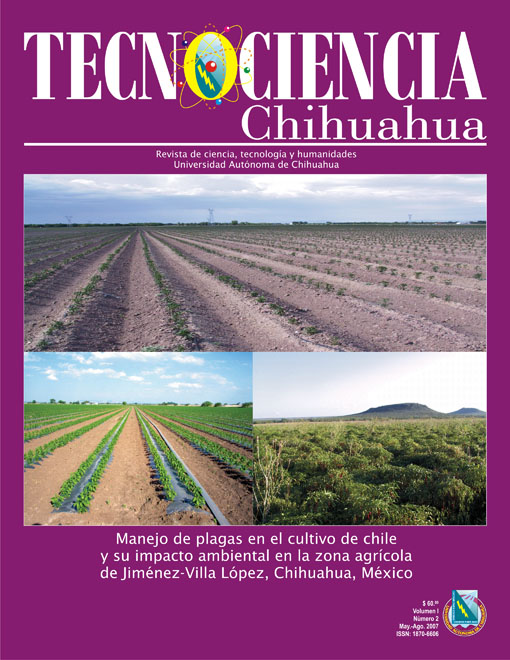
Manejo de plagas en el cultivo de chile y su impacto ambiental en la zona agrícola de Jiménez-Villa López, Chihuahua, México
Pest management in the pepper crop and their environmental impact in the Jiménez-Villa López, Chihuahua, México agricultural zone
DOI:
https://doi.org/10.54167/tch.v1i2.50Keywords:
Capsicum annuum, chemical control, integrated pest management, toxicologyAbstract
Pepper crops have a high pest incidence which requires increased use of chemical products for control. To identify pesticides and pest management programs used in pepper crop and to evaluate the pesticides environmental impact on health risk, questionnaires were supplied to producers in the Jiménez-Villa López agricultural zone during the 2001 and 2002 agricultural cycles. Pesticides environmental impact quotient (EIQ) and field environmental impact were calculated. 48 products were identified, 26 insecticides/ acaricides, 20 fungicides/bactericides and 2 herbicides. Endosulfan and chlorpyrifos were the insecticides most widely used in the production of pepper (82.3% and 49% of the cultivated area, respectively). Copper oxiclorure and manco-zeb were the most used fungicides (66.3% and 64.6% of the cultivated area, respectively). 37.5% of pest management programs exert a strong environmental pres- sure (EIQ> 500), 25% an EIQ between 300 and 500, and 37.5% an EIQ <290. Pepper crop management using some products such as endosulfan (EIQ=43 to 85), chlorpyrifos (EIQ=27 to 40), copper oxiclorure (EIQ=16 to 117) and manco-zeb (EIQ=37 to 299) may seriously impact the envi- ronment of the region.
DOI: https://doi.org/10.54167/tch.v1i2.50
Downloads
References
Avelar, M.J. & M. Marban. 1989. Intentos de Control de la Marchitez del Chile Ocasionada por el Hongo Phytophthora capsici L. en la Región de Valsequillo, Puebla, Mex. (Tesis. Colegio de Postgraduados).
Avendaño, F., R. Gastélum, M. Ruiz & M. López. 2001. Susceptibilidad del Picudo del Chile (Anthonomus eugenii ) Cano (Coleoptera:Curculionidae) a Insecticidas en Culiacán, Sin. En Memorias del XXXVI Congreso Nacional de Entomología. Instituto Tecnológico y Estudios Superiores de Monterrey.
Barros, B. F. 2001. Comparación del Impacto Ambiental de Diferentes Programas de Manejo Fitosanitario en Manzano (Memoria de Titulo. Universidad de Talca). http://dspace.utalca.cl/bitstream/1950/743/1/FBarrosBisquertt.pdf
Bravo, E. 2002. Uso Reducido de Insecticidas y Control Biológico de Plagas del Jitomate en Oaxaca. Agricultura Técnica en México 28 (2):137-149. https://www.redalyc.org/pdf/608/60828204.pdf
Bues, R., P. Bussières, M. Dadomo, Y. Dumas, M. I. Garcia-Pomar & J. P. Lyannaz. 2003. Assessing the environmental impacts of pesticides used on processing tomato crops. Agriculture Ecosystems & Environment 102 (2):155-162. https://doi.org/10.1016/j.agee.2003.08.007
Castro, R., J. S. García & L.J. Galán. 2000. Aportaciones de la Biotecnología de Formulados a Base de Bacillus thuringiensis para el Control de Plagas Agrícolas. En Aprovechamiento Integral de los Recursos Naturales en Zonas Aridas (pp.71-87). Universidad Autónoma de Chapingo.
Colborn, T., F. S. Vom Saal & A.M. Soto. 1993. Developmental Effects of Endocrine-Disrupting Chemicals in Wildlife and Humans. Environmental Impact Assessment Review 14(5-6):469-489. https://doi.org/10.1016/0195-9255(94)90014-0
De la Isla, M. L. 1987. Fitopatología. Ed. LIMUSA. ISBN 9789681823528, 9681823524.
Environmental Protection Agency. 2000. Chlorpyrifos, Revised Risk Assessment and Agreement with Registrants. Prevention, Pesticides and Toxic Substances (7506C). United States Environmental Protection Agency. https://www.ibiblio.org/london/NAFEX/message-archives/old/pdf00000.pdf
Environmental Protection Agency. 2002. Pesticides Fact Sheets. Prevention, Pesticides and Toxic Substances. United States Environmental Protection Agency.
Environmental Protection Agency. 2003. Copper Compounds EPA Rule-Water Quality Standard. United States Environmental Protection Agency.
Garthwaite, D. G. & M.R. Thomas. 1999. Pesticide Usage Survey Report 159: Arable Farm Crops in Great Britain. Pesticide Usage Survey Group. Central Science Laboratory. Sand Hutton.
Granados, D. & M. L. Pérez. 1991. Educación Ambiental: Ecología e Impacto Ambiental. SEP. SEIT. DGETA. ISBN 9682935776.
Goldberg, N.P. 1998. Chile Pepper Diseases. Circular 549. College of Agriculture and Home Economics. New Mexico State University. https://pubs.nmsu.edu/_circulars/CR549/
Guigón, C. & P.A. González. 2001. Estudio Regional de las Enfermedades del Chile (Capsicum annuum, L.) y su Comportamiento Temporal en el Sur de Chihuahua, México. Revista Mexicana de Fitopatología 19(1):49-56. https://www.redalyc.org/articulo.oa?id=61219107
Harris, S. A, A.M. Sass-Kortsak, P.N. Corey & J. T. Purdham. 2002. Development of models to predict dose of pesticides in professional turf applicators. Journal of Exposure Analysis and Environmental Epidemiology 12(2):130-144. https://doi.org/10.1038/sj.jea.7500208
Henry, J.G & O.J.C. Runnalls. 1999. Residuos Peligrosos. En Ingeniería Ambiental. 2ª Edición (pp. 620-684). Prentice Hall Hispanoamericana. ISBN 9701702662.
Hurley, M.P., R.N. Hill & R.J. Whiting. 1998. Mode of Carcinogenic Action of Pesticides Inducing Thyroid Follicular Cell Tumors in Rodents. Environ. Health Perspect 106(8):437-445. https://doi.org/10.2307/3434175
Jorgenson, J. L. 2001. Aldrin & Dieldrin: A Review of Research on Their Production, Environmental Deposition and Fate, Bioaccumulation, Toxicology and Epidemiology in the United States. Environ. Health Perspect 109 (suppl 1):113-139. https://doi.org/10.1289/ehp.01109s1113
Kovach, J., C. Petzdolt, J. Degni & J. Tette. 1992. A Method to Measure the Environmental Impact of Pesticides. New York´s Food and Life Sciences. Bulletin No. 139. Cornell University. http://ucbiotech.org/biotech_info/PDFs/Kovach_2003.pdf
Lugo, D. 1998. Regulación del Uso y Registro de Plaguicidas en México. En Plagas y Enfermedades de las Hortalizas en México (pp. 295-310). SEP. SEIT. DGETA. ISBN 9789701840870
Luján, M. & N. Chávez. 2003. El arreglo topológico y su efecto en el crecimiento, desarrollo y producción del chile jalapeño ( Capsicum annuum L.). Rev. Fitotecnia Mex. 26(2):81-87. https://doi.org/10.35196/rfm.2003.2.81
Margalef, R. 1991. Ecología. Ed. Omega. ISBN 9788428204057
Metcalf, R.L. & W.H. Luckmann. 1992. Insecticidas en el Manejo de Plagas. En Introducción al Manejo de Plagas de Insectos (pp. 271-344). Ed. Limusa. ISBN 9681832752
Moroz, W.J. 1999. Contaminación del Aire. En Ingeniería Ambiental. 2da. Edición (pp. 492- 566). Prentice Hall Inc. ISBN 9701702662
Mota, D. 1998. Plaguicidas Autorizados en México. En Plagas y Enfermedades de las Hortalizas en México (pp. 246-248). SEP. SEIT. DGETA. ISBN 9789701840870
Nieto, Z. O. 2001. Fichas Técnicas de Plaguicidas a Prohibir o Restringir Incluidos en el Acuerdo No. 9 de la XVI Reunión del Sector Salud de Centroamérica y República Dominicana (RESSCAD). Organización Panamericana de la Salud/ Organización Mundial de la Salud.
Oficina de Estudios y Políticas Agrarias. 1999. Manual de capacitación para el buen uso y manejo de plaguicidas Comité proyecto Chile-Canadá. Primera Serie. ODEPA:SAG:RPC.
Peet, M. 2002. Sustainable Practices for Vegetable Production in the South. NC State University. ISBN 9780941051552, 0941051552
Pedigo, L. P. 1991. Entomology and Pest Management. MacMillan Pub. Co. ISBN 0029463416, 9780029463413
Ramírez, M. R. & J.L. Jacobo. 2002. Impacto Ambiental del Uso de Pesticidas en Huertos de Manzano del Noroeste de Chihuahua. Revista Mexicana de Fitopatología 20(2):168-173. https://www.redalyc.org/articulo.oa?id=61220206
Ruesink, G.W. & M. Kogan. 1992. Bases Cuantitativas del Manejo de Plagas: Muestreo y Medición. En Introducción al Manejo de Plagas de Insectos (pp. 389-434). Ed. LIMUSA. ISBN 9681832725
Segura, A. 1998. Técnicas para Determinar Residuos de Plaguicidas. En Plagas y Enfermedades de las Hortalizas en México (pp. 295-310). SEP.SEIT. DGETA. ISBN 9789701840870
Secretaría de Desarrollo Rural. 2002. Programa Sectorial 2001-2004. Secretaría de Desarrollo Rural-Gobierno del Estado de Chihuahua.
Sivilla, .2001. Prioridades del Sector Agropecuario y Forestal para la Formulación de Proyectos Integrales. Compilación. Sistema de Investigación Francisco Villa. SEP. CONACYT.
Soto, A.M., K.L. Chung. & C. Sonneschein. 1994. The Pesticides Endosulfan, Toxaphene and Dieldrin Have Estrogenic Effects on Human Estrogen-Sensitive Cells. Environ. Health Perspect 102(4):380-383. https://doi.org/10.2307/3431626
United States. Forest Service. 1996. Six Rivers National Forest, Nursery Pest Management, Humboldt Nursery: Environmental Impact Statement. Northwestern University.