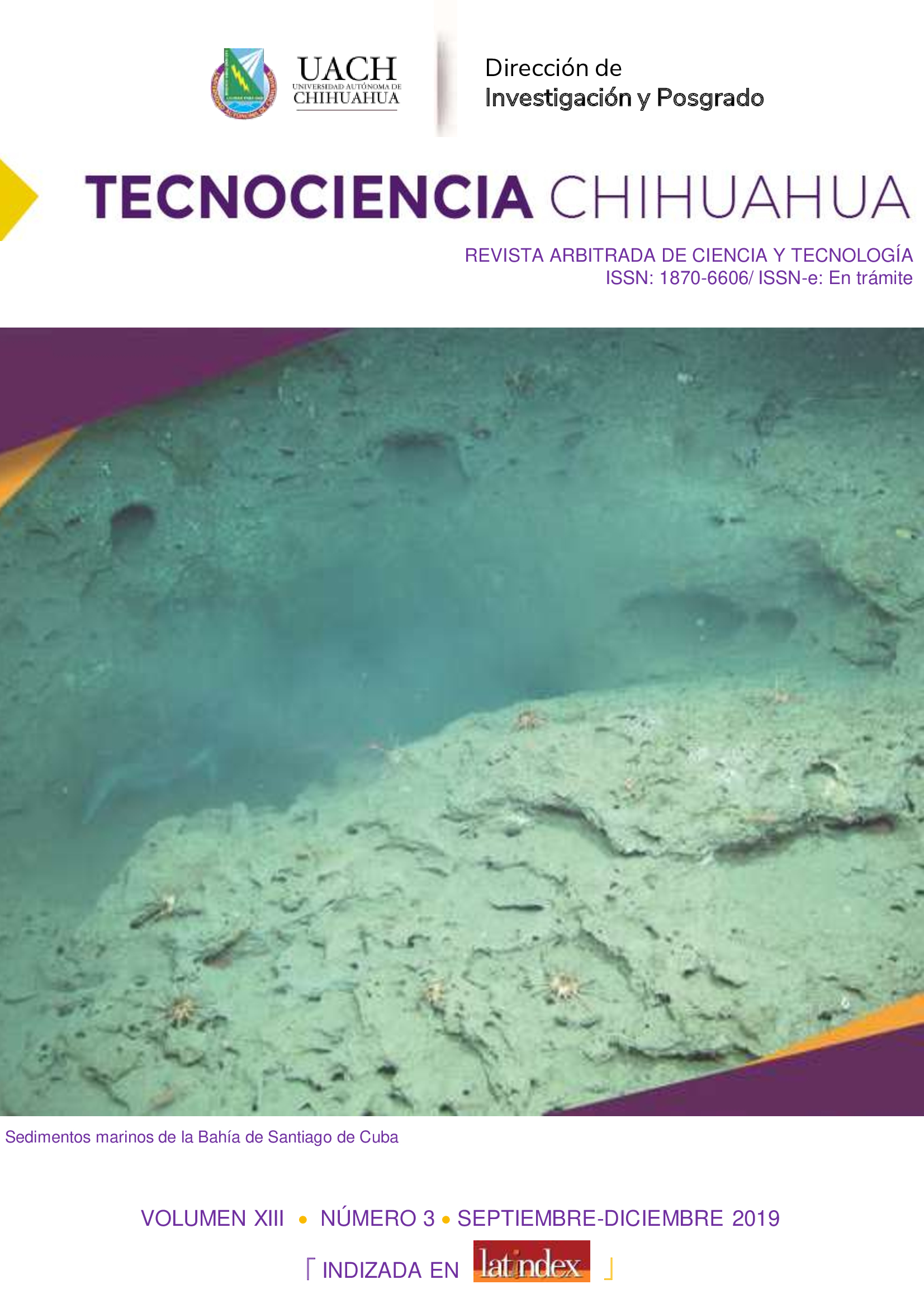
Estudio de la contaminación por metales en sedimentos marinos de la Bahía de Santiago de Cuba
Study of the contamination by marine sediments metals in Santiago of Cuba Bay
DOI:
https://doi.org/10.54167/tch.v13i3.476Keywords:
environmental, metals, marine sediments, atomic absorption spectrometryAbstract
Santiago of Cuba bay is a complex ecosystem. The deposition of different pollutant agents can originate a permanent contamination of the bay´s sediments, affecting plants and animals. In this work was evaluated the contamination for metals (Cu, Zn, Neither, Co, Cd and Pb) in the superficial sediments of this bay through the determination of the total contents, its direct comparison with the reference concentrations established in international quality guides of sediments and the employment of enrichment and ecological risk indexes. Cu was the element that presents the highest concentrations and the maximum variability, while Ni, Zn and Pb have more homogeneous distributions. The evaluation of the content of metals showed that the order of abundance of the analyzed elements in the sediments was: Cu > Zn > Ni > Pb > Co ~ Cd. According to the geo-accumulation index, the sediments are strongly polluted with Cu, moderately polluted with Zn and three of the considered stations present a contamination of moderate to strong with Ni. According to the employed ecological risk index, the sediments of three of the stations are moderately polluted, while the rest presents a slight contamination.
Downloads
References
Azevedo, M. L., Ferraceiu, L. R.,Guimaraes, L. R. 2003. Biosolids and heavy metals in Soils. Sci. Agric. (60): 793-806. https://doi.org/10.1590/S0103-90162003000400029
Ajlec, R.; Cop, M. and Stupar, J. Analyst, 1988. Interferences in the determination of chromium in plant materials and soil samples by flame atomic absorption spectrometry. Analyst 4 (113): 585. https://doi.org/10.1039/AN9881300585
Araúz, D., García, A., Rodríguez, F., & Zárate, M. (1). 2013. Nivel de Contaminación y Distribución Espacial de Metales Pesados en Sedimentos Superficiales de Bahía Damas, Isla Coiba. I+D Tecnológico, 9(2), 14-23. https://revistas.utp.ac.pa/index.php/id-tecnologico/article/view/79
Calderón, C; Valdés, J. 2012. Contenido de metales en sedimentos y organismos bentónicos de la bahía San Jorge, Antofagasta, Chile. Revista de biología marina y oceanografía, 47(1), 121-133. https://dx.doi.org/10.4067/S0718-19572012000100011
Davutluoglu, O.I.; Seckin, G.; Ersu, C.B.; Yilmaz, T.; Sari, B. 2011. Assessment of metal pollution in water and surface sediments of the Seyhan river, Turkey, using different indexes. Clean-Soil, Air, Water (39) 2: 185-194. https://doi.org/10.1002/clen.201000266
Essien, J.P.; Antai, S.P.; Olajire, A.A. 2009. Distribution, Seasonal Variations and Ecotoxicological Significance of Heavy Metals in Sediments of Cross River Estuary Mangrove Swamp. Water Air Soil Pollut 197, 91–105. https://doi.org/10.1007/s11270-008-9793-x
EURACHEM: The Fitness for Purpose of Analytical Methods: A Laboratory Guide to Method Validation and Related Topics. 1998. https://www.eurachem.org/index.php/publications/pubarch/143-gdmv98
González, H. 1991. Heavy metal surveys in sediments of five important Cuban Bays. Biogeochemistry. (14): 113-128. https://doi.org/10.1007/BF00002901
González-Lozano, M.C.; Méndez-Rodríguez, L.C.; López-Veneroni, D.G.; Vázquez-Botello, A. 2006. "Evaluación de la contaminación en sedimentos del área portuaria y zona costera de Salina Cruz, Oaxaca, México." Interciencia, 31 (9) 647-656. https://www.redalyc.org/articulo.oa?id=33912008
Henríquez C. 2006. Evaluación de la contaminacion por metales pesados en suelos de la Cuenca del Rio Quibu. Tesis Maestría. Universidad de la Habana. Cuba.
Hahladakis, J., Smaragdaki, E., Vasilaki, G., Gidarakos, E. 2013. Use of Sediment Quality Guidelines and pollution indicators for the assessment of heavy metal and PAH contamination in Greek surficial sea and lake sediments. Environ Monit Assess (185): 2843-2853. https://doi.org/10.1007/s10661-012-2754-2
ISO 5667/15-99. Calidad del agua. Muestreo. Parte 15: Guía sobre conservación y manipulación de muestras de lodo y sedimento.
ISO 5667/19-2004. Calidad del agua. Muestreo. Parte 19: Guía para el muestreo de sedimentos marinos.
ívila H., Quintero, E., Angulo, N., Cárdenas, C., Araujo, M., Morales, N., & Prieto, M. (2014). Determinación de metales pesados en sedimentos superficiales costeros del Sistema Lago de Maracaibo, Venezuela. Multiciencias, 14(1). https://produccioncientificaluz.org/index.php/multiciencias/article/view/16990
Lukkari, T., Taavistsainen, M., Vaisanen, A. and Haimi, J. (2004) Effects of Heavy Metals on Earthworms along Contamination Gradients in Organic Rich Soil. Ecotoxicology and Environmental Safety, 59, 340-348. https://doi.org/10.1016/j.ecoenv.2003.09.011
Martínez M.,Pérez, R. et al. 1998. Nivel de contaminación metálica de los sedimentos de fondo de algunas zonas de la plataforma insular cubana. Memorias IV Taller Cátedra de Medio Ambiente.
Martino, M.; Turner, A.; Nimmo, M.; Milward, E.; 2002. Resuspension, reactivity and recycling of trace metals in the Mersey Estuary, UK. Mar. Chem. (77): 171-186. https://doi.org/10.1016/S0304-4203(01)00086-X
Method EPA 3052. 1996. Microwave assisted acid digestion of siliceous and organically based matrices. https://www.epa.gov/sites/default/files/2015-12/documents/3052.pdf
Muller, G., 1971. Schermetalle in den Sedimenten des Rheins – Veranderungen. Umschau (79): 778-783.
Nomenclature in evaluation of analytical methods including detection and quantification capabilities (IUPAC Recomendations 1995). 1995. Pure and Appl. Chem. (67): 1699-1723. https://doi.org/10.1351/pac199567101699
Rao, C.R.M.; Sahuquillo, A.; Lopez Sanchez, J.F. 2008. A Review of the Different Methods Applied in Environmental Geochemistry For Single and Sequential Extraction of Trace Elements in Soils and Related Materials. Water Air Soil Pollut 189, 291–333. https://doi.org/10.1007/s11270-007-9564-0
Sastre, J., Sahuquillo, A., Vidal, M. and Rauret, G., 2002. Determination of Cd, Cu, Pb and Zn in environmental samples: microwave-assisted total digestion versus aqua regia and nitric acid extraction. Analytica Chimica Acta, (462): 59-72. https://doi.org/10.1016/S0003-2670(02)00307-0
Soylak M.; Divrikli U.; Saracoglu S; Elci L. 2002. Monitoring trace metal levels in Yozgat-Turkey: Copper, iron, nickel, cobalt, lead, cadmium, manganese and chromium levels in stream sediments. Polish Journal of Environmental Studies, 11(1), pp.47-51. https://bit.ly/3Rbatao
Sun, Y.; Chi, P.; Shiue, M. 2001. Comparison of Different Digestion Methods for Total Decomposition of Siliceous and Organic Environmental Samples. Analytical Sciences (17) 12: 1395-1399. https://doi.org/10.2116/analsci.17.1395
Turekian, K. K., Wedepohl, K. H. 1961. Distribution of the elements in some major units of the earth s crust. Geol. Soc. Am. (72): 175-192. https://bit.ly/3cKBanh