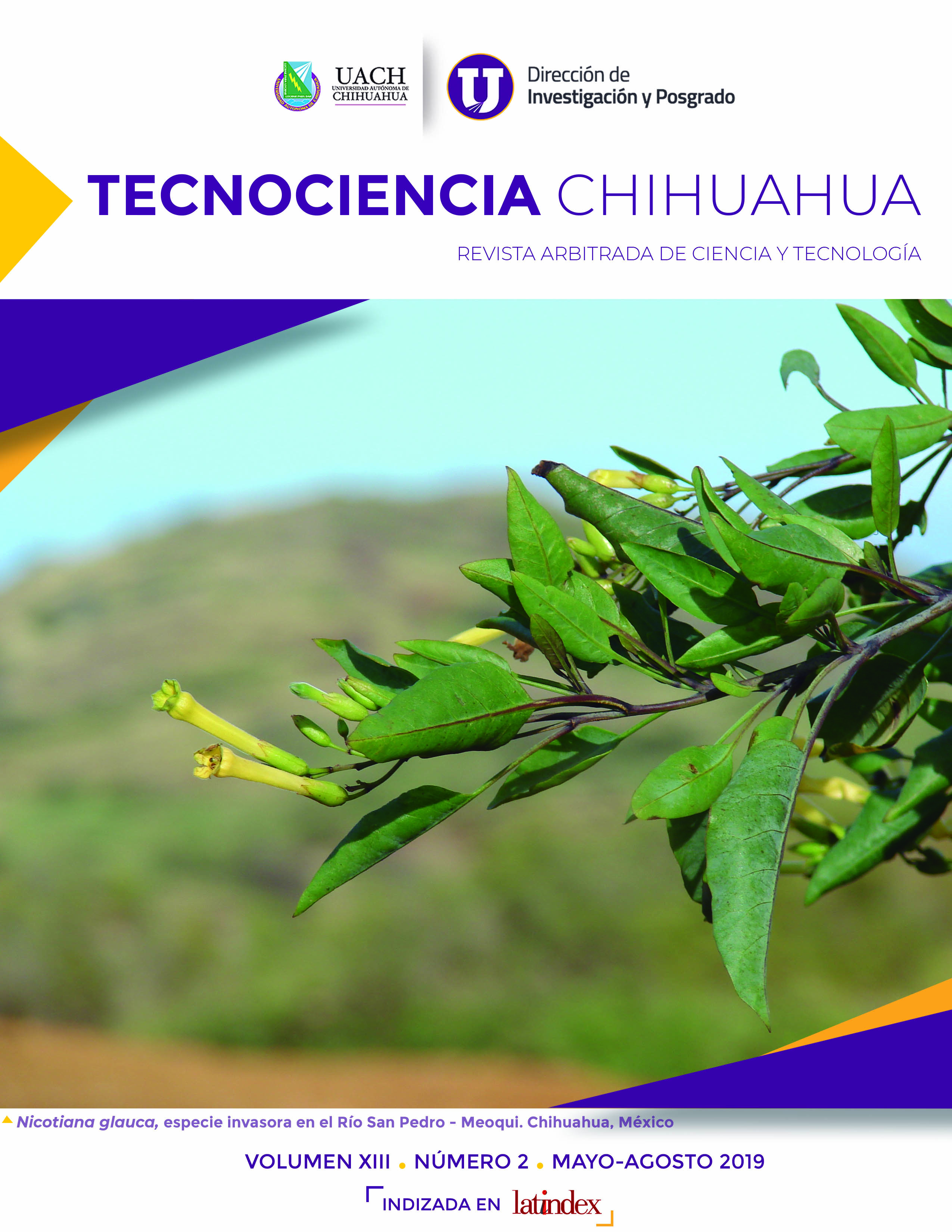
Listado florístico preliminar del humedal Río San Pedro-Meoqui a siete años de su designación Ramsar
Preliminary list of flora established in the Río San Pedro - Meoqui wetland after seven years of its Ramsar designation
DOI:
https://doi.org/10.54167/tch.v13i2.431Keywords:
Chihuahua, Ramsar wetland, San Pedro River, riparian vegetationAbstract
Wetlands in arid areas provide important ecological services for the environment, which include filtration of contaminants and providing habitat to wildlife. This study provides the first list of dominant aquatic, subaquatic, and arboreal species of the Río San Pedro-Meoqui wetland along five km or river wetland flowing by the urban centers of Delicias and Meoqui. Species were identified using well-known wetland plant identification guides, while samples were collected following the line intercept method. A total of twenty species are reported here, from which three are invasive. This list can be used as a reference in future studies about vegetation established in the wetland, as well as its treatment and ecological functions.
Downloads
References
Alarcón Herrera, M.T., L. Reynoso Cuevas. 2018. Humedales de tratamiento, en: Alarcón Herrera M.T., Zurita Martínez F., Lara Borrero J., Vidal G (Editores), Humedales de Tratamiento: Alternativa de saneamiento de aguas residuales aplicable en América Latina., Editorial Pontificia Universidad Javeriana, Colombia, 15-21. ISBN: 978-958-781-235-0. https://bit.ly/3dsDJL6
Carreón-Hernández, E. 2014. Conservación y manejo de los humedales (lénticos) pp: 520. En: (CONABIO). 2014. La biodiversidad en Chihuahua: Estudio de Estado. Comisión Nacional para el Conocimiento y Uso de la Biodiversidad. México. https://dev-chm.cbd.int/doc/nbsap/study/mx-study-chihuahua-es.pdf
CONABIO, Malezas de México. 2012. http://www.conabio.gob.mx/malezasdemexico/2inicio/home-malezas-mexico.htm
De la Maza Benignos, M. 2009. Los Peces del Río Conchos. Alianza WWF - FGRA y Gobierno del Estado de Chihuahua. ISBN 978- 607-00-1569-4 http://dx.doi.org/10.13140/2.1.2744.2242
González, D. U., H. Padilla, F. González, J. Uvalle, L. Reséndiz. 2012. Mejora la estimación de la cobertura vegetal por línea intercepto o línea de Canfield. Ciencia UANL 15 (59), 72-76. ISSN 1405-9177. http://eprints.uanl.mx/id/eprint/2897
Gutiérrez, R. L, H. O. Rubio-Arias, R. Quintana, J. A. Ortega, M. Gutierrez. 2008. Heavy metals in water of the San Pedro River in Chihuahua, Mexico and its potential health risk. International Journal of Environmental Research and Public Health 5(2):91-98. https://doi.org/10.3390/ijerph5020091
ITIS. 2017. Interagency Taxonomic Information System. Canadá, EEUU y México. https://www.itis.gov/servlet/SingleRpt/SingleRpt
Lot, A., M. Olvera, C. Flores, A. Díaz. 2015. Guía ilustrada de campo. Plantas indicadoras de humedales. Fondo sectorial de investigación y desarrollo sobre el agua, Conagua-Conacyt, Mexico. ISBN 978-607-02-0000-0. https://www.gob.mx/cms/uploads/attachment/file/102190/Gu_a_PIH-min.pdf
Mondaca-Fernández, F., I. Moreno-Contreras, M. Jurado-Ruiz, A. G. Navarro-Sigüenza. 2017. Species richness, phylogenetic distinctness and conservation priorities of the avifauna of the Río San Pedro-Meoqui Ramsar site, Chihuahua, Mexico. Biodiversity 18(4):156-167. http://dx.doi.org/10.1080/14888386.2017.1408032
Plaza de los Reyes, C. y G. Vidal. 2018. Tratamiento de aguas residuales, en: Humedales de Tratamiento: Alternativa de saneamiento de aguas residuales aplicable en América Latina. Capítulo 6 - tema 6.1. ISBN: 978-958-781-235-0. Editorial Pontificia Universidad Javeriana, Colombia, 200-205. https://bit.ly/3dsDJL6
Ramsar. 2014. The Ramsar convention on wetlands. https://bit.ly/3C23qvw
Valerio Villaseñor, A. y E. Carreón Hernández. 2014. Vegetación. Ecosistemas acuáticos. pp: 478-480. En: CONABIO, La Biodiversidad en Chihuahua: Estudio de Estado. https://dev-chm.cbd.int/doc/nbsap/study/mx-study-chihuahua-es.pdf