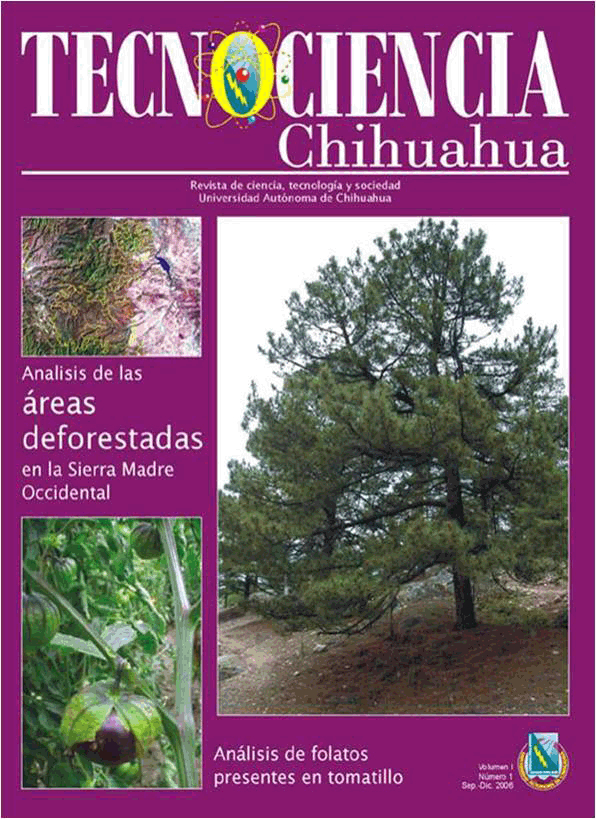
Quantification of folates in Physalis ixocarpa by high pressure liquid chromatography
DOI:
https://doi.org/10.54167/tecnociencia.v1i1.31Keywords:
green tomato, husk tomato, folates, HPLC, Physalis ixocarpaAbstract
An efficient quantification method by HPLC was implemented for folates analysis in Physalis ixocarpa (husk tomato). A trienzymatic treatment was used for the initial extraction of folates followed by glutamate deconjugation by a folate affinity column. The average amount of folates was 1.2 μM/100 grams of fresh weight. The major folate structures present in Physalis were identified as 5-methyl-tetrahydrofolate, tetrahydrofolate and 5-formyl-tetrahydrofolate. The importance of the methodology stresses the fact that the difficulty implied in the analysis was overcome. Since this vitamin is involved in several new born disorders such as neural tube defects and anencephaly, it is of great importance to provide such elements in the diet and Physalis ixocarpa represents an excellent source of folates. DOI: https://doi.org/10.54167/tecnociencia.v1i1.31Downloads
References
Berry, R.J., Li, Z., Erickson, J. D., Li, S., Moore, C.A., Wang, H., Mulinare, J., Zhao, P., Wong, L.Y. C., Gindler, J., Hong, S.X., Hao, L., Gunter, E., & Correa, A. (1999). Prevention of neural-tube defects with folic acid in China. N. Engl. J. Med., 341: 1485-1490. http://dx.doi.org/10.1056/NEJM199911113412001
Birktoft, J.J., & Bredman, K. (1994). Glutamyl endopeptidases. Methods in Enzymology, 244: 114-126. https://doi.org/10.1016/0076-6879(94)44010-7
Boushey, C.J., Beresford, S.A.A., Omenn, G.S., & Motulsky, A.G. (1995). A quantitative assessment of plasma homocysteine as a risk factor for vascular disease. Probable benefits of increasing folic acid intakes. JAMA, 274(13): 1049-1057. https://doi.org/10.1001/jama.1995.03530130055028
Černá, L., & Káš, J. (1983). New conception of folacin assay in starch or glycogen containing food samples. Nahrung, 27(10): 957-964. https://doi.org/10.1002/food.19830271013
Czeizel, A., & Dudás, I. (1992). Prevention of the first occurrence of neural tube defects by periconceptional vitamin supplementation. N. Engl. J. Med., 327(26): 1832- 1835. https://doi.org/10.1056/nejm199212243272602
Díaz, R., Quinlivan, E.P., Klaus, S. M.J., Basset, G. J.C., Gregory III, J.F., & Hanson, A.D. (2004). Folate biofortification in tomatoes by engineering the pteridine branch of folate synthesis. Proc. Nat. Ac. Sci., 101 (38): 13720-13725. https://doi.org/10.1073/pnas.0404208101
Fohr, I.P., Prinz-Langenohl, R., Brönstrup, A., Bohlmann, A. M., Nau, H., Berthold, H. K., & Pietrzik, K. (2002). 5,10-Methylenetetrahydrofolate reductase genotype determines the plasma homocysteine-lowering effect of supplementation with 5-methyltetrahydrofolate or folic acid in healthy young woman. Am. J. Clin. Nut., 75(2): 275-282. https://doi.org/10.1093/ajcn/75.2.275
Giovannucci, E., Rimm, E.B., Ascherio, A., Stampfer, M.J., Colditz, G.A., & Willett, W.C. (1995). Alcohol, low-methionine-lowfolate diets, and risk of colon cancer in men. J. Nat. Cancer Inst., 87(4): 265-273. https://doi.org/10.1093/jnci/87.4.265
Gregory III, J.F., Engelhardt, R., Bhandari, S.D., Sartain, D.B., & Gustafson, S.K. (1990). Adequacy of extraction techniques for determination of folate in foods and other biological materials. J. Food Comp. An., 3(2): 134-144. https://doi.org/10.1016/0889-1575(90)90020-M
Gregory III, J.F., Sartain, D.B., & Day, B.P.F. (1984). Fluorometric determination of folacin in biological materials using higher performance chromatography. J. Nutrition, 114(2): 341–353. https://doi.org/10.1093/jn/114.2.341
Gregory III, J.F., & Toth, J.P. (1988). Chemical synthesis of deuterated folate monoglutamate and in vivo assessment of urinary excretion of deuterated folates in man. Anal. Biochem., 170(1): 94-104. https://doi.org/10.1016/0003-2697(88)90094-2
Jastrebova, J., Witthöft, C., Grahn, A., Svensson, U., & Jägerstad, M. (2003). HPLC determination of folates in raw and processed beetroots. Food Chem., 80 (4): 579-588. https://doi.org/10.1016/S0308-8146(02)00506-X
Lucock, M.D., Green, M., Priestnall, M., Daskalakis, I., Levene, M.I., & Hartley, R. (1995). Optimization of chromatographic conditions for the determination of folates in foods and biological tissues for nutritional and clinical work. Food Chem., 53(3): 329-338. https://doi.org/10.1016/0308-8146(95)93941-J
Martin, J.I., Landen, W.O., Soliman, A.G., & Eitenmiller, R.R. (1990). Application of a tri-enzyme extraction for total folate determination in foods. J. Ass. Off. Anal. Chem., 73(5): 805-808. https://pubmed.ncbi.nlm.nih.gov/2125600/
Mason, J. (1995). Folate status: effects on carcinogenesis. In: Bailey, L.B., (ed.). Folate in Health and Disease. pp. 329-361. New York: Marcel Dekker, Inc.
Nehmatallah, N.J. (2003). Capillary electrophoresis and high performance liquid choromatography determination of polyglutamyl folates in citrus products (Tesis, University of Florida). https://ufdcimages.uflib.ufl.edu/UF/E0/00/10/91/00001/UFE0001091.pdf
Peña, L.A. (2001). Situación actual y perspectivas de la producción y mejoramiento genético de tomate de cáscara (Physalis ixocarpa Brot.) en México. En: Memoria del XXIV Congreso Nacional de Fitogenética. 4-9 de octubre. UAAN. ISBN 9786078029068
Rader, J.I., Weaver, C.M., & Angyal, G. (1998). Use of a micro-biological assay with trienzyme extraction for measurement of prefortification levels of folates in enriched cereal-grain products. Food Chem., 62(4): 451-465. https://doi.org/10.1016/S0308-8146(98)00089-2
Ravanel, S., Cherest, H., Jabrin, S., Grunwald, D., Surdin-Kerjan, Y., Douce, R., & Rébeillé, F. (2001). Tetrahydrofolate biosynthesis in plants: Molecular and functional characterization of dihydrofolate synthetase and three isoforms of folylpolyglutamate synthetase in Arabidopsis thaliana. Proc. Nat. Ac. Sci., 98(26): 15360-15365. https://doi.org/10.1073/pnas.261585098
Robinson, D.R. (1971). The nonenzymatic hydrolysis of N5 N10-methenyltetrahydrofolic acid and related reactions. Methods Enzymol, 18(Part B): 716-725. https://doi.org/10.1016/S0076-6879(71)18141-4
Sauberlich, H.E. (1995). Folate status of U. S. population groups. In: Bailey LB, (ed.). Folate in Health and Disease. pp 171-194. New York: Marcel Dekker, Inc.
Scholl, T.O., & Johnson, W.G. (2000). Folic Acid: influence on the outcome of pregnancy. Am. J. Clin. Nut., 71(5): 1295-1303. https://doi.org/10.1093/ajcn/71.5.1295s
Selhub, J., Ahmad, O., & Rosenberg, I.H. (1980). Preparation and use of affinity columns with bovine milk folate-binding protein covalently linked to Sepharose 4B. Methods Enzymol. 66: 686-690. https://doi.org/10.1016/0076-6879(80)66528-8
Tamura, T., Mizuno, Y., Johnson, K.E., & Jacob, R.A. (1997). Food folate assay with protease a-amylase and folate conjugase treatments. J. Agr. Food Chem., 45(1): 135-139. https://doi.org/10.1021/jf960497p
Tamura, T. (1998). Determination of food folate. Nutr. Biochem., 9(5): 285-293. https://doi.org/10.1016/S0955-2863(98)00013-8
Van Oort, F.V.A., Melse-Boonstra, A., Brower, I. A., Clarke, R., West, C. E., Katan, M. B., & Verhoef, P. (2003). Folic acid and reduction of plasma homocysteine concentration in older adults, a dose response study. Am. J. Clin. Nut., 77 (5): 1318-1323. https://doi.org/10.1093/ajcn/77.5.1318
Vahteristo, L.T., Ollilainen, V., Koivistoinen, P.E., & Varo, P. (1996). Improvements in the analysis of reduced folate monoglutamates and folic acid in food by high-perfor- mance liquid chromatography. J. Agr. Food Chem., 44(2): 477–482. https://doi.org/10.1021/jf9503467
Wagner, C. (1995). Biochemical role of folate in cellular metabolism. In: Bailey, L.B., (ed)., Folate in Health and Disease. pp. 23-42. New York: Marcel Dekker, Inc.
Downloads
Published
Issue
Section
License
Copyright (c) 2007 TECNOCIENCIA Chihuahua

This work is licensed under a Creative Commons Attribution-NonCommercial 4.0 International License.