Evaluation of the antitopoisomerase activity of aqueous seed extracts of sweet Pithecellobium obtained by ultrasound-assisted extraction
DOI:
https://doi.org/10.54167/tch.v19iEspecial.2087Keywords:
Pithecellobium, waste management, ultrasound, antioxidant, antitopoisomeraseAbstract
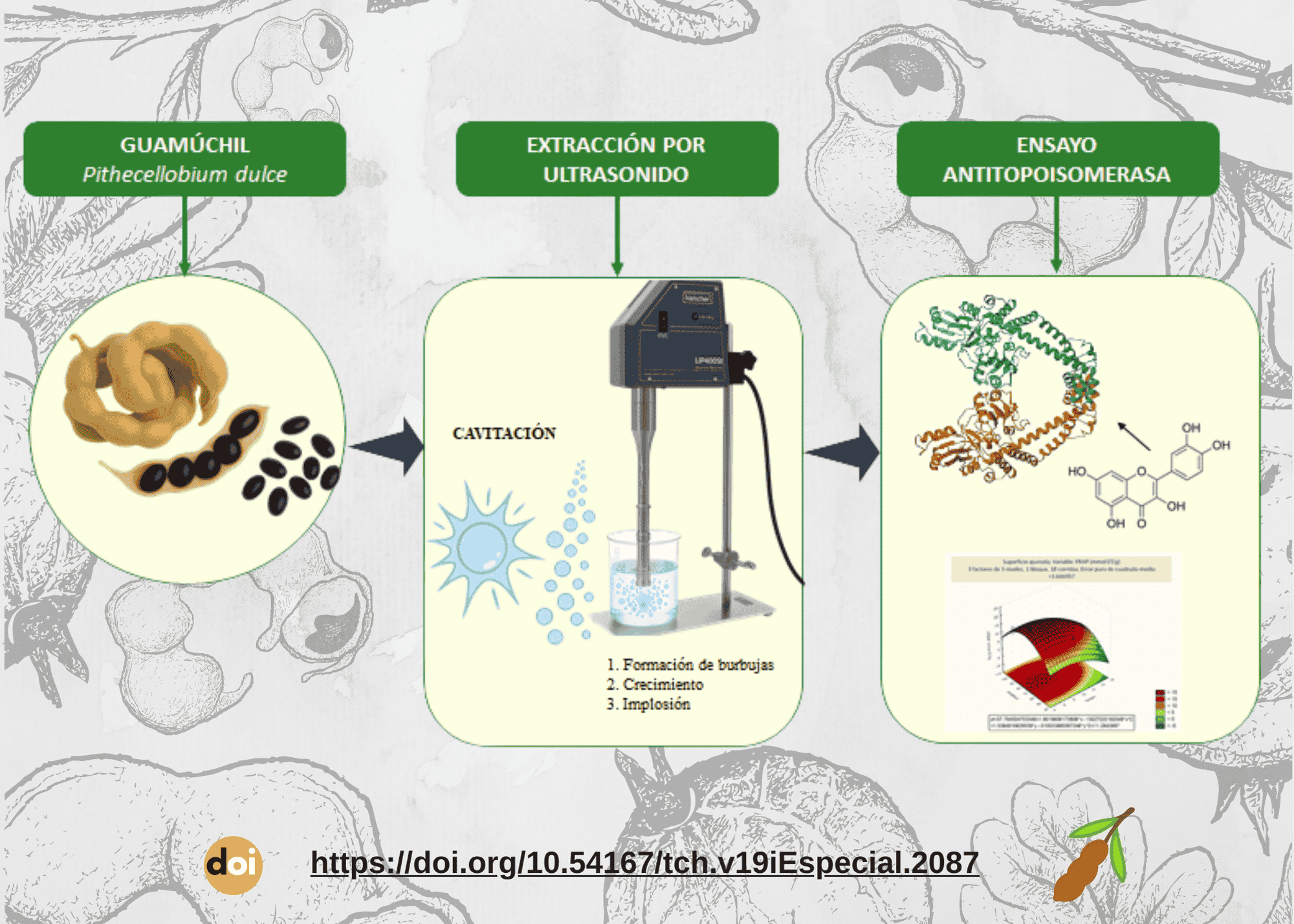
This study optimized ultrasound-assisted extraction (UAE) from Pithecellobium dulce seeds by evaluating the effect of sonication time (5–15 min), amplitude (50–100 %), and pulse cycle (0.25–1 s) using a 3³⁻¹ fractional factorial design coupled with response surface analysis. Response variables included total soluble phenolics (TSP) and antioxidant capacity (ABTS, DPPH, and FRAP). Optimal conditions (10 min, 100 % amplitude, 0.625 s cycle) yielded an extract with high phenolic content and the greatest antioxidant activity. The optimized extract was further tested in a genetically modified Saccharomyces cerevisiae model to assess antitopoisomerase activity. Results showed an overall inhibition of 51 % and a specific effect of 21 % against type II topoisomerase, without cytotoxicity in strains with intact DNA repair mechanisms. These findings provide the first evidence of antitopoisomerase activity in P. dulce seeds and suggest that this underutilized byproduct represents a promising source of bioactive compounds. Its potential applications in nutraceutical and pharmaceutical industries, combined with its role in agro-industrial waste valorization through sustainable processes, highlight the relevance of UAE as an efficient tool for obtaining functional extracts.
DOI: https://doi.org/10.54167/tch.v19iEspecial.2087
Downloads
References
Aldarhami, A., Bazaid, A. S., Alhamed, A. S., Alghaith, A. F., Ahamad, S. R., Alassmrry, Y. A., ... & Alreshidi, M. (2023). Antimicrobial potential of Pithecellobium dulce seed extract against pathogenic bacteria: in silico and in vitro evaluation. BioMed Research International, 2023(1), 2848198. https://doi.org/10.1155/2023/2848198
Alvarez-Parrilla, E., De La Rosa, L. A., Amarowicz, R., & Shahidi, F. (2011). Antioxidant activity of fresh and processed Jalapeño and Serrano peppers. Journal of Agricultural and Food Chemistry, 59(1), 163–173. https://doi.org/10.1021/jf103434u
AOAC. (2005). Official Methods of Analysis of AOAC International (18th ed., Rev. 2005). Association of Official Analytical Chemists International, Gaithersburg, MD, USA
Barba, F. J., Zhu, Z., Koubaa, M., Sant’Ana, A. S., & Orlien, V. (2016). Green alternative methods for the extraction of antioxidant bioactive compounds from winery wastes and by-products: A review. Trends in Food Science & Technology, 49, 96–109. https://doi.org/10.1016/J.TIFS.2016.01.006
Borthwick, K. A. J., Coakley, W. T., McDonnell, M. B., Nowotny, H., Benes, E., & Gröschl, M. (2005). Development of a novel compact sonicator for cell disruption. Journal of Microbiological Methods, 60(2), 207–216. https://doi.org/10.1016/J.MIMET.2004.09.012
Chemat, F., Rombaut, N., Sicaire, A. G., Meullemiestre, A., Fabiano-Tixier, A. S., & Abert-Vian, M. (2017). Ultrasound assisted extraction of food and natural products. Mechanisms, techniques, combinations, protocols and applications. A review. Ultrasonics Sonochemistry, 34, 540–560. https://doi.org/10.1016/j.ultsonch.2016.06.035
Contreras-López, E., Castañeda-Ovando, A., Jaimez-Ordaz, J., Cruz‐Cansino, N. S., González-Olivares, L. G., Rodríguez-Martínez, J. S., & Ramírez-Godínez, J. (2020). Release of Antioxidant Compounds of Zingiber officinale by Ultrasound-Assisted Aqueous Extraction and Evaluation of Their In Vitro Bioaccessibility. Applied Sciences 10(14), 4987. https://doi.org/10.3390/app10144987
Da Porto, C., Natolino, A., & Decorti, D. (2015). The combined extraction of polyphenols from grape marc: Ultrasound assisted extraction followed by supercritical CO2 extraction of ultrasound-raffinate. LWT - Food Science and Technology, 61(1), 98–104. https://doi.org/10.1016/J.LWT.2014.11.027
Dhanisha, S. S., Drishya, S., & Guruvayoorappan, C. (2021). Traditional knowledge to clinical trials: A review on nutritional and therapeutic potential of Pithecellobium dulce. Journal of Basic and Clinical Physiology and Pharmacology 33(2), 133–142. https://doi.org/10.1515/jbcpp-2020-0166
Dubois, M., Gilles, K. A., Hamilton, J. K., Rebers, P. A., & Smith, F. (1956). Colorimetric Method for Determination of Sugars and Related Substances. Analytical Chemistry 28(3), 350-356. https://doi.org/10.1021/ac60111a017
Gupta, M.P., Olmedo Agudo, D.A., Marrone Paredes, N.S., Espinosa Rivas, A.F., & Guerra Torres, C.P. (2016). Evaluación de la actividad antiproliferativa de extractos metanólicos de plantas de la familia leguminosae. Revista Cubana de Plantas Medicinales 21(3). https://revplantasmedicinales.sld.cu/index.php/pla/article/view/355
Hameed, A., Srivastav, Y., Afaq, H., Hashmi, A., & Ahmad, Mohd. I. (2024). Outline of the Pharmacological and Phytochemical Profile of the Jungle Jalebi (Pithecellobium dulce). Asian Plant Research Journal, 12(2), 22–27. https://doi.org/10.9734/aprj/2024/v12i2245
Hernández-Montesinos, I. Y., Carreón-Delgado, D. F., Lazo-Zamalloa, O., Tapia-López, L., Rosas-Morales, M., Ochoa-Velasco, C. E., Hernández-Carranza, P., Cruz-Narváez, Y., & Ramírez-López, C. (2024). Exploring Agro-Industrial By-Products: Phenolic Content, Antioxidant Capacity, and Phytochemical Profiling via FI-ESI-FTICR-MS Untargeted Analysis. Antioxidants, 13(8), 925. https://doi.org/10.3390/antiox13080925
Hevener, K. E., Verstak, T. A., Lutat, K. E., Riggsbee, D. L., & Mooney, J. W. (2018). Recent developments in topoisomerase-targeted cancer chemotherapy. Acta Pharmaceutica Sinica B, 8(6), 844–861. https://doi.org/10.1016/J.APSB.2018.07.008
Jensen, L.H., Nitiss, K.C., Rose, A., Dong, J., Zhou, J., Hu, T., Osheroff, N., Jensen, P.B., Sehested, M., & Nitiss, J.L. (2000). A Novel Mechanism of Cell Killing by Anti-topoisomerase II Bisdioxopiperazines*. The Journal of Biological Chemistry, 275(3), 2137 - 2146. https://doi.org/10.1074/jbc.275.3.2137
Kavita, K., Sarla, L., & Ojha, K. (2023). Physico-Functional Properties of Jungle Jalebi (Pithecellobium dulce) Fruit Powder. Biological Forum-An International Journal, 15(5), 897-905. https://www.researchgate.net/publication/372956985_Physico-Functional_Properties_of_Jungle_Jalebi_Pithecellobium_dulce_Fruit_Powder
Khan, S. I., Nimrod, A. C., Mehrpooya, M., Nitiss, J. L., Walker, L. A., & Clark, A. M. (2002). Antifungal activity of eupolauridine and its action on DNA topoisomerases. Antimicrobial Agents and Chemotherapy, 46(6), 1785–1792. https://doi.org/10.1128/AAC.46.6.1785-1792.2002
Kidak, R., & Ince, N. H. (2006). Ultrasonic destruction of phenol and substituted phenols: A review of current research. Ultrasonics Sonochemistry, 13(3), 195–199. https://doi.org/10.1016/J.ULTSONCH.2005.11.004
Kulkarni, K. V., & Jamakhandi, V. R. (2018). Medicinal uses of Pithecellobium dulce and its health benefits. J Pharmacogn phytochem, 7(2), 700-704. https://www.phytojournal.com/archives/2018.v7.i2.3358/medicinal-uses-of-pithecellobium-dulce-and-its-health-benefits
Kumar, R., Usmani, S., Singh, B., Prakash, O., Verma, P., Wahab, S., & Khatoon, S. (2022). A comprehensive review on phytopharmacological perspectives of Pithecellobium dulce (Roxb.) Benth. Annals of Phytomedicine: An International Journal, 11(1), 115-120. https://doi.org/10.54085/ap.2022.11.1.11
Martínez-Olivo, A. O., Carlos-Murillo, M. U., Sáyago-Ayerdi, S. G., Sánchez-Burgos, J. A., & Zamora-Gasga, V. M. (2023). Optimization of ultrasonic extraction for enhanced polyphenol profile and antioxidant capacity in mango seeds: a comparative study with thermal extraction. Food Chemistry Advances, 3, 100480. https://doi.org/10.1016/j.focha.2023.100480
Momin, R. A., & Nair, M. G. (2002). Antioxidant, cyclooxygenase and topoisomerase inhibitory compounds from Apium graveolens Linn. seeds. Phytomedicine, 9(4), 312–318. https://doi.org/10.1078/0944-7113-00131
Monroy, R., & Colín, H. (2004). El guamúchil Pithecellobium dulce (Roxb.) Benth, un ejemplo de uso múltiple. Madera y bosques, 10(1), 35-53. https://doi.org/10.21829/myb.2004.1011278
Muñoz, L. A., Cobos, A., Diaz, O., & Aguilera, J. M. (2013). Chia Seed (Salvia hispanica): An Ancient Grain and a New Functional Food. Food Reviews International, 29(4), 394–408. https://doi.org/10.1080/87559129.2013.818014
Nagmoti, D. M., Kothavade, P. S., Bulani, V. D., Gawali, N. B., & Juvekar, A. R. (2015). Antidiabetic and antihyperlipidemic activity of Pithecellobium dulce (Roxb.) Benth seeds extract in streptozotocin-induced diabetic rats. European Journal of Integrative Medicine, 7(3), 263–273. https://doi.org/10.1016/J.EUJIM.2015.01.001
Okeke, U. J., Micucci, M., Mihaylova, D., & Cappiello, A. (2025). The effects of experimental conditions on extraction of polyphenols from African Nutmeg peels using NADESs-UAE: a multifactorial modelling technique. Scientific Reports, 15, 4890. https://doi.org/10.1038/s41598-025-88233-8
Özdemir, M., Ak, İ., Coşkun, S., & Ünverdi, N. (2025). Ultrasound-assisted extraction of bioactive compounds from plants. Gıda ve Yem Bilimi Teknolojisi Dergisi, 35, 1713475. https://doi.org/10.56833/gidaveyem.1713475
Pereira, T. C., Souza, V. P., Padilha, A. P. F., Duarte, F. A., & Flores, E. M. M. (2025). Trends and perspectives on the ultrasound-assisted extraction of bioactive compounds using natural deep eutectic solvents. Current Opinion in Chemical Engineering, 47, 101088. https://doi.org/10.1016/J.COCHE.2024.101088
Prior, R. L., Wu, X., & Schaich, K. (2005). Standardized methods for the determination of antioxidant capacity and phenolics in foods and dietary supplements. Journal of Agricultural and Food Chemistry, 53(10), 4290–4302. https://doi.org/10.1021/jf0502698
Re, R., Pellegrini, N., Proteggente, A., Pannala, A., Yang, M., & Rice-Evans, C. (1999). Antioxidant activity applying an improved ABTS radical cation decolorization assay. Free Radical Biology and Medicine, 26(9–10), 1231–1237. https://doi.org/10.1016/S0891-5849(98)00315-3
Redon, C., Pilch, D. R., Rogakou, E. P., Orr, A. H., Lowndes, N. F., & Bonner, W. M. (2003). Yeast histone 2A serine 129 is essential for the efficient repair of checkpoint-blind DNA damage. EMBO Reports, 4, 678–684. https://doi.org/10.1038/sj.embor.embor871
Saura-Calixto, F., Garcia-Alonso, A., Goñi, I., & Bravo, L. (2000). In vitro determination of the indigestible fraction in foods: An alternative to dietary fiber analysis. Journal of Agricultural and Food Chemistry, 48(8), 3342–3347. https://doi.org/10.1021/jf0000373
Silva-Cristobal, L., Osorio-Díaz, P., Tovar, J., & Bello-Pérez, L. A. (2010). Chemical composition, carbohydrate digestibility, and antioxidant capacity of cooked black bean, chickpea, and lentil Mexican varieties Composición química, digestibilidad de carbohidratos, y capacidad antioxidante de variedades mexicanas cocidas de frijol negro, garbanzo, y lenteja. CyTA–Journal of Food, 8(1), 7-14. https://doi.org/10.1080/19476330903119218
Sneha, D., Prashanth, S., Kaveti, V. S., & Boggula, N. (2020). Systematic review of Pithecellobium dulce (Roxb.) benth.: A traditional medicinal herb. Journal For Innovative Development in Pharmaceutical and Technical Science (JIDPTS), 3(05), 1-9. https://jidps.com/paper_issue/systematic-review-of-pithecellobium-dulce-roxb-benth-a-traditional-medicinal-herb/
Szabo, K., Mitrea, L., Călinoiu, L. F., Teleky, B. E., Martău, G. A., Plamada, D., Pascuta, M. S., Nemeş, S. A., Varvara, R. A., & Vodnar, D. C. (2022). Natural Polyphenol Recovery from Apple-, Cereal, and Tomato-Processing By-Products and Related Health-Promoting Properties. Molecules, 27(22), 7977. https://doi.org/10.3390/molecules27227977
Teixeira, B. A. (2023). Ultrasound-assisted extraction of bioactive compounds from plant sources: optimization, kinetic, and modeling study. Tesis. (Doutorado em Ciência e Tecnologia de Alimentos) - Universidade Federal de Viçosa, Viçosa. https://doi.org/10.47328/ufvbbt.2023.508
Zeng, G., Wang, Y., Zhu, M., Yi, J., Ma, J., Yang, B., Sun, W., Dai, F., Yin, J., & Zeng, G. (2024). Inhibition of DNA Topoisomerase Ι by Flavonoids and Polyacetylenes Isolated from Bidens pilosa L. Molecules, 29(15), 3547. https://doi.org/10.3390/molecules29153547
Zhong, X., Zhang, S., Wang, H., Yang, J., Li, L., Zhu, J., & Liu, Y. (2022). Ultrasound-alkaline combined extraction improves the release of bound polyphenols from pitahaya (Hylocereus undatus 'Foo-Lon') peel: Composition, antioxidant activities and enzyme inhibitory activity. Ultrasonics Sonochemistry, 90, 106213. https://doi.org/10.1016/j.ultsonch.2022.106213
Zhou, Y., Yang, K., Cui, J., Ye, J. Y., & Deng, C. X. (2012). Controlled permeation of cell membrane by single bubble acoustic cavitation. Journal of Controlled Release, 157(1), 103–111. https://doi.org/10.1016/J.JCONREL.2011.09.068
Downloads
Published
Issue
Section
License
Copyright (c) 2025 TECNOCIENCIA Chihuahua

This work is licensed under a Creative Commons Attribution-NonCommercial 4.0 International License.