Chemical composition of sawdust mixtures, and wood and bark from four Pinus spp. species from Durango, Mexico
DOI:
https://doi.org/10.54167/tch.v19i2.1912Keywords:
sawdust, ash, bark, extractives, holocellulose, ligninAbstract
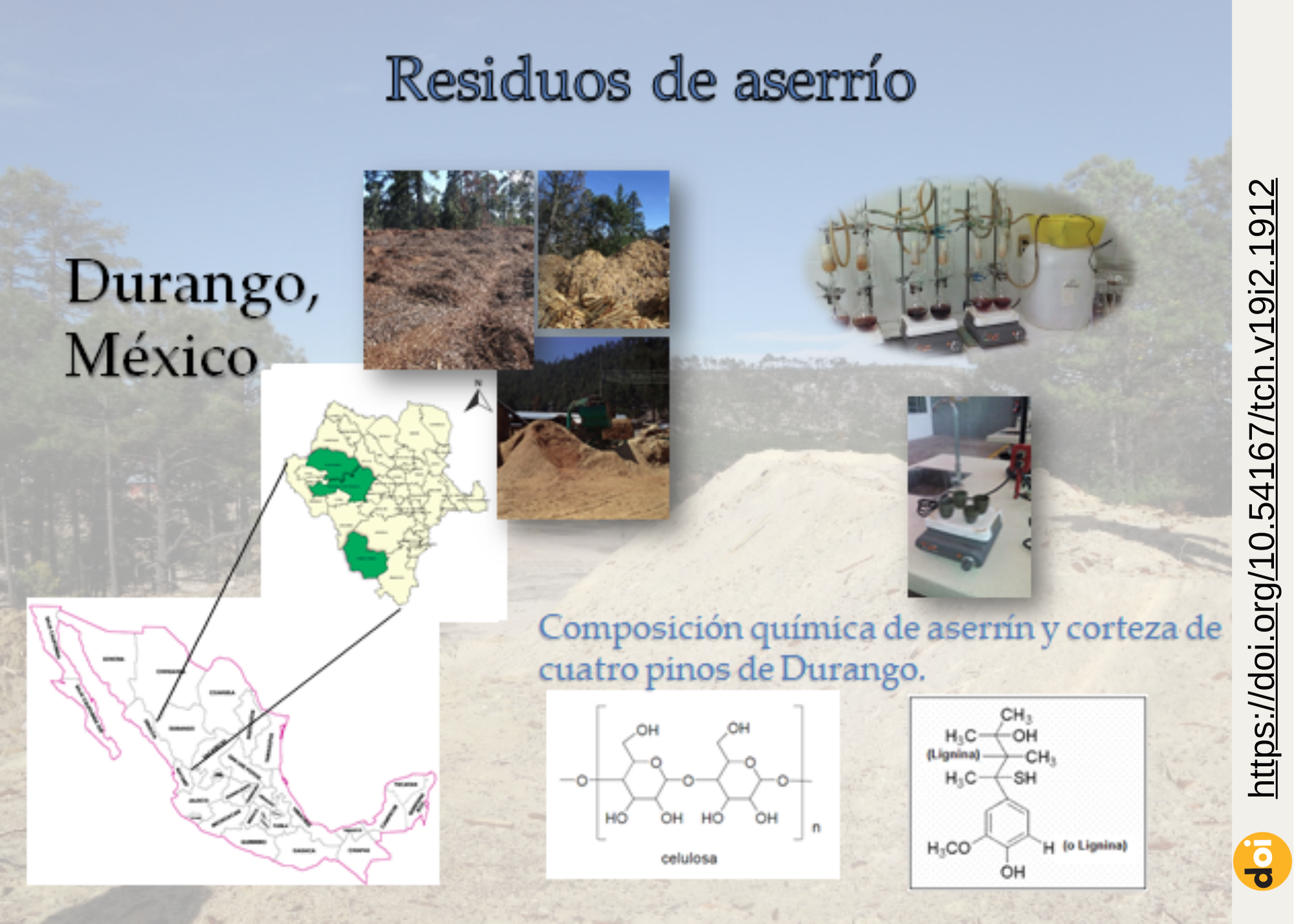
The purpose of this work was to determine the basic chemical composition of wood sawdust mixtures coming from the sawmills of three municipalities in the state of Durango (Pueblo Nuevo, Santiago Papasquiaro and Tepehuanes), as well as wood and bark of four pine species with important economic value in forestry (Pinus arizonica, P. cooperi, P. durangensis and P. engelmannii) in order to assess its potential for the production of densified biofuels. The pH, ash content, extractable substances, lignin and holocellulose contents were determined through the study and analysis of the mentioned materials. A microanalysis was performed on the ashes. In the sawdust samples from the three municipalities, significant statistical differences were found in the content of lignin being higher in Pueblo Nuevo (35.53 %) and lower in Tepehuanes (27.57 %), meanwhile the content of holocellulose was similar across the three municipalities. In the ash samples, nine chemical elements were identified and those with the highest concentration were Calcium (40.61 %), Potassium (25.94 %), and Magnesium (19.30 %); only samples from Santiago Papasquiaro had a high content of Silicon (22.33 %). In the wood and bark of the four pine species, significant statistical differences were found only in pH and the total content of extractable substances, with a value of 5.34 % and 14.64 %, respectively, both from P. arizonica; in the ashes the highest value (35 %) was presented by P. durangensis. Nine chemical elements were identified in wood ashes, the most representatives being Calcium (42.91 %) and Potassium (21.89 %) found on P. arizonica; and eleven chemical elements in bark ashes, the highest being Silicon (43.17 %) on P. arizonica and Calcium (42.90 %) on P. cooperi. Heavy metals were not detected. Results of the chemical analysis indicate that the samples studied have potential as raw materials for densified biofuels.
DOI: https://doi.org/10.54167/tch.v19i2.1912
Downloads
References
Albin, A., R. (1975). Determinación del pH en diversas especies de los renovales de la provincia de Valdivia. Bosque, 1(1), 3-5. https://doi.org/10.4206/bosque.1975.v1n1-02
Alonso–Esteban, J. I., Carocho, M., Barros, D., Vaz Velho, M., Heleno, S., & Barros, L. (2022). Chemical composition and industrial applications of Maritime pine (Pinus pinaster Ait.) bark and other non-wood parts. Reviews in Environmental Science and Bio/Technology, 21, 583-633. https://doi.org/10.1007/s11157-022-09624-1
Apolinar, H., F., Honorato-Salazar, J.A., & Colotl, H., G. (2024). Lignocellulosic characterization of Pinus patula wood from Oaxaca, Mexico. Brazilian Journal of Animal and Environmental Research, 7(4): e73759. https://doi.org/10.34188/bjaerv7n4-004
Ávila-Calderón, L. E., & Rutiaga-Quiñones, J. G. (2015). Wood chemical components of three species from a medium deciduous forest. Wood Research, 60(3), 463-469. http://www.woodresearch.sk/wr/201503/12.pdf
Barros, D., Fernandes, E., Jesus, M., Barros, L., Alonso-Esteban, J. I., Pires, P., & Vaz Velho, M. (2023). The chemical characterisation of the maritime pine bark cultivated in Northern Portugal. Plants, 12(23): 3940. https://doi.org/10.3390/plants12233940
Bernabé-Santiago, R., Ávila-Calderón, L. E., & Rutiaga-Quiñones, J. G. (2013). Componentes químicos de la madera de cinco especies de pino del municipio de Morelia, Michoacán. Madera y Bosques, 19(2): 21-35. https://doi.org/10.21829/myb.2013.192338
Chávez-Rosales, J. S., Pintor-Ibarra, L. F., González-Ortega, N., Orihuela-Equihua, R., Ruiz-Aquino, F., Luján-Álvarez, C., & Rutiaga-Quiñones, J. G. (2021). Basic chemical composition of Pinus spp. sawdust from five regions of Mexico, for bioenergetic purposes. BioResources, 16(1): 816-824. https://doi.org/10.15376/biores.16.1.816-824
Chávez-Sifontes, M., & Domine, M. E. (2013). Lignina, estructura y aplicaciones: métodos de despolimerización para la obtención de derivados aromáticos de interés industrial. Avances en Ciencias e Ingeniería, 4(4), 15-46. https://www.executivebs.org/publishing.cl/avances-en-ciencias-e-ingenieria-vol-4-nro-4-ano-2013-articulo-3/
Choon, K. K., & Roffael, E. (1990). The acidity of five hardwood species. Holzforschung, 44(1): 53–58. https://doi.org/10.1515/hfsg.1990.44.1.53
Correa-Méndez, F., Carrillo-Parra, A., Rutiaga-Quiñones, J. G., González-Rodríguez, H., Jurado-Ybarra, E., & Garza-Ocañas, F. (2013). Humedad, ceniza e inorgánicos en corteza industrial de tres pinos para bioenergía. Revista Forestal Baracoa, 32(2): 77-83.
Correa-Méndez, F., Carrillo-Parra, A., Rutiaga-Quiñones, J. G., Márquez-Montesino, F., González-Rodríguez, H., Jurado-Ybarra, E., & Garza-Ocañas, F. (2014). Contenido de humedad y sustancias inorgánicas en subproductos maderables de pino para su uso en pélets y briquetas. Revista Chapingo Serie Ciencias Forestales y del Ambiente, 20(1), 77-88. https://doi.org/10.5154/r.rchscfa.2013.04.012
Cortés-Ortiz, W. G. (2011). Materiales lignocelulósicos como fuente de biocombustibles y productos químicos. Revista de Ciencia y Tecnología Aeronáutica, 16: 41-46. https://es.scribd.com/document/408543377/Materiales-Lignocelulosicos
Esteves-Magalhaes, W. L., Bolzon de Muniz, G. I., Lomelí-Ramírez, M. G., & Cesar-Batista, D. (2010). Estudio de la productividad de corte en madera de Pinus elliottii utilizando un prototipo de aserradero portátil. Maderas, Ciencia y Tecnología, 12(1): 43-52. http://revistas.ubiobio.cl/index.php/MCT/article/view/1380
Fragoso-Madueño, J. N., Goche-Télles, J. R., Rutiaga-Quiñones, J. G., González-Laredo, R. F., Bocanegra-Salazar, M., & Chávez-Simental, J. A. (2017). Usos alternativos de los desechos de la industria del aserrío. Revista Chapingo Serie Ciencias Forestales y del Ambiente, 23(2): 243-260. http://dx.doi.org/10.5154/r.rchscfa.2016.06.040
Fengel, D., & Wegener, G. (Eds.) (1984). Wood chemistry, ultrastructure, reactions. Germany: Walter de Gruyter & Co., Berlín. 626 pp.
Fuentes-López, M. E., Suárez-Patlán, E. E., Carrillo-Ávila, N., & Flores-Velázquez, R. (2018). Coeficiente de aprovechamiento en un aserradero ejidal del estado de Puebla. Revista de Investigación y Desarrollo, 4(14), 32-38. https://www.researchgate.net/publication/390463937_Coeficiente_de_aprovechamiento_en_un_aserradero_ejidal_del_estado_de_Puebla
García Delgado, J. M., Izquierdo Chala, O., Henry Torriente, P. P., & Domínguez Goizueta, A. (2009). Algunos aspectos relacionados con la calidad de la madera aserrada de Pinus caribaea Morelet var. caribaea. Revista Ra Ximhai, 5(3): 259–270. https://doi.org/10.35197/rx.05.03.2009.01.jg
Gonçalves, F. G., Chaves, I. L. S., Fassarella, M. V., Brito, A. S., Silva, E. S. G. da, López, Y. M., & Oliveira, R. E. G. de. (2021). Extracción de taninos de la corteza de Pinus spp tratada térmicamente – aplicación como adhesivo. Madera y Bosques: 27(1), e2712041. https://doi.org/10.21829/myb.2021.2712041
González-Elizondo, M. S., González-Elizondo, M., Tena-Flores, J. A., Ruacho-González, L., & López-Enríquez, L. (2012). Vegetación de la Sierra Madre Occidental, México: Una síntesis. Acta Botánica Mexicana, (100): 351-403. https://doi.org/10.21829/abm100.2012.40
Guerra-Medina, C. E., Cobos-Peralta, M. A., Montañez-Valdez, O. D., & Pérez-Sato, M. (2010). Uso de aserrín de pino (Pinus patula) como fuente de fibra en dietas para borregos en cebo. Tropical and Subtropical Agroecosystems, 12(3): 667-673. https://www.revista.ccba.uady.mx/ojs/index.php/TSA/article/view/426
Gutiérrez-Acosta, J. M., Orihuela-Equihua, R., Pintor-Ibarra, L. F., González-Ortega, N., Hernández-Solís, J. J., Ruíz-Aquino, F., Navarrete-García, M. A., & Rutiaga-Quiñones, J. G. (2021). On the basic chemical composition of selected biomass types from four regiones of Mexico, for bioenergetic purposes. BioResources, 16(3): 5694-5705. https://doi.org/10.15376/biores.16.3.5694-5705
Honorato-Salazar, J. A., Apolinar-Hidalgo, F., & Colotl-Hernández, G. (2016). Composición lignocelulósica de Pinus ayacahuite Ehrenb. ex Schltdl., P. leiophylla Schlecht. & Cham. y P. herrerae Martínez. Revista Mexicana de Ciencias Forestales, 7(34): 47-56. https://doi.org/10.29298/rmcf.v7i34.82
Honorato-Salazar, J. A., & Hernández-Pérez, J. (1998). Determinación de componentes químicos de la madera de cinco especies de encino del estado de Puebla. Madera y Bosques, 4(2): 79-93. https://doi.org/10.21829/myb.1998.421361
Hon, D. N.-S., & Shiraishi, N. (Eds) (2001). Wood and Cellulose Chemistry, Marcel Dekker, New York, USA. 928 pp. https://doi.org/10.1016/S0141-3910(01)00147-1
ISO 17225-2 2014. Solid biofuels – Fuel specifications and classes, International Organization for Standardization, Geneva, Switzerland.
Kollmann, F. (1959). Tecnología de la madera y sus aplicaciones. Madrid, España: Instituto Forestal de Investigaciones y Experiencias y Servicio de la Madera.
López-Miranda, J., Soto-Cruz, N. O., Rutiaga-Quiñones, O. M., Medrano-Roldán, H., & Arévalo-Niño, K. (2009). Optimización del proceso de obtención enzimática de azúcares fermentables a partir de aserrín de pino. Revista Internacional de Contaminación Ambiental, 25(2): 95-102. https://www.revistascca.unam.mx/rica/index.php/rica/article/view/21586
Mejía-Díaz, L. A., & Rutiaga-Quiñones, J. G. (2008). Chemical composition of Schinus molle L. wood and kraft pulping process. Revista Mexicana de Ingeniería Química, 7(2): 145-149. http://www.rmiq.org/iqfvp/Pdfs/Vol%207%20no%202/RMIQ_6.pdf
Mertoglu Elmas, G., & Yilgor, N. (2020). Chemical and thermal characterizations of Pinus sylvestris and Pinus pinaster. BioResources, 15(2), 3604-3620. https://bioresources.cnr.ncsu.edu/resources/chemical-and-thermal-characterizations-of-pinus-sylvestris-and-pinus-pinaster/
Mevanarivo, Z. E., Ramananantoandro, T., Tomazello-Filho, M., Napoli, A., Razafimahatratra R, A., Razakamanarivo, H. R., & Chaix, G. (2020). Variability in the physic-chemical properties of wood from Eucalyptus robusta depending on ecological growing conditions and forestry practices: the case of Smallholdings in the highlands of Madagascar. Maderas, Ciencia y Tecnología, 22(4): 425–438. https://revistas.ubiobio.cl/index.php/MCT/article/view/4136
Miranda, I., Gaminho, J., Mirra, I., & Pereira, H. (2012). Chemical characterization of barks from Picea abies and Pinus sylvestris into different particle sizes. Industrial Crops and Products, 36(1): 395-400. https://doi.org/10.1016/j.indcrop.2011.10.035
Morales-Máximo, M., García, C. A., Pintor-Ibarra, L. F., Alvarado-Flores, J. J., Velázquez-Martí, B., & Rutiaga-Quiñones, J. G. (2021). Evaluation and characterization of timber residues of Pinus spp. as an energy resource for the production of solid biofuels in an Indigenous Community in Mexico. Forests, 12(8): 977. https://doi.org/10.3390/f12080977
Nájera-Luna, J. A., Aguirre-Calderón, O. A., Treviño-Garza, E. J., Jiménez-Pérez, J., Jurado-Ybarra, E., Corral-Rivas J. J., & Vargas-Larreta, B. (2011). Tiempos y rendimientos del aserrío en la región de El Salto, Durango, México. Revista Chapingo Serie Ciencias Forestales y del Ambiente, 17(2): 199-213. https://doi.org/10.5154/r.rchscfa.2010.05.034
Obemberg, I., & Thek, G. (2004). Physical characterization and chemical composition of densified biomass fuels with regard to their combustion behaviour. Biomass and Bioenergy, 27(6): 653-669. https://doi.org/10.1016/j.biombioe.2003.07.006
ÖNORM M 7135. (2000). Compressed Wood or compressed bark in natural state pellets and briquettes, requirements and test specification, Österreichisches Normungsinstitut [Austrian Standard Institute], Vienna, Austria. https://www.austrian-standards.at/en/shop/onorm-c-4006-2013-02-15~p1989414
Ortiz B., R., Martínez, S., Vázquez R., D., & Juárez, W. (2016). Determinación del coeficiente y calidad de aserrío del género Pinus en la región Sierra Sur, Oaxaca, México. Colombia Forestal, 19(1): 79-94. http://dx.doi.org/10.14483/udistrital.jour.colomb.for.2016.1.a06
Park, S. Y., Kim, J. H., Kim, J. C., Yang, S. Y., Yeo, H., & Choi, I. G. (2021). Classification of softwoods using wood extract information and near infrared spectroscopy. BioResources, 16(3): 5301-5312. http://dx.doi.org/10.15376/biores.16.3.5301-5312
Pérez-Vinent, A. R., Serret-Guasch, N., & Penedo-Medina, M. (2022). Caracterización de la biomasa vegetal aserrín de pino. Tecnología Química, 42(3): 556-573. https://tecnologiaquimica.uo.edu.cu/index.php/tq/article/view/5279
Pintor-Ibarra, L. F., Carrillo-Parra, A., Herrera-Bucio, R., López-Albarrán, P., & Rutiaga-Quiñones, J. G. (2017). Physical and chemical properties of timber by-products from Pinus leiophylla, P. montezumae and P. pseudostrobus for a bioenergetics use. Wood Research, 62(6): 849-862. https://www.woodresearch.sk/cms/physical-and-chemical-properties-of-timber-by-products-from-pinus-leiophylla-p-montezumae-and-p-pseudostrobus-for-a-bioenergetics-use/
Ramírez-Ramírez, M. A., Carrillo-Parra, A., Ruíz-Aquino, F., Pintor-Ibarra, L. F., González-Ortega, N., Orihuela-Equihua, R., Carrillo-Ávila, N., Luján-Álvarez, C., & Rutiaga-Quiñones, J. G. (2021). Valorization of briquettes fuel using Pinus spp. sawdust from five regions of Mexico. BioResources, 16(2), 2249-2263. http://dx.doi.org/10.15376/biores.16.2.2249-2263
Revilla-González, E. (2011). Química de la madera de cuatro pinos mexicanos de la subsección cembroides. (Tesis Licenciatura, Universidad Autónoma Chapingo).
Rominiyi, O., Adaramola, B., Ikumapayi, O., Oginni, O., & Akinola, S. (2017) Potential utilization of sawdust in energy, manufacturing and agricultural industry; waste to wealth. World Journal of Engineering and Technology, 5(3): 526-539. https://doi.org/10.4236/wjet.2017.53045
Rosales-Castro, M., & González-Laredo, R. F. (2003). Comparación del contenido de compuestos fenólicos en la corteza de ocho especies de pino. Madera y Bosques, 9(2): 41-49. https://doi.org/10.21829/myb.2003.921285
Rosales-Castro, M., González-Laredo, R. F., Rivas-Arreola, M. J., & Karchesy, J. (2017). Chemical analysis of polyphenols with antioxidant capacity from Pinus durangensis bark. Journal of Wood Chemistry and Technology, 37(5): 393–404. http://dx.doi.org/10.1080/02773813.2017.1310898
Rosales-Castro, M., González-Laredo, R. F., Rocha-Guzmán, N. E, Gallegos-Infante, J.A., Peralta-Cruz, J., & Karchesy, J. J. (2016). Evaluación química y capacidad antioxidante de extractos polifenólicos de cortezas de Pinus cooperi, P. engelmannii, P. leiophylla y P. teocote. Madera y Bosques, 15(3): 87-105. https://doi.org/10.21829/myb.2009.1531187
Runkel, R. O. H., & Wilke, K. D. (1951). Zur Kenntnis des thermoplastischen Verhaltens von Holz. Holz als Roh- und Werkstoff, 9: 260-270. https://doi.org/10.1007/BF02617370
Rutiaga-Quiñones, J. G. (2001). Chemische und biologische Untersuchungen zum Verhalten dauerhafter Holzarten und ihrer Extrakte gegenüber holzabbauenden Pilzen. Technische Universität München, 210 pp. Buchverlag Gräfelfing, Germany.
Rutiaga-Quiñones, J. G., Pintor-Ibarra, L. F., Orihuela-Equihua, R., González-Ortega, N., Ramírez-Ramírez, M. A., Carrillo-Parra, A., Carrillo-Ávila, N., Navarrete-García, M. A., Ruíz-Aquino, F., Rangel-Méndez, J. R., Hernández-Solís, J. J., & Luján-Álvarez, C. (2020). Characterization of Mexican waste biomass relative to energy generation. BioResources, 15(4): 8529-8553. http://dx.doi.org/10.15376/biores.15.4.8529-8553
Rutiaga-Quiñones, J. G., Pedraza-Bucio, F. E., & López-Albarrán, P. (2010). Componentes químicos principales de la madera de Dalbergia granadillo Pittier y de Platymiscium lasiocarpum Sandw. Revista Chapingo Serie Ciencias Forestales y del Ambiente, 16(2): 179-186. https://doi.org/10.5154/r.rchscfa.2010.04.023
Sáenz-Esqueda, M. A., Rosales-Castro, M., Rocha-Guzmán, N. E., Gallegos-Infante, J. A., & González-Laredo, R. F. (2010). Contenido fenólico y acción antioxidante de extractos de acículas de Pinus cooperi, P. durangensis, P. engelmanii y P. teocote. Madera y Bosques, 16(3): 37-48. https://doi.org/10.21829/myb.2010.1631165
Sánchez-González, A. (2016). Una visión actual de la diversidad y distribución de los pinos en México. Madera y Bosques, 14(1): 107-12. https://doi.org/10.21829/myb.2008.1411222
Sandermann, W., & Rothkamm, M. (1959). Über die Bedeutung der pH-Werte von Handelshölzern und deren Bedeutung für die Praxis. Holz als Roh- und Werkstoff, 17: 433-440. https://doi.org/10.1007/BF02605386
Serret-Guasch, N., Giralt-Ortega, G., & Quintero-Ríos, M. (2016). Caracterización de aserrín de diferentes maderas. Tecnología Química, 36(3): 468-479. https://www.redalyc.org/articulo.oa?id=445546669012
Téllez-Sánchez, C., Ochoa-Ruiz, H. G., Sanjuán-Dueñas, R., & Rutiaga-Quiñones J. G. (2010). Componentes químicos del duramen de Andira inermis (W. Wright) DC. (Leguminosae). Revista Chapingo Serie Ciencias Forestales y del Ambiente, 16(1): 87-93. http://dx.doi.org/10.5154/r.rchscfa.2009.11.046
Trugilho, P. F., Assis, M. R. de, Loureiro, B. A., Simetti, R., Lima, L. V. L., Rodrigues, T. A. F., & Mendes, F. M. (2020). Effect of genetic material and solvent type on the quantification of soluble wood compounds in Eucalyptus clones. Brazilian Journal of Animal and Environmental Research, 3(2): 785–792. https://ojs.brazilianjournals.com.br/ojs/index.php/BJAER/article/view/12398
UNE-EN 14775: 2010. Biocombustibles sólidos. Método para la determinación del contenido en cenizas. Asociación Española de Normalización UNE-Normalización Española. Madrid, España. https://www.une.org/encuentra-tu-norma/busca-tu-norma/norma?c=N0045971
UNE-EN 14961-1: 2011. Biocombustibles sólidos. Especificaciones y clases de combustibles. Parte 1: Requisitos generales. Asociación Española de Normalización UNE-Normalización Española. Madrid, España. https://en.tienda.aenor.com/norma-une-en-14961-1-2011-n0046855
Wang, N., Xu, B., Wang, X., Lang, J., & Zhang, H. (2022). Chemical and structural elucidation of lignin and cellulose isolated using DES from bagasse based on alkaline and hydrothermal pretreatment. Polymers, 14(14): 2756. https://doi.org/10.3390/polym14142756
Wise, L. E., Murphy, M., & d´Addieco, A. A. (1946). A chlorite holocellulose, its fraction and bearing on summative wood analysis and on studies on hemicelluloses. Paper Trade Journal, 122(2), 35-43. https://www.sid.ir/paper/567136/en
Downloads
Published
Issue
Section
License
Copyright (c) 2025 TECNOCIENCIA Chihuahua

This work is licensed under a Creative Commons Attribution-NonCommercial 4.0 International License.