Dynamic Simulation of a Non-linear CSTR Using Scilab/Xcos®: a Practical Approach for Chemical Engineering Education
DOI:
https://doi.org/10.54167/tch.v19i1.1874Keywords:
dynamics systems, open-source, MATLAB/simulink® alternativesAbstract
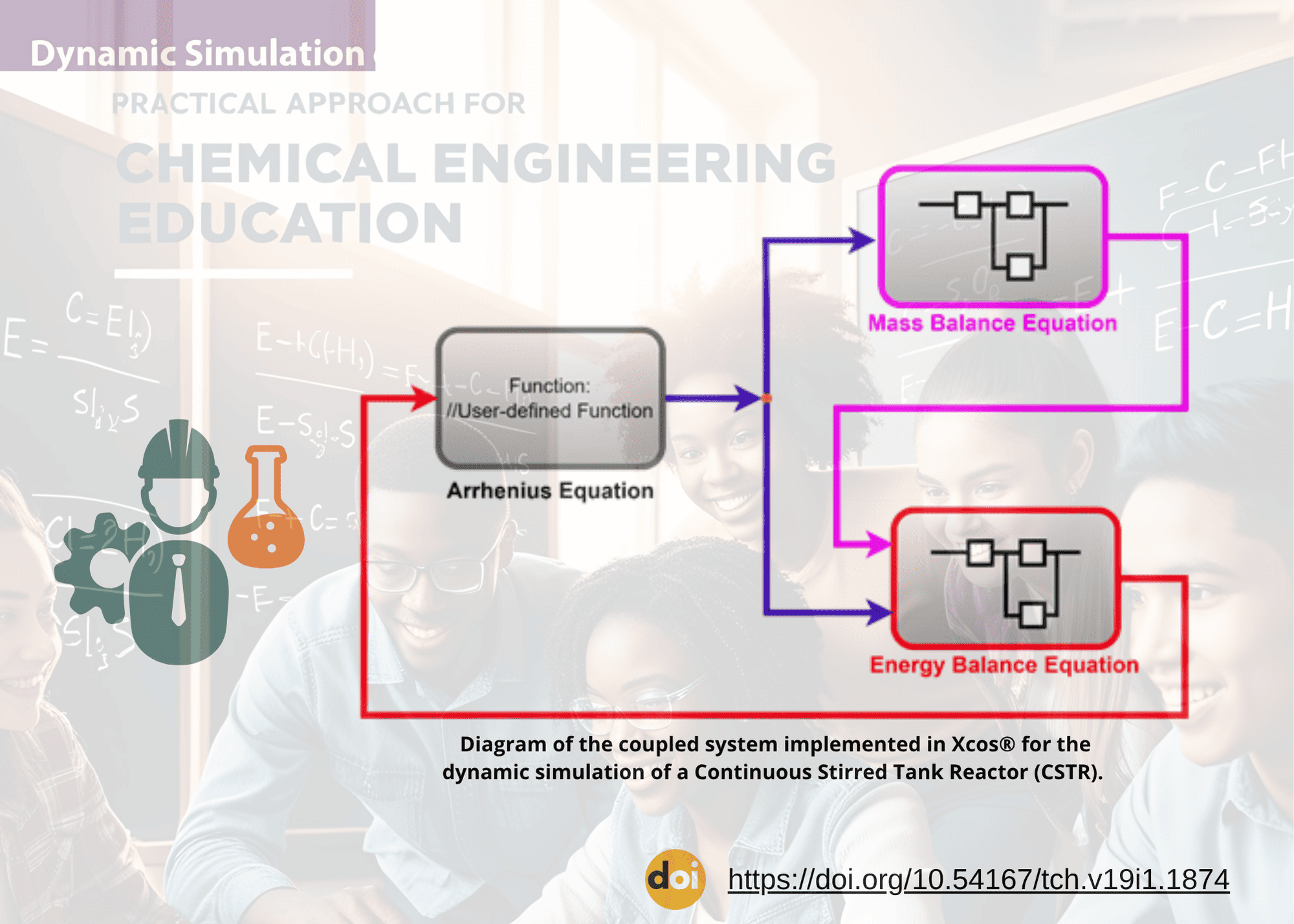
Understanding the dynamic behavior of chemical processes is essential for controlling industrial operation, enhancing safety, and products quality. This work provides an accessible and practical guide for students and educators to demonstrate the potential of Scilab/Xcos® as an open-source alternative to MATLAB/Simulink®, for dynamic process simulation in chemical engineering education. The study focuses on a non-linear Continuous Stirred Tank Reactor (CSTR) model, with a classic example used to illustrate the different phenomena involved in reaction engineering. Two different scenarios were simulated to analyze the transient behavior of the CSTR under different coolant temperature perturbations. In the first case, a 10 K reduction in coolant temperature led to a significant drop in reaction temperature and increase in reactant concentration. In the second case, an increase of 5 K in coolant temperature resulted in oscillatory behavior, showcasing the reactor's sensitivity to temperature changes. The presented simulation is consistent with reference values from the literature, confirming the accuracy and reliability of the Xcos® model.
Downloads
References
Baldea, M., & Edgar, T. F. (2018). Dynamic process intensification. Current Opinion in Chemical Engineering, 22: 48–53. https://doi.org/10.1016/J.COCHE.2018.08.003
Dassault Systèmes. (2024). Xcos | Scilab. https://www.scilab.org/download/scilab-2024.1.0
Ghimire, A., Frunzo, L., Pirozzi, F., Trably, E., Escudie, R., Lens, P. N. L., & Esposito, G. (2015). A review on dark fermentative biohydrogen production from organic biomass: Process parameters and use of by-products. Applied Energy, 144: 73–95. https://doi.org/10.1016/J.APENERGY.2015.01.045
Hedengren, J. D. (2024). Process Dynamics and Control. https://apmonitor.com/che436/
Henrique, J. P., de Sousa, R., Secchi, A. R., Ravagnani, M. A. S. S., & Costa, C. B. B. (2018). Optimization of chemical engineering problems with EMSO software. Computer Applications in Engineering Education, 26(1): 141–161. https://doi.org/10.1002/CAE.21867
Hu, C. (2021). Reactor design and selection for effective continuous manufacturing of pharmaceuticals. Journal of Flow Chemistry 11:3: 243–263. https://doi.org/10.1007/S41981-021-00164-3
Jin, H. Z., Gu, Y., & Ou, G. F. (2021). Corrosion risk analysis of tube-and-shell heat exchangers and design of outlet temperature control system. Petroleum Science, 18(4): 1219–1229. https://doi.org/10.1016/J.PETSCI.2021.07.002
Minh, V. T. (2010). Modeling and control of distillation column in a petroleum process. Proceedings of the 2010 5th IEEE Conference on Industrial Electronics and Applications, Taichung, Taiwan, ICIEA 2010: 259–263. https://doi.org/10.1109/ICIEA.2010.5516816
MIT OpenCourseWare. (2006). Process Dynamics, Operations, and Control. © 2001–2025 Massachusetts Institute of Technology. https://ocw.mit.edu/courses/10-450-process-dynamics-operations-and-control-spring-2006/
Moodley, K. (2020). Improvement of the learning and assessment of the practical component of a Process Dynamics and Control course for fourth year chemical engineering students. Education for Chemical Engineers, 31: 1–10. https://doi.org/10.1016/J.ECE.2020.02.002
Muhammad, D., Ahmad, Z., & Aziz, N. (2019). Low density polyethylene tubular reactor control using state space model predictive control. Chemical Engineering Communications, 208(4): 500–516. https://doi.org/10.1080/00986445.2019.1674816
Pugazhendi, A., Qari, H., Al-Badry Basahi, J. M., Godon, J. J., & Dhavamani, J. (2017). Role of a halothermophilic bacterial consortium for the biodegradation of PAHs and the treatment of petroleum wastewater at extreme conditions. International Biodeterioration & Biodegradation, 121: 44–54. https://doi.org/10.1016/J.IBIOD.2017.03.015
Seborg, D. E., Edgar, T. F., Mellichamp, D. A., & Doyle III, F. J. (2016). Process Dynamics and Control (Fourth edition). John Wiley & Sons, Inc.
Shi, Y., Prieto, P. L., Zepel, T., Grunert, S., & Hein, J. E. (2021). Automated Experimentation Powers Data Science in Chemistry. Accounts of Chemical Research, 54(3): 546–555. https://doi.org/10.1021/acs.accounts.0c00736
Shokry, A., Baraldi, P., Zio, E., & Espuña, A. (2020). Dynamic Surrogate Modeling for Multistep-ahead Prediction of Multivariate Nonlinear Chemical Processes. Industrial and Engineering Chemistry Research, 59(35): 15634–15655. https://doi.org/10.1021/acs.iecr.0c00729
The MathWorks, Inc. (2025). Simulink Online - MATLAB & Simulink. https://la.mathworks.com/products/simulink-online.html
Vieira, E. B., Busch, W. F., Prata, D. M., & Santos, L. S. (2019). Application of Scilab/Xcos for process control applied to chemical engineering educational projects. Computer Applications in Engineering Education, 27(1): 154–165. https://doi.org/10.1002/CAE.22065
Wang, D., Yang, G., Guo, F., Wang, J., & Jiang, Y. (2018). Progress in Technology and Catalysts for Continuous Stirred Tank Reactor Type Slurry Phase Polyethylene Processes. Petroleum Chemistry, 58(3): 264–273. https://doi.org/10.1134/S0965544118030064
Published
Issue
Section
License
Copyright (c) 2025 TECNOCIENCIA Chihuahua

This work is licensed under a Creative Commons Attribution-NonCommercial 4.0 International License.