Endocrine Disruptors: Impact on Hormonal Axes and Nutritional Strategies. A Narrative Review
DOI:
https://doi.org/10.54167/tch.v19i2.1796Keywords:
environmental-exposures, endocrine-disruptor, hormonal-axes, health-risks, nutritionAbstract
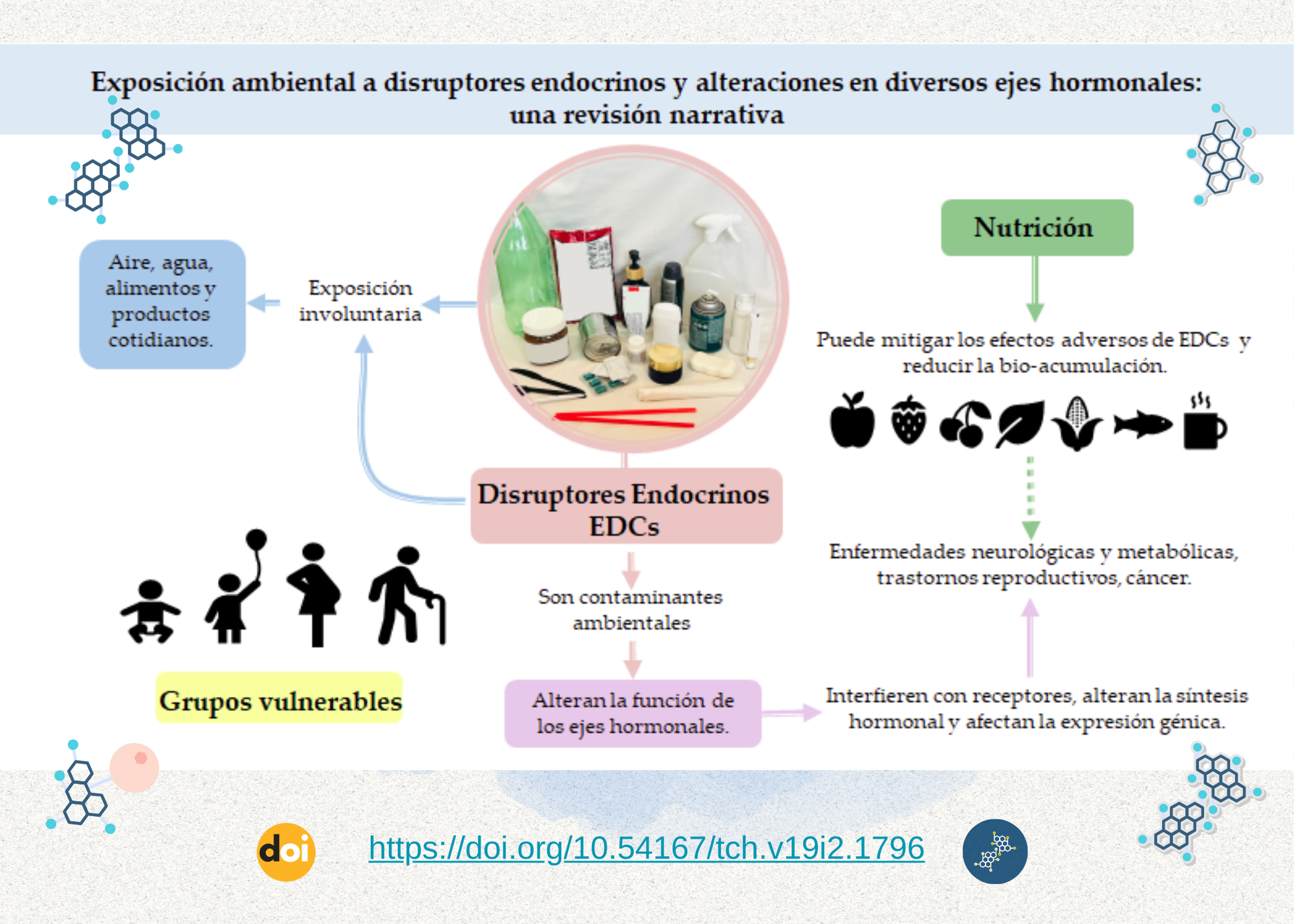
Endocrine-disrupting chemicals (EDCs) are environmental contaminants that interfere with hormonal systems from the time of fetal development onward. This narrative review summarizes the mechanisms of action of EDC across key hormonal axes and explores nutritional interventions as preventive strategies. A comprehensive literature search in PubMed, Scopus, Web of Science, and SciELO revealed that EDC exposure primarily occurs through contaminated food, either naturally or due to migration from packaging. Phthalates, bisphenol A, PCBs, food additives, and heavy metals interfere with hormone transport proteins and receptors, contributing to the development of developmental, metabolic, and reproductive disorders. Evidence suggests that a balanced diet may mitigate these adverse effects through three pathways: reducing EDC intake, limiting their accumulation in the body, and supplying essential nutrients and bioactive compounds, such as vitamin C, vitamin E, β-carotene, flavonoids, coenzyme Q-10, omega-3 fatty acids, and polyphenols, that combat oxidative stress and inflammation induced by EDCs. Incorporating EDC exposure assessment into clinical practice may improve early diagnostic and management of non-communicable diseases.
DOI: https://doi.org/10.54167/tch.v19i2.1796
Downloads
References
Referencias
Al'Absi, M., DeAngelis, B., Nakajima, M., Hatsukami, D., & Allen, S. (2021). Early life adversity and appetite hormones: The effects of smoking status, nicotine withdrawal, and relapse on ghrelin and peptide YY during smoking cessation. Addictive behaviors, 118. https://doi.org/10.1016/j.addbeh.2021.106866
Al-Chalabi, M. (2023). Physiology, prolactin. National Library of Medicine. (pp 391-392). StatPearls.
Álvarez-Crespo, M., González-Matías, L. C., Gil-Lozano, M., Fontans-Paz, S., Romaní-Pérez, M., Vigo Gago, E., y Mallo-Ferrer, F. (2009). Las hormonas gastrointestinales en el control de la ingesta de alimentos. Endocrinología y Nutrición, 56(6): 317-330. https://doi.org/10.1016/S1575-0922(09)71946-1.
Araujo-Castro , M., Pascual, C. E., Arias, M., Castro-Feijóo, L., Barreiro, J., & Cabanas, P. (2020). Una revisión sobre los disruptores endocrinos y su posible impacto sobre la salud de los humanos. Revista Española de Endocrinología Pediátrica, 11(2): 34–53. https://doi.org/10.3266/RevEspEndocrinolPediatr.pre2020.Nov.619
Asenuga, E. R., & Olagunju, A. S. (2023). Exposure and associated health risk of endocrine disruption compounds. African Journal of Health, Safety and Environment, 4(1): 57–66. https://doi.org/10.52417/ajhse.v4i1.332
Ayman, J., Palotai, M., Dochnal, R., & Bagosi, Z. (2023). Ghrelin Amplifies the Nicotine-Induced Release of Dopamine in the Bed Nucleus of Stria Terminalis (BNST). Biomedicines, 11(9): 2456 https://doi.org/10.3390/biomedicines11092456
Azaretzky, M., Ponzo, O. J., Viale, M. L., Fernandez, G. I., Sedlinsky, C. E., Lasaga, M., Scaglia, H. E., Lewitan, G. E., Pozniak, S., y Leiderman, S. (2018). Disruptores endocrinos: Guía de reconocimiento, acciones y recomendaciones para el manejo médico. Revista argentina de endocrinología y metabolismo, 55(2): 21-30. https://www.scielo.org.ar/scielo.php?script=sci_arttext&pid=S1851-30342018000200021&lng=es&tlng=es.
Briceño-Rodríguez, L. L., Céspedes-Salazar, C., & Forero-Ronderos, C. (2024). Disruptores endocrinos y enfermedades endocrinológicas en niños y adolescentes. Revista Colombiana de Endocrinología, Diabetes & Metabolismo, 11(2): 186-199. https://doi.org/10.53853/encr.11.2.872
Calzada-León, R., Altamirano-Bustamante, N. y Ruiz-Reyes, M. L. (2008). Reguladores neuroendocrinos y gastrointestinales del apetito y la saciedad. Boletín médico del Hospital Infantil de México, 65(6): 468-487. https://www.scielo.org.mx/pdf/bmim/v65n6/v65n6a7.pdf
Carranza-Quispe, L. E. (2016). Fisiología del apetito y el hambre. Enfermería Investiga, Investigación, Vinculación, Docencia y Gestión, 1(3): 117-124.
Criswell, R., Crawford, K. A., Bucinca, H., & Romano, M. E. (2020). Endocrine-disrupting chemicals and breastfeeding duration: a review. Current opinion in endocrinology, diabetes, and obesity, 27(6): 388–395. https://doi.org/10.1097/MED.0000000000000577
Derakhshan, A., Shu, H., Broeren, M. A. C., Lindh, C. H., Peeters, R. P., Kortenkamp, A., Demeneix, B., Bornehag, C. G., & Korevaar, T. I. M. (2021). Association of phthalate exposure with thyroid function during pregnancy. Environment International, 157: 106795. https://doi.org/10.1016/j.envint.2021.106795
Deschaine, S. L., Farokhnia, M., Gregory-Flores, A., Zallar, L. J., You, Z. B., Sun, H., Harvey, D. M., Marchette, R. C. N., Tunstall, B. J., Mani, B. K., Moose, J. E., Lee, M. R., Gardner, E., Akhlaghi, F., Roberto, M., Hougland, J. L., Zigman, J. M., Koob, G. F., Vendruscolo, L. F., & Leggio, L. (2022). A closer look at alcohol-induced changes in the ghrelin system: novel insights from preclinical and clinical data. Addiction biology, 27(1): 13033. https://doi.org/10.1111/adb.13033
Díaz, R. E., Véliz, J., & Wohllk, N. (2015). Laboratorio de hormonas: aspectos prácticos. Rev. Med. Clin. Condes., 26(6): 776-787. https://www.elsevier.es/es-revista-revista-medica-clinica-las-condes-202-resumen-laboratorio-de-hormonas-aspectos-prcticos-S0716864015001534
Dickerson, S. M., & Gore, A. C. (2007). Estrogenic environmental endocrine-disrupting chemical effects on reproductive neuroendocrine function and dysfunction across the life cycle. Reviews in Endocrine and Metabolic Disorders, 8, 143-159.
https://www.doi.org/10.1007/S11154-007-9048-Y
Espinoza Loja, P. A. (2024). Actuación de enfermería ante el Síndrome de Sheehan en pacientes: una revisión bibliográfica. Religación. Revista de Ciencias Sociales y Humanidades, 9(40). https://doi.org/10.46652/rgn.v9i40.1203
Esteve-Ràfols, M. (2014). Adipose tissue: cell heterogeneity and functional diversity. Endocrinologia y Nutricion: Organo de La Sociedad Española de Endocrinologia y Nutricion, 61(2): 100–112. https://doi.org/10.1016/j.endonu.2013.03.011
Fateme, M., Kiani, A. & Gholamzadeh, S. (2018). The factors affecting successful breast-feeding. Iranian Journal of neonatology. 9(2): 73-82. https://doi.org/10.22038/ijn.2018.10868
Freeman, M. E., Kanyicska, B., Lerant, A., & Nagy, G. (2000). Prolactin: Structure, function and regulation of secretion. Physiological reviews, 80(4): 1523–1631. https://doi.org/10.1152/physrev.2000.80.4.1523
Ge, X., Weis, K., & Raetzman, L. (2024). Impact of real-life environmental exposures on reproduction: Impact of developmental exposures to endocrine-disrupting chemicals on pituitary gland reproductive function. Reproduction, 168:(6). https://doi.org/10.1530/REP-24-0072
Gore, A. C. (2001). Environmental toxicant effects on neuroendocrine function. Endocrine, 14, 235-246. https://www.doi.org/10.1385/ENDO:14:2:235
González-Castell, L. D., Unar-Munguía, M., Bonvecchio-Arenas, A., Rivera-Pasquel, M., Lozada-Tequeanes, A. L., Ramírez-Silva, C. I., Álvarez-Peña, I. J., Cobo-Armijo, F., y Rivera-Dommarco, J. A. (2024). Lactancia materna. Salud Pública de México, 66(4): 498–508. https://doi.org/10.21149/15898
González-Hita, M. E., Ambrosio-Macías, K. G., y Sánchez-Enríquez, S. (2006). Regulación neuroendocrina del hambre, la saciedad y mantenimiento del balance energético. Rev Med UV, 8(3): 35-40. https://www.medigraphic.com/pdfs/invsal/isg-2006/isg063i.pdf
Gupta, P., Mahapatra, A., Suman, A., & Singh, R. K. (2021). Effect of endocrine disrupting chemicals on HPG axis: a reproductive endocrine homeostasis. In Hot Topics in Endocrinology and Metabolism. IntechOpen.
https://www.doi.org/10.5772/INTECHOPEN.96330
Guyton, A.C., & Hall, J.E. (2021). Textbook of Medical Physiology (14th ed.). Elsevier. https://www.elsevierhealth.com.au/guyton-and-hall-textbook-of-medical-physiology-9780323597128.html?srsltid=AfmBOopR204vr9jUf0Om937yDBkkFoZXIfxYfQqEGZw8tjwkQlgO4_IZHenley, C. (2021). HPG AXIS. https://openbooks.lib.msu.edu/neuroscience/chapter/hpg-axis/
Hernández-Gúzman, A., Bazán-Pérez, A., Ortíz-Reyes, R. A., Maldonado-García, J. L., y Terrones-Lozano, A. (2022). Perspectiva neuroinmunoendocrina de la lactancia materna: prolactina, más que una hormona lactógena. Revista mexicana de endocrinología, metabolismo y nutrición, 9: 78-84. https://www.revistadeendocrinologia.com/files/rme_22_9_2_078-084.pdf
Hernandez Stegmann María F., R. V. (2018). Sociedad Española de Otorrinolaringología. https://seorl.net/
Heshmati, M. H. (2021). Human health consequences of endocrine-disrupting chemicals. En Environmental Issues and Sustainable Development (pp. 1-16). IntechOpen.
Hoffman, J. B., & Hennig, B. (2017). Protective influence of healthful nutrition on mechanisms of environmental pollutant toxicity and disease risks. Annals of the New York Academy of Sciences, 1398(1): 99–107. https://doi.org/10.1111/nyas.13365
Itrat, N. (2021). Hormone Harmony in metabolic disorders. En Emerging Contaminants and Associated Treatment Technologies (pp. 393–408). Springer International Publishing.
Jimenez-Yanza, K. L. (2019). Amiodarona en hipotiroidismo. RECIAMUC, 3(3): 517-543.
Koopmann, A., Bez, J., Lemenager, T., Hermann, D., Dinter, C., Reinhard, I., Hoffmann, H., Wiedemann, K., Winterer, G., Y Kiefer, F. (2015). Efectos del tabaquismo en la concentración plasmática de la grelina peptídico que regula el apetito. Anales de nutrición y metabolismo, 66(2-3): 155–161. https://doi.org/10.1159/000381834
Kordas, K., Lönnerdal, B., & Stoltzfus, R. J. (2007). Interactions between nutrition and environmental exposures: effects on health outcomes in women and children. The Journal of Nutrition, 137(12): 2794–2797. https://doi.org/10.1093/jn/137.12.2794
Lee, R., & Sawa, A. (2014). Environmental Stressors and Epigenetic Control of the Hypothalamic-Pituitary Adrenal Axis. Neuro-endrocrinología, 100(4): 278-287. https://doi.org/10.1159/000369585
Leggio, L., Ferrulli, A., Cardone, S., Nesci, A., Miceli, A., Malandrino, N., Capristo, E., Canestrelli, B., Monteleone, P., Kenna, G. A., Swift, R. M., & Addolorato, G. (2012). Ghrelin system in alcohol-dependent subjects: role of plasma ghrelin levels in alcohol drinking and craving. Addiction biology, 17(2): 452–464. https://doi.org/10.1111/j.1369-1600.2010.00308.x
López-Rubio, M. A. (2012). CONOCIMIENTOS GENERALES: Regulación neurológica y hormonal de la función reproductora. Fisiología de la pubertad y del climaterio. https://www.chospab.es/area_medica/obstetriciaginecologia/docencia/seminarios/2012-2013/sesion20120620.pdf
Loszcano, J. et al., A. F. (s.f.). Harrison, Principios de medicina Interna 25° edición (25° ed.). Mc.Graw Hill.
Maidana, P., Bruno, O. D., & Mesch, V. (2013). Medición de cortisol y sus fracciones: Una puesta al día. Medicina, 73(6): 579–584. https://www.scielo.org.ar/scielo.php?pid=S0025-76802013000800016&script=sci_arttext.
Morales-Ovalles, Y., Miranda-de-Contreras, L., & Di Bernardo-Navas, M. L. (2015). Neurotoxicidad de los plaguicidas como agentes disruptores endocrinos: una revisión. Instituto nacional de higiene "Rafael Rangel": 55-68. ISSN 0798-0477
Marconetto, A., Babini, A., Ñañez, M., Moreno, L., Rosato, O., & Fux, O. (2022). Principales disruptores endocrinos vinculados con salud reproductiva femenina: bases biológicas de su asociación. Medicina (B.Aires), 82(3): 428-438. https://www.scielo.org.ar/scielo.php?script=sci_arttext&pid=S0025-76802022000500428&lng=es
Martinez-Rodriguez, A. (2021). Grado en medicina. La conexión hipotálamo - neurohipófisis: estructura, funciones y enfermedades asociadas. Santander, España. https://medicinabuenosaires.com/revistas/vol73-13/6/579-584-MED6038_MAIDANA.pdf
Martins-de-Oliveira, R., Rocha-Salgado, M. G., Pereira-Pascoal, C. K., Y Viegas-Rodrigues-Albuquerque, K. C. (2024). Síndrome de Sheehan. Interdisciplinary Studies Journal. https://doi.org/10.54751/revistafoco.ed.esp-034
Melmed, S., et al. (2015). Williams Textbook of Endocrinology (13th ed.). Elsevier. https://www.sciencedirect.com/book/9780323297387/williams-textbook-of-endocrinology
Mosca, A., Manco, M., Braghini, M. R., Cianfarani, S., Maggiore, G., Alisi, A., & Vania, A. (2024). Environment, Endocrine Disruptors, and Fatty Liver Disease Associated with Metabolic Dysfunction (MASLD). Metabolites, 14(1): 71. https://doi.org/10.3390/metabo14010071
Muvdi, A. (2018). Síndrome de Sheehan. Revista Colombiana de Endocrinología, Diabetes y Metabolismo, 1(12). https://doi.org/10.53853/encr.-1.2.397
Engelmann, M., Landgraf, R., & Wotjak, C. T. (2004). The hypothalamic-neurohypophysial system regulates the hypothalamic-pituitary-adrenal axis under stress: an old concept revisited. Frontiers in Neuroendocrinology, 25(3–4): 132–149. https://doi.org/10.1016/j.yfrne.2004.09.001
NHI. (2024). Endocrine disruptors. National Institute of Environmental Health Sciences. https://www.niehs.nih.gov/health/topics/agents/endocrine
Nibali, S. (2015). The support of breastfeeding: Physiology and false myths. Quaderni ACP, 22(2). https://www.scopus.com/record/display.uri?eid=2-s2.0-84927126760&origin=inward&txGid=e32f9c9786bf0257826e2db33c65c2c8
Ortiz-Flores, A., & Escobar-Morreale, H. (2020). Eje hipotálamo hipofisario. Fisiología y Patología. Medicine- Programa de Formación Médica Continuada Acreditado, 13(15): 846-855. https://doi.org/10.1016/j.med.2020.09.003
Özen, S., & Darcan, Ş. (2011). Effects of environmental endocrine disruptors on pubertal development. Journal of clinical research in pediatric endocrinology, 3(1): 1–6. https://doi.org/10.4274/jcrpe.v3i1.01
Özkan-Kotiloğlu, S., Kaya-Akyüzlü, D., Güven, E., Doğan, Ö., Ağtaş-Ertan, E., & Özgür-İlhan, İ. (2024). A case control study investigating the methylation levels of GHRL and GHSR genes in alcohol use disorder. Molecular biology reports, 51(1): 663. https://doi.org/10.1007/s11033-024-09585-4
Parker, K., & Schimmer, B. (2012). Introducción a la endocrinología: eje hipotálamo-hipófisis. Goodman & Gilman Las bases farmacológicas de la terapéutica (pp 1103–1127). Mc Graw Hill.
Pérez, L. O. (2004). Reporte: Hormonas tiroideas y trastornos afectivos. Revista Colombiana de Psiquiatría, 33(1): 98-107.
Pérez, M. (2019). Fisiología de la prolactina. Access Medicine.
Pecori Giraldi, F., Ferraù, F., Ragonese, M., & Cannavò, S. (2024). Endocrine disruptors, aryl hydrocarbon receptor and cortisol secretion. Journal of Endocrinological Investigation, 47(10): 2407–2419. https://doi.org/10.1007/s40618-024-02371-w
Peluso, T. V. (2023). La exposición crónica al clorpirifos daña la actividad tiroidea y desequilibra la señalización hepática de las hormonas tiroideas y el metabolismo de la glucosa: dependencia del eje T3-FOXO1 por hiperglucemia. Revista Internacional de Ciencias Moleculares, 24(11): 9582-9582. https://doi.org/10.3390/ijms24119582
Plunk, E. C., & Richards, S. M. (2020). Endocrine-disrupting air pollutants and their effects on the hypothalamus-pituitary-gonadal axis. International Journal of Molecular Sciences, 21(23): 9191. https://doi.org/10.3390/ijms21239191
Potretzke, S., Lemieux, A., Nakajima, M., & al'Absi, M. (2022). Circulating ghrelin changes as a biomarker of the stress response and craving in abstinent smokers. Pharmacology, biochemistry, and behavior, 218: 173423. https://doi.org/10.1016/j.pbb.2022.173423
Pötzl, B., Kürzinger, L., Stopper, H., Fassnacht, M., Kurlbaum, M., & Dischinger, U. (2024). Endocrine disruptors: Focus on the adrenal cortex. Hormone and Metabolic Research, 56(01): 78–90. https://doi.org/10.1055/a-2198-9307
Ralevski, E., Horvath, T. L., Shanabrough, M., Newcomb, J., Pisani, E., & Petrakis, I. (2023). Ghrelin Predicts Stimulant and Sedative Effects of Alcohol in Heavy Drinkers. Alcohol and alcoholism (Oxford, Oxfordshire), 58(1): 100–106. https://doi.org/10.1093/alcalc/agac058
Rang, H. P., Ritter, J. M., Flower, R. J., y Henderson, G. (2016). Obesity. In Rang and Dale Pharmacology (pp. 393-401). Elsevier.
Rannaud-Bartaire P. (2022). Perturbateurs endocriniens et origine environnementale des maladies : intégrer ces données pour un nouveau modèle d’accompagnement des patients vers la santé environnementale [Endocrine disruptors and environmental origins of diseases: Integrating data for a new model of environmental health patient support]. Recherche en soins infirmiers, 149(2): 7–18. https://doi.org/10.3917/rsi.149.0007
Reilly, M. P., Kunkel, M. N., Thompson, L. M., Zentay, A., Weeks, C. D., Crews, D., Cormack, L. K., & Gore, A. C. (2022). Effects of endocrine-disrupting chemicals on hypothalamic oxytocin and vasopressin systems. Journal of Experimental Zoology. Part A, Ecological and Integrative Physiology, 337(1): 75–87. https://doi.org/10.1002/jez.2475
Rhee, S. S., & Pearce, E. N. (2011). Sistema endocrino y corazón: una revisión. Revista Española de Cardiología, 64(3): 220–231. https://doi.org/10.1016/j.recesp.2010.10.015
Rivas, A., Granada, A., Jiménez, M., Olea, F., & Olea, N. (2004). Exposición humana a disruptores endocrinos. Ecosistemas, 13(3).
Rodríguez-Fernández, J. M., García-Acero, M., & Franco., P. (2013). Neurobiología del Estrés Agudo y Crónico: Su Efecto en el Eje Hipotálamo-Hipófisis-Adrenal y la Memoria. Univ. Med., 54(4): 472-494. https://revecuatneurol.com/wp-content/uploads/2015/06/neurobiologia.pdf
Sánchez, E., Cuevas, R. A., Espinosa, C. D., Hinojosa, A. E., y Reza, B. J. (2024). Diagnóstico y tratamiento de la enfermedad de Cushing. Actualidades y posicionamiento del Grupo de Trabajo de Neuroendocrinología de la Sociedad Mexicana de Nutrición y Endocrinología. Revista Mexicana de Endocrinología, Metabolismo y Nutrición, 10(Supl 1): 9-32. https://doi.org/10.24875/rme.m23000025.
Santiago-Peña, L. (2020). Fisiología de la glándula tiroides. Disfunción y parámetros funcionales de laboratorio en patología de tiroides. ORL, 11(3): 253-257.
Senanayake, R., MacFarlane, J., van der Meulen, M., Bashari, W. A., & Gurnell, M. (2023). The Hypothalamic–Pituitary (Neuroendocrine) Axis. En Cambridge Textbook of Neuroscience for Psychiatrists (pp. 287–299). Cambridge University Press.
Sousa-Vidal, É. K., Henrique, G., da-Silva, R. E. C., & Serrano-Nascimento, C. (2023). Intrauterine exposure to di(2-ethylhexyl) phthalate (DEHP) disrupts the function of the hypothalamus-pituitary-thyroid axis of the F1 rats during adult life. Frontiers in endocrinology, 13: 995491. https://doi.org/10.3389/fendo.2022.995491
Stuhldreher, W. (2023). Breastfeeding. Salem Press Encyclopedia of Science.
Suchankova, P., Nilsson, S., von der Pahlen, B., Santtila, P., Sandnabba, K., Johansson, A., Jern, P., Engel, J. A., & Jerlhag, E. (2016). Genetic variation of the growth hormone secretagogue receptor gene is associated with alcohol use disorders identification test scores and smoking. Addiction biology, 21(2): 481–488. https://doi.org/10.1111/adb.12277
Tell, L., & Lysenkov, S. (2014). Lungs as a crucial organ of endocrine system ő new view on hormonal homeostasis (718.4). FASEB Journal: Official Publication of the Federation of American Societies for Experimental Biology, 28(S1). https://doi.org/10.1096/fasebj.28.1_supplement.718.4
Tresguerres, J. (3a). (2005). Fisiología humana (pp. 923-1233). McGraw-Hill.
Trindade, F. (2020). Nutritional Influences on Hormonal Health. En Integrative and Functional Medical Nutrition Therapy (pp. 517–532). Springer International Publishing.
UpToMedicine. (2019). Hipotálamo-Hipófisis (Eje lactotropo). UpToMedicine.
Utiger, R. (2024). Prolactin. Encyclopedia Britannica.
Vandenberg L. N. (2021). Endocrine disrupting chemicals and the mammary gland. Advances in pharmacology (San Diego, Calif.), 92: 237–277. https://doi.org/10.1016/bs.apha.2021.04.005
Willner, S. A., & Blumberg, B. (2019). Endocrine Disruptors and Obesity. En Encyclopedia of Endocrine Diseases (pp. 776–786). Elsevier.
Wu, H., Zhang, W., Zhang, Y., Kang, Z., Miao, X., & Na, X. (2021). Novel insights into di‑(2‑ethylhexyl)phthalate activation: Implications for the hypothalamus‑pituitary‑thyroid axis. Molecular medicine reports, 23(4): 290. https://doi.org/10.3892/mmr.2021.11930
Yavuz, Y., Oyku-Ozen, D., Yagmur-Erol, Z., Goren, H., & Yilmaz, B. (2023). Effects of endocrine disruptors on the electrical activity of leptin receptor neurons in the dorsomedial hypothalamus and anxiety-like behavior in male mice. Environmental pollution, 324: 121366. https://doi.org/10.1016/j.envpol.2023.121366
Downloads
Published
Issue
Section
License
Copyright (c) 2025 TECNOCIENCIA Chihuahua

This work is licensed under a Creative Commons Attribution-NonCommercial 4.0 International License.