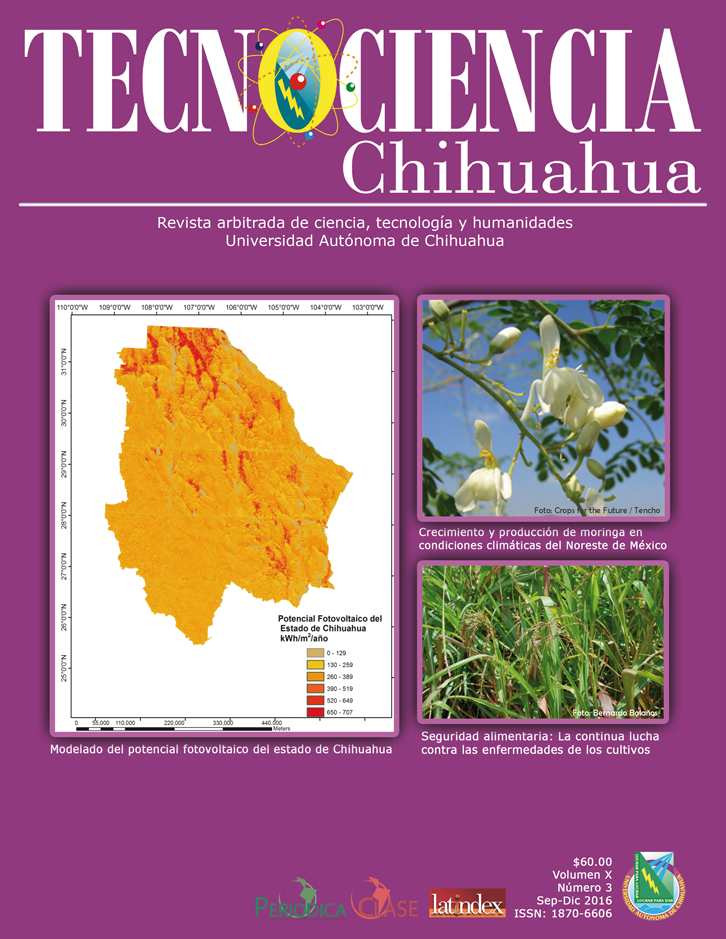
Modelado del potencial fotovoltaico del estado de Chihuahua
Modeling of photovoltaic potential in Chihuahua State
DOI:
https://doi.org/10.54167/tch.v10i3.178Keywords:
climate change, Chihuahua, photovoltaic potential model, sustainable developmentAbstract
Global energy demand has been growing along time to support social and economical development, while leading to increase emissions of green house gasses (GHG), such as carbon dioxide (CO2). Replace or support electrical power generation facilities based on fossil fuels with renewable energy options, such as solar photovoltaic technology, would decrease emissions of GHG, thus it would help to minimize the effects of climate change, and furthermore, would assist in the development of city and rural communities. Mexico, located within a region with a very high solar radiation (Sunbelt), is a very attractive country for photovoltaic installations, being that Chihuahua is one of the states with higher radiation, however given its vast area; it has required a more detailed study to identify the highest photovoltaic potential zones. In this research it was built a geoprocessing model using ArcGIS® 10.2.1 software. The model was able to clearly identify and classify 8,660 km2 of highly photovoltaic potential areas, in perspective, Chihuahua State would require only 23.74 km2 of them to fully meet its electrical generation demand, this reflects the abundance of the natural resource on Chihuahua and its photovoltaic potential.
Downloads
References
Afsharzade, N., A. Papzan, M. Ashjaee, S. Delangizan, S.V. Passel, & H. Azadi. 2016. Renewable energy development in rural areas of Iran. Renewable and Sustainable Energy Reviews 65: 743–755. http://dx.doi.org/10.1016/j.rser.2016.07.042.
Alemán-Nava, G.S., V.H. Casiano-Flores, D.L. Cárdenas-Chávez, R. Díaz-Chávez, N. Scarlat, J. Mahlknecht, J.F Dallemand & R. Parra. 2014. Renewable energy research progress in Mexico: A review. Renewable and Sustainable Energy Reviews 32: 140–153. http://dx.doi.org/10.1016/j.rser.2014.01.004.
Breyer, C., O. Koskinen & P. Blechinger- 2015. Profitable climate change mitigation: The case of greenhouse gas emission reduction benefits enabled by solar photovoltaic systems. Renewable and Sustainable Energy Reviews 49: 610–628. http://dx.doi.org/10.1016/j.rser.2015.04.061.
Cancino-Solórzano, Y., E. Villicaña-Ortiz, A.J. Gutiérrez-Trashorras & J. Xiberta-Bernat. 2010. Electricity sector in Mexico: Current status. Contribution of renewable energy sources. Renewable and Sustainable Energy Reviews 14: 454–461. https://doi.org/10.1016/j.rser.2009.07.022
Congreso del Estado de Chihuahua. 2014. Ley de cambio climático del estado de Chihuahua. Periódico Oficial del Estado No. 50. https://www.congresochihuahua2.gob.mx/biblioteca/leyes/archivosLeyes/1001.pdf
Diario Oficial de la Federación. 2014. Ley de Industria eléctrica. https://www.dof.gob.mx/nota_detalle.php?codigo=5355986&fecha=11/08/2014#gsc.tab=0
European Photovoltaic Industry Association. 2010. Unlocking the Sunbelt Potential of Photovoltaics. https://www.mesia.com/research_papers/epia-unlocking-the-sunbelt-potential-of-pv/
Fu, P. & P.M. Rich. 2000.The solar analyst 1.0 user manual. Helios Environmental Modeling Institute, LLC. https://www.sciencebase.gov/catalog/item/5140acafe4b089809dbf56f5
Fu, P. & P.M Rich. 2002. A geometric solar radiation model with applications in agriculture and forestry. Computers and Electronics in Agriculture 37(1-3): 25–35. http://dx.doi.org/10.1016/S0168-1699(02)00115-1
Gobierno de la República. 2013. Reforma energética. México. https://bit.ly/3Un2qJ0
Instituto Nacional de Ecología y Cambio Climático. 2013. Inventario Nacional de Emisiones de gases de efecto invernadero 1990-2010. INECC. México. ISBN 9786078246632.
Instituto Nacional de Estadística Geografía e Informática. 2015. Anuario estadístico y geográfico de Chihuahua 2015. INEGI. ISBN 9786077396802. https://www.inegi.org.mx/app/biblioteca/ficha.html?upc=702825076191
Instituto Nacional de Estadística Geografía e Informática. Continúo de elevación mexicano 3.0 (CEM 3.0). INEGI. https://www.inegi.org.mx/temas/relieve/continental/
Intergovernmental Panel on Climate Change. 2011. Special report of the Intergovernmental Panel on Climate Change. Renewable energy sources and climate change mitigation. Summary for policymakers and technical summary. IPCC. ISBN 9789291691319. https://www.ipcc.ch/report/renewable-energy-sources-and-climate-change-mitigation/
Irandoust, M. 2016.The renewable energy-growth nexus with carbon emissions and technological innovation: Evidence from the Nordic countries. Ecological Indicators 69: 118–125. http://dx.doi.org/10.1016/j.ecolind.2016.03.051
Kılkıs, S. 2016. Sustainable development of energy, water and environment systems index for Southeast European cities. Journal of Cleaner Production 130: 222-234. http://dx.doi.org/10.1016/j.jclepro.2015.07.121.
Moran, F. & S. Natarajan. 2015. Photovoltaic potential in historic dwellings: The potential to reduce domestic CO2 emissions. Journal of Building Engineering 3: 70–78. http://dx.doi.org/10.1016/j.jobe.2015.06.004.
National Renewable Energy Laborator. https://www.bnamericas.com/es/perfil-empresa/national-renewable-energy-laboratory
Okoye, C.O., O. Taylan & D.K. Baker. 2016. Solar energy potentials in strategically located cities in Nigeria: Review, resource assessment and photovoltaic potential system design. Renewable and Sustainable Energy Reviews 55: 550–566. http://dx.doi.org/10.1016/j.rser.2015.10.154.
Ould-Amrouche, S., D. Rekioua & A. Hamidat. 2010. Modeling photovoltaic water pumping systems and evaluation of their CO2 emissions mitigation potential. Applied Energy 87(11): 3451–3459. https://doi.org/10.1016/j.apenergy.2010.05.021
Rasul, G. 2016. Managing the food, water, and energy nexus for achieving the Sustainable Development Goals in South Asia. Environmental Development 18: 14–25. http://dx.doi.org/10.1016/j.envdev.2015.12.001.
Ren, H., Q. Wu, W. Gao & W. Zhou. 2016. Optimal operation of a grid-connected hybrid photovoltaic potential/fuel cell/battery energy system for residential applications. Energy 113:702-712. http://dx.doi.org/10.1016/j.energy.2016.07.091.
Rich, P.M., R. Dubayah, W. A Hetrick & S.C. Saving. 1994. Using viewshed models to calculate intercepted solar radiation: applications in ecology. American Society for Photogrammetry and Remote Sensing, Technical Papers. 524–529. http://professorpaul.com/publications/rich_et_al_1994_asprs.pdf
Sistema de Información Energética. 2015. Sector eléctrico Nacional. Generación bruta de electricidad por estado (megawatt-hora) 2015. Secretaría de Energía.
Valdes-Barrón, M., D. Rivero-Rosas, C.A. Arancibia-Bulnes & R. Bonifaz. 2014. The solar Resource Assessment in Mexico: State of the Art. Energy Procedia 57: 1299 – 1308. https://doi.org/10.1016/J.EGYPRO.2014.10.120
Wiser, R., D. Millstein, T. Mai, J. Macknick, A. Carpenter, S. Cohen, W. Cole, B. Frew & G. Heath. 2016. The environmental and public health benefits of achieving high penetrations of solar energy in the United States. Energy 113: 472-486. http://dx.doi.org/10.1016/j.energy.2016.07.068.