Variation of the seed and foliar phenolic contents of five wild forms of common bean (Phaseolus vulgaris L.)
DOI:
https://doi.org/10.54167/tch.v19i1.1691Keywords:
phytochemicals, wild forms, spectroscopy, Phaseolus vulgaris, HPLC-DAD, phenolic compositionAbstract
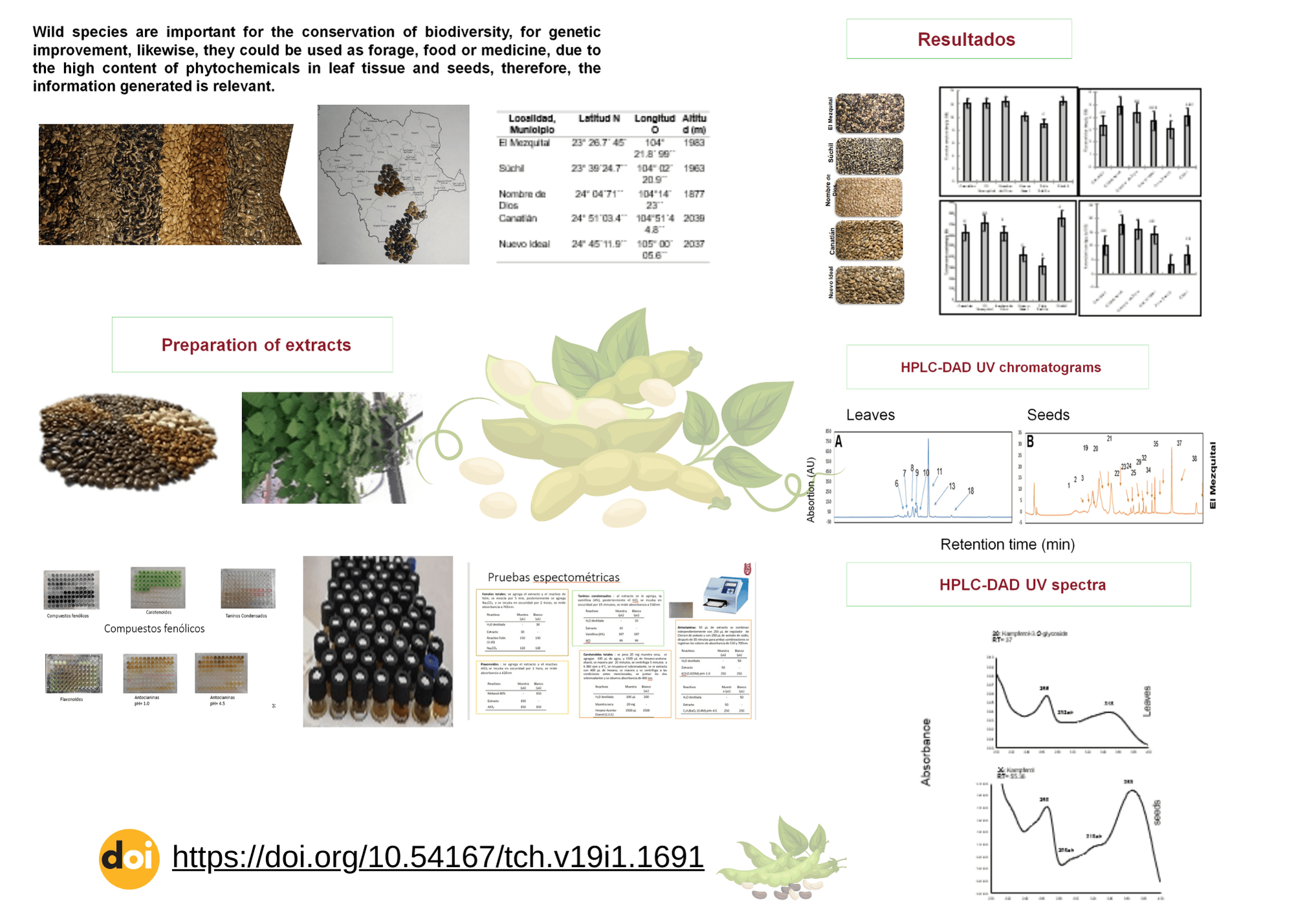
The objective of the present study was to evaluate the seed and foliar phenolic composition from populations of wild Phaseolus vulgaris of Durango, Mexico. Seeds and leaves extracts were analyzed by HPLC-DAD, and UV-visible spectrophotometry. Analysis of variance were used to determine the capacity of the phenolic contents to discriminate between samples, the data were submitted to principal component analysis (PCA) and cluster analysis. The population with the highest content of phenolic compounds in both seed and leaves was the wild population of Nuevo Ideal and those that accumulated the lowest content of these compounds were Nombre de Dios and Canatlán. A total of 37 phenolic compounds in both seed and leaves from wild common bean were identified by HPLC–DAD. Wild species are important for the conservation of biodiversity, and for the genetic improvement of new varieties. Likewise, they could be used as forage, food or medicine, due to the high content of phytochemicals in seeds and leaf tissue, therefore, the information generated is relevant to knowledge about the characterization and diversity of wild Phaseolus species.
DOI: https://doi.org/10.54167/tch.v19i1.1691
Downloads
References
Addinsoft, (2021). XLSTAT statistical and data analysis solution. New York, USA. https://www.xlstat.com
Akond, A. G. M., Khandaker, L., Berthold, J., Gates, L., Peters, K., Delong, H., & Hossain, K. (2011). Anthocyanin, total polyphenols and antioxidant activity of common bean. American Journal of Food Technology, 6: 385-394. https://doi.org/10.3923/ajft.2011.385.394
Armendáriz-Fernández, K. V., Herrera-Hernández, I. M., Muñoz-Márquez, E., & Sánchez, E. (2019). Characterization of Bioactive Compounds, Mineral Content, and Antioxidant Activity in Bean Varieties Grown with Traditional Methods in Oaxaca, Mexico. Antioxidants 8(1): 26. https://doi.org/10.3390/antiox8010026
Aquino-Bolaños, E. N., García-Díaz, Y. D., Chavez-Servia, J. L., Carrillo-Rodríguez, J. C., Vera-Guzman, A. M. and Heredia-Garcia, E. (2017). Anthocyanin, polyphenol, and flavonoid contents and antioxidant activity in Mexican common bean (Phaseolus vulgaris L.) landraces. Emirates Journal of Food & Agriculture 28(8): 581-588. https://ejfa.me/index.php/journal/article/view/1178
Arteaga-Castillo, S. M. (2021). Cultivos para el cambio climático: selección y caracterización de variedades de judía (Phaseolus vulgaris L.) y Phaseolus lunatus tolerantes a la sequía y salinidad (Doctoral dissertation, Universitat Politècnica de València). https://doi.org/10.4995/Thesis/10251/168450
Assefa, T., Assibi, M. A., Brown, A. V., Cannon, E. K., Rubyogo, J. C., Rao, I. M., & Cannon, S. B. (2019). A review of breeding objectives, genomic resources, and marker-assisted methods in common bean (Phaseolus vulgaris L.). Molecular Breeding, 39, 1-23. https://doi.org/10.1007/s11032-018-0920-0
Bhuyan, D. J., & Basu, A. (2017). Phenolic compounds potential health benefits and toxicity. In Utilisation of bioactive compounds from agricultural and food production waste (pp. 27-59). CRC Press. https://goo.su/CQkqX
Bedoya, R. A., & Maldonado, M. E. (2022). Características nutricionales y antioxidantes de la especie de frijol petaco (Phaseolus coccineus). Revista chilena de nutrición, 49(1): 34-42. https://pesquisa.bvsalud.org/portal/resource/pt/biblio-1388583
Bystricka, J., Musilova, J., Tomas, J., Vollmannova, A., Lachman, J.,& Kavalcova, P. (2014). Changes of Polyphenolic Substances in the Anatomical Parts of Buckwheat (Fagopyrum esculentum Moench.) during Its Growth Phases. Foods 3(4): 558-568. https://doi.org/10.3390/foods3040558
Campa, A., Rodríguez-Madrera, R., Jurado, M., García-Fernández, C., Suárez-Valles, B., & Ferreira, J. J. (2023). Genome-wide association study for the extractable phenolic profile and coat color of common bean seeds (Phaseolus vulgaris L.). BMC Plant Biology, 23(1): 158. https://doi.org/10.1186/s12870-023-04177-z
Carbas, B., Machado, N., Oppolzer, D., Ferreira, L., Queiroz, M., Brites, C., Rosa, E.A., & Barros, A. I. (2020). Nutrients, antinutrients, phenolic composition, and antioxidant activity of common bean cultivars and their potential for food applications. Antioxidants, 9(2): 186. https://doi.org/10.3390/antiox9020186
Capistrán-Carabarin, A., Aquino-Bolaños. E. N., García-Díaz Y. D., Chávez-Servia, J. L., Vera-Guzmán, A. M., & Carrillo-Rodríguez, J. C. (2019). Complementarity in Phenolic Compounds and the Antioxidant Activities of Phaseolus coccineus L. and P. vulgaris L. Landraces. Foods 8(8): 295. https://doi.org/10.3390/foods8080295
Chávez-Mendoza, C., & Sánchez, E. (2017). Bioactive compounds from Mexican varieties of the common bean (Phaseolus vulgaris): Implications for health. Molecules, 22(8): 1360. https://doi.org/10.3390/molecules22081360
Claros-Osorio, P. D. P. (2021). Evaluacion de la capacidad antioxidante total y contenido de polifenoles totales del Phaseolus vulgaris “Frijol”. http://hdl.handle.net/20.500.14067/5297
Colina-Ramos, A. C. (2016). Análisis fitoquímico, determinación cualitativa y cuantitativa de flavonoides y taninos, actividad antioxidante, antimicrobiana de las hojas de “Muehlenbeckia hastulata (JE Sm) IM Johnst” de la zona de Yucay (Cusco). [Tesis. Universidad Nacional Mayor de San Marcos]. https://goo.su/ed9KUg
da Graça, C. M., Markham, K. R. (2007). Structure information from HPLC and on-line measured absorption spectra: Flavones, Flavonols and Phenolic Acids. Imprensa da Universidade de Coimbra/Coimbra University Press. http://dx.doi.org/10.14195/978-989-26-0480-0
Del Valle, J. C., Buide, M. L., Casimiro-Soriguer, I., Whittall, J. B., & Narbona, E. (2015). On flavonoid accumulation in different plant parts: variation patterns among individuals and populations in the shore campion (Silene littorae). Front Plant Sci 6: 939. https://doi.org/10.3389/fpls.2015.00939
Dzomba, P., Togarepi, E., & Mupa, M. (2013). Anthocyanin content and antioxidant activities of common bean species (Phaseolus vulgaris L.) grown in Mashonaland Central, Zimbabwe. African Journal of Agricultural Research, 8(25): 3330-3333. https://goo.su/1XaGg0C
Espinoza-García, N., Martínez-Martínez, R., Chávez-Servia, J. L., Vera-Guzmán, A. M., Carrillo-Rodríguez, J. C., Heredia-García, E., & Velasco-Velasco, V. A. (2016). Contenido de minerales en semilla de poblaciones nativas de frijol común (Phaseolus vulgaris L.). Revista fitotecnia mexicana, 39(3): 215-223. http://www.scielo.org.mx/scielo.php?script=sci_arttext&pid=S0187-73802016000300215&lng=es
Falleh, H., Ksouri, R., Medini, F., Guyot, S., Abdelly, C., & Magné, C. (2011). Antioxidant activity and phenolic composition of the medicinal and edible halophyte Mesembryanthemum edule L. Industrial Crops and Products 34(1): 1066-1071. https://doi.org/10.1016/j.indcrop.2011.03.018
Gaafar, A. A., Ali, S. I., El-Shawadfy, M. A., Salama, Z. A., Sękara, A., Ulrichs, C., & Abdelhamid, M. T. (2020). Ascorbic acid induces the increase of secondary metabolites, antioxidant activity, growth, and productivity of the common bean under water stress conditions. Plants, 9(5), 627. https://doi.org/10.3390/plants9050627
Ganesan, K., & Xu, B. (2017). Polyphenol-rich dry common beans (Phaseolus vulgaris L.) and their health benefits. International Journal of Molecular Sciences, 18(11): 2331. https://doi.org/10.3390/ijms18112331
García-Díaz, Y.D. (2016). Compuestos fenólicos y actividad antioxidante en testa y grano de 54 poblaciones nativas de frijol común (Phaseolus vulgaris L.) (Tesis Maestría en Ciencias Alimentarias, Universidad Veracruzana). https://www.uv.mx/mca/files/2018/01/L.-N.-Yatzil-Denih-Garcia-Diaz.pdf
Giusti, M. M., & Wrolstad, R. E. (2001). Characterization and measurement of anthocyanins by UV-visible spectroscopy. CPFAC 0(1): 1-13. https://doi.org/10.1002/0471142913.faf0102s00
Harlen, W. C., & Jati, I. R.A.P. (2018). Antioxidant activity of anthocyanins in common legume grains. In: Watson, R.R., Preedy, V.R., Zibadi, S. (Eds.) Polyphenols: Mechanisms of action in human health and disease. Academic Press. pp. 81-92. https://doi.org/10.1016/B978-0-12-813006-3.00008-8
Heredia, R. L. (2017). Caracterización fisicoquímica y de compuestos bioactivos del frijol tepari (Phaseolus acutifolius gray) cultivado en Nuevo León, México. [Tesis de Maestría] Universidad Autónoma de Nuevo León. http://eprints.uanl.mx/id/eprint/14362
Julkunen-Tiitto, R. (1985). Phenolic constituents in the leaves of northern willows: methods for the analysis of certain phenolics. J. Agric. Food Chem. 33(2): 213-217. https://doi.org/10.1021/jf00062a013
Khang, D. T., Dung, T. N., Elzaawely, A. A., & Xuan, T. D. (2016). Phenolic profiles and antioxidant activity of germinated legumes. Foods, 5(2): 27. https://doi.org/10.3390/foods5020027
Kleintop, A. E., Myers, J. R., Echeverria, D., Thompson, H. J., & Brick, M. A. (2016). Total phenolic content and associated phenotypic traits in a diverse collection of snap bean cultivars. Journal of the American Society for Horticultural Science, 141(1): 3-11. https://doi.org/10.21273/JASHS.141.1.3
Kim, D. O., & Lee, C. Y. (2002). Extraction and isolation of polyphenolics. In: Wrolstad, R.E. (Ed.) Current Protocols in Food Analytical Chemistry. John Wiley & Sons: New York. https://doi.org/10.1002/0471142913.fai0102s06
Lauranson-Broyer, J., & Lebreton, P. (1993). Flavonoids and morphological traits of needles, as markers of natural hybridization between Pinus uncinata Ram and Pinus sylvestris L. Biochem. Syst. Ecol. 21(2): 241-247. https://doi.org/10.1016/0305-1978(93)90041-O
Maleki, S. J., Crespo, J. F., & Cabanillas, B. (2019). Anti-inflammatory effects of flavonoids. Food chemistry, 299: 125124. https://doi.org/10.1016/j.foodchem.2019.125124
McClean, P. E., Bett, K. E., Stonehouse, R., Lee, R., Pflieger, S., Moghaddam, S. M., Geffroy, V., Miklas, P., & Mamidi, S. (2018). White seed color in common bean (Phaseolus vulgaris) results from convergent evolution in the P (pigment) gene. New Phytologist, 219(3): 1112-1123. https://doi.org/10.1111/nph.15259
Mojica, L., Berhow, M., & González de Mejia, E. (2017). Black bean anthocyanin-rich extracts as food colorants: Physicochemical stability and antidiabetes potential. Food chemistry, 229: 628-639. https://doi.org/10.1016/j.foodchem.2017.02.124
Mueller-Harvey, I., Bee, G., Dohme-Meier, F., Hoste, H., Karonen, M., Kölliker, R., Waghorn, G. C…. et.al. (2019). Benefits of condensed tannins in forage legumes fed to ruminants: Importance of structure, concentration, and diet composition. Crop Science, 59(3): 861-885. https://doi.org/10.2135/cropsci2017.06.0369
Murube, E., Beleggia, R., Pacetti, D., Nartea, A., Frascarelli, G., Lanzavecchia, G., Bellucci, E., Nanni, L., Gioia, T., Marciello, U., Esposito, S., Foresi, G., Logozzo, G., Frega, G. N., Bitocchi, E., & Papa, R. (2021). Characterization of nutritional quality traits of a common bean germplasm collection. Foods, 10(7): 1572. https://doi.org/10.3390/foods10071572
Pérez-Perez, L.M., Del Toro Sánchez, C. L., Sánchez Chavez, E., González Vega, R. I., Reyes Díaz, A., Borboa Flores, J., … Flores-Cordova, M.A. (2019). Bioaccesibilidad de compuestos antioxidantes de diferentes variedades de frijol (Phaseolus vulgaris L.) en México, mediante un sistema gastrointestinal in vitro. Biotecnia 22(1): 117–125. https://doi.org/10.18633/biotecnia.v22i1.1159
Reyes-Martínez, A., Almaraz-Abarca, N., Gallardo-Velazquez, T., González-Elizondo, M.S., Herrera-Arrieta, Y., Pajarito-Ravelo, A., Alanís-Bañuelos, R. E., & Torres-Morán, M. I. (2014). Evaluation of foliar phenols of 25 Mexican varieties of common bean (Phaseolus vulgaris L.) as antioxidants and varietal markers. Natural Product Research 28(23): 2158-2162. https://doi.org/10.1080/14786419.2014.930855
Rodríguez-Madrera, R., Campa-Negrillo, A., Suárez-Valles, B., & Ferreira-Fernández, J.J. (2021). Phenolic content and antioxidant activity in seeds of common bean (Phaseolus vulgaris L.). Foods. 2021 Apr 15;10(4):864. https://doi.org/10.3390/foods10040864
Sahu, P. K., Cervera-Mata, A., Chakradhari, S., Singh Patel, K., Towett, E. K., Quesada-Granados, J. J., Martín-Ramos, P., & Rufián-Henares, J. A. (2022). Seeds as potential sources of phenolic compounds and minerals for the Indian population. Molecules, 27(10): 3184. https://doi.org/10.3390/molecules27103184
Šamec, D., Karalija, E., Šola, I., Vujčić Bok, V., & Salopek-Sondi, B. (2021). The Role of Polyphenols in Abiotic Stress Response: The Influence of Molecular Structure. Plants, 10(1): 118. https://doi.org/10.3390/plants10010118
Singh, B., Singh, J. P., Kaur, A., & Singh, N. (2017). Phenolic composition and antioxidant potential of grain legume seeds: A review. Food research international, 101: 1-16. http://dx.doi.org/10.1016/j.foodres.2017.09.026
Suárez-Martínez, S.E., Ferriz-Martínez, R. A., Campos-Vega, R., Elton-Puente, J.E., de la Torre-Carbot, K., & García-Gasca, T. (2016). Bean seeds: leading nutraceutical source for human health. CyTA-Journal of Food 14(1): 131-137. https://doi.org/10.1080/19476337.2015.1063548
Torche, Y., Blair, M., Saida, C. (2018). Biochemical, physiological and phenological genetic analysis in common bean (Phaseolus vulgaris L.) under salt stress. Ann Agric Sci 63(2): 153–161. https://doi.org/10.1016/j.aoas.2018.10.002
Yang, Q. Q., Gan, R. Y., Ge, Y. Y., Zhang, D., & Corke, H. (2018). Polyphenols in common beans (Phaseolus vulgaris L.): Chemistry, analysis, and factors affecting composition. Comprehensive Reviews in Food Science and Food Safety, 17(6): 1518-1539. https://doi.org/10.1111/1541-4337.12391
Yusnawan, E., Nugrahaeni, N., Utomo, J.S. (2018). Changes of Phenolic Contents and Antioxidant Activity in Soybean Seeds Harvested from Phakopsora pachyrhizi Infected Crops. J. Biol. Edu. 10(2): 369-378. https://doi.org/10.15294/biosaintifika.v10i2.14481
Zhang, H., Yu, D., Sun, J., Liu, X., Jiang, L., Guo, H., & Ren, F. (2014). Interaction of plant phenols with food macronutrients: charcaterisation and nutritional-physiological conse-quences. Nutrition research reviews, 27(1): 1-15. https://doi.org/10.1017/S095442241300019X
Published
Issue
Section
License
Copyright (c) 2025 TECNOCIENCIA Chihuahua

This work is licensed under a Creative Commons Attribution-NonCommercial 4.0 International License.