Effect of a black garlic extract combined with ascorbic acid on the colour and lipid oxidative stability of patties
DOI:
https://doi.org/10.54167/tch.v18i4.1683Keywords:
natural antioxidant, patty, meat quality, black garlic, shelf lifeAbstract
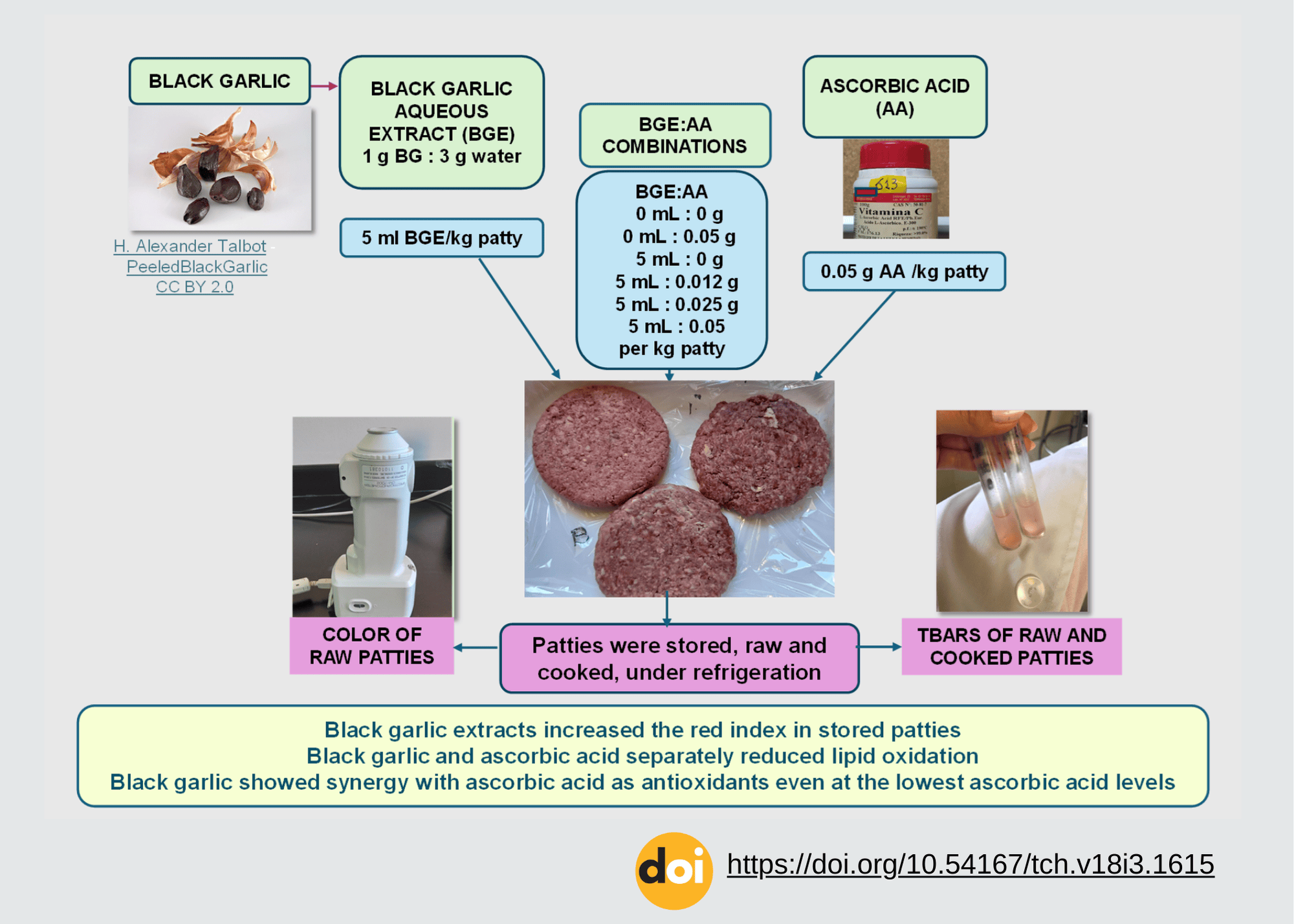
Oxidation of meat products limits their quality and shelf life and is prevented by antioxidant additives. Natural ingredients rich in antioxidants are proposed as an alternative to these additives. In this study, the antioxidant effect of an aqueous extract of black garlic, as a natural ingredient rich in polyphenols, was evaluated in pork patties. 20 ml of extract, obtained from a homogenate prepared with one-part garlic and three parts water, was used per kg of patty in combination with three levels of ascorbic acid (from 0.125 to 0.5 g/kg). The effect of different combinations to prevent discolouration in raw patties and lipid oxidation stability in cooked patties during aerobic refrigerated storage was tested. The use of black garlic extract darkened the patties and increased the red and yellow indices. Ascorbic acid potentiated the antioxidant effect of black garlic in cooked patties and vice versa. The black garlic extract combined with ascorbic acid, even in an amount four times lower than that commonly used in the meat industry, was the treatment with the highest antioxidant effect.
DOI: https://doi.org/10.54167/tch.v18i4.1683
Downloads
References
Augustyńska-Prejsnar, A., Kačániová, M., Ormian, M., Topczewska, J., Sokołowicz, Z., & Hanus, P. (2024). Quality Assessment of Minced Poultry Products Including Black Fermented Garlic. Foods, 13(1), 70. https://doi.org/10.3390/foods13010070
AMSA. (2012). http://www.meatscience.org
Barido, F. H., Jang, A., Pak, J. I., Kim, Y. J., & Sung, S. K. (2022). Combined effects of processing method and black garlic extract on quality characteristics, antioxidative, and fatty acid profile of chicken breast. Poultry Science, 101(4): 101723. https://doi.org/10.1016/j.psj.2022.101723.
Bellucci, E. R. B., Bis-Souza, C. V., Domínguez, R., Bermúdez, R., & Barretto, A. C. d. S. (2022). Addition of Natural Extracts with Antioxidant Function to Preserve the Quality of Meat Products. Biomolecules, 12(10): 1506. https://doi.org/10.3390/biom12101506
Bruun-Jensen, L., Skovgaard, Ib M., Madsen, E. A., Skibsted, L. H., & Bertelsen, G. (1996). The combined effect of tocopherols, L-ascorbyl palmitate and L-ascorbic acid on the development of warmed-over flavour in cooked, minced turkey. Food Chemistry, 55(1): 41-47. https://doi.org/10.1016/0308-8146(95)00070-4
Callejas-Cárdenas, A. R., Caro, I., Blanco, C., Villalobos-Delgado, L. H., Prieto, N., Bodas, R., Giráldez, F. J., & Mateo, J. (2014). Effect of vacuum ageing on quality changes of lamb steaks from early fattening lambs during aerobic display. Meat Science, 98(4): 646-651. https://doi.org/10.1016/j.meatsci.2014.06.036
Cirkovic Velickovic, T. D., & Stanic-Vucinic, D. J. (2018). The Role of Dietary Phenolic Compounds in Protein Digestion and Processing Technologies to Improve Their Antinutritive Properties. Comprehensive Reviews in Food Science and Food Safety, 17(1): 82-103. https://doi.org/10.1111/1541-4337.12320
Choe, E., & Min, D. B. (2006). Mechanisms and factors for edible oil oxidation. Comprehensive Reviews in Food Science and Food Safety, 5(4): 169-186. https://doi.org/10.1111/j.1541-4337.2006.00009.x
Choi, I. S., Cha, H. S., & Lee, Y. S. (2014). Physicochemical and Antioxidant Properties of Black Garlic. Molecules, 19(10): 16811-16823. https://doi.org/10.3390/molecules191016811
Dai, F., Chen, W. F., & Zhou, B. (2008). Antioxidant synergism of green tea polyphenols with α-tocopherol and l-ascorbic acid in SDS micelles. Biochimie, 90(10): 1499-1505. https://doi.org/10.1016/j.biochi.2008.05.007
Dewi, N. N. A., & Mustika, I. W. (2018). Nutrition content and antioxidant activity of black garlic. International Journal of Health Sciences, 2(1): 11-20. http://dx.doi.org/10.29332/ijhs.v2n1.86
Domínguez, R., Pateiro, M., Agregán, R., & Lorenzo, J. M. (2017). Effect of the partial replacement of pork backfat by microencapsulated fish oil or mixed fish and olive oil on the quality of frankfurter type sausage. Journal of Food Science and Technology, 54: 26-37. https://doi.org/10.1007/s13197-016-2405-7
Falowo, A. B., Fayemi, P. O., & Muchenje, V. (2014). Natural antioxidants against lipid–protein oxidative deterioration in meat and meat products: A review. Food Research International, 64: 171-181. https://doi.org/10.1016/j.foodres.2014.06.022
Habinshuti, I., Chen, X., Yu, J., Mukeshimana, O. Duhoranimana, E., Karangwa, E., Muhoza, B., Zhang, M., Xia, S., & Zhang, X. (2019). Antimicrobial, antioxidant and sensory properties of Maillard reaction products (MRPs) derived from sunflower, soybean and corn meal hydrolysates. LWT, 101: 694-702. https://doi.org/10.1016/j.lwt.2018.11.083
Hygreeva, D., Pandey, M. C., & Radhakrishna, K. (2014). Potential applications of plant-based derivatives as fat replacers, antioxidants and antimicrobials in fresh and processed meat products. Meat Science, 98(1): 47-57. https://doi.org/10.1016/j.meatsci.2014.04.006
Karre, L., Lopez, K., & Getty, K. J. (2013). Natural antioxidants in meat and poultry products. Meat Science, 94(2) : 220-227. https://doi.org/10.1016/j.meatsci.2013.01.007
Kimura, S., Tung, Y. C., Pan, M. H., Su, N. W., Lai, Y. J., & Cheng, K. C. (2017). Black garlic: A critical review of its production, bioactivity, and application. Journal of Food and Drug Analysis, 25(1): 62-70. https://doi.org/10.1016/j.jfda.2016.11.003
Khlebnikov, A. I., Schepetkin, I. A., Domina, N. G., Kirpotina, L. N., & Quinn, M. T. (2007). Improved quantitative structure-activity relationship models to predict antioxidant activity of flavonoids in chemical, enzymatic, and cellular systems. Bioorganic & Medicinal Chemistry, 15(4): 1749-1770. https://doi.org/10.1016/j.bmc.2006.11.037
Lee, H. J., Yoon, D. K., Lee, N. Y., & Lee, C. H. (2019). Effect of aged and fermented garlic extracts as natural antioxidants on lipid oxidation in pork patties. Food Science of Animal Resources, 39(4): 610-622. https://pmc.ncbi.nlm.nih.gov/articles/PMC6728816/
Min, B. R., Nam, K. C., Cordray, J. C., & Anh, D. U. (2008). Factors affecting oxidative stability of pork, beef, and chicken meat. Iowa State University Animal Industry Report, 5(1). https://doi.org/10.31274/ans_air-180814-1046
Morrissey, P. A., Sheehy, P. J. A., Galvin, K., Kerry, J. P., & Buckley, D. J. (1998). Lipid stability in meat and meat products. Meat Science, 49(1): S73-S86. https://doi.org/10.1016/S0309-1740(98)90039-0
Musci, M., & Yao, S. (2017). Optimization and validation of Folin–Ciocalteu method for the determination of total polyphenol content of Pu-erh tea. International Journal of Food Science and Nutrition, 68(8): 913–918. https://doi.org/10.1080/09637486.2017.1311844
Nam, K. C., & Ahn, D. U. (2003). Effects of ascorbic acid and antioxidants on the color of irradiated ground beef. Journal of Food Science, 68(5): 1686-1690. https://doi.org/10.1111/j.1365-2621.2003.tb12314.x
Pérez-Palacios, T., & Estévez, M. (2020). Analysis of lipids and lipid oxidation products. In Biswas, A. K., & Mandal, P. K. (Eds.) Meat Quality Analysis: Advanced Evaluation Methods, Techniques, and Technologies. (pp. 217-239). Academic Press. https://doi.org/10.1016/B978-0-12-819233-7.00013-6
Santos, L. C. R., Santos, E. N. F., Oliveira, C. C., Nascentes, G. A. N., Saldaña, E., Bastos, L. M., Martins, M. M., Campagnol, P.C.B., Cunha, L. C. S., & Jardim, F. B. B. (2024). Black garlic extract: Phytochemical characterisation and application as natural antioxidant in burgers. International Food Research Journal, 31(3). https://doi.org/10.47836/ifrj.31.3.14
Sampels, S. (2013). Oxidation and antioxidants in fish and meat from farm to fork. In Muzzalupo, I (Ed). Food Industry. Intech Open. https://dx.doi.org/10.5772/53169
Sang, S., Cheng, X., Stark, R. E., Rosen, R. T., Yang, C. S., & Ho, C. T. (2002). Chemical studies on antioxidant mechanism of tea catechins: analysis of radical reaction products of catechin and epicatechin with 2,2-Diphenyl-1-picrylhydrazyl. Bioorganic & Medicinal Chemistry, 10(7): 2233-2237. https://doi.org/10.1016/S0968-0896(02)00089-5
Shahidi, F., & Ambigaipalan, P. (2015). Phenolics and polyphenolics in foods, beverages and spices: Antioxidant activity and health effects–A review. Journal of Functional Foods, 18(Part B): 820-897. https://doi.org/10.1016/j.jff.2015.06.018
Škrovánková, S., Mlček, J., Snopek, L., & Planetová, T. (2018). Polyphenols and antioxidant capacity in different types of garlic. Potravinarstvo Slovak Journal of Food Sciences, 12(1): 267–272. https://doi.org/10.5219/895
Toledano-Medina, M. A., Pérez-Aparicio, J., Moreno-Rojas, R., & Merinas-Amo, T. (2016). Evolution of some physicochemical and antioxidant properties of black garlic whole bulbs and peeled cloves. Food Chemistry, 199: 135-139. https://doi.org/10.1016/j.foodchem.2015.11.128
Yuan, H., Sun, L., Chen, M., & Wang, J. (2016). The comparison of the contents of sugar, amadori, and heyns compounds in fresh and black garlic. Journal of Food Science, 81(7): C1662-C1668. https://doi.org/10.1111/1750-3841.13365
Downloads
Published
Issue
Section
License
Copyright (c) 2024 TECNOCIENCIA Chihuahua

This work is licensed under a Creative Commons Attribution-NonCommercial 4.0 International License.