Evaluation and physicochemical, nutraceutical, microbiological and sensory characterization of a beverage formulated from agroindustrial by-products
DOI:
https://doi.org/10.54167/tch.v18i4.1678Keywords:
beverage, orange bagasse, wheyAbstract
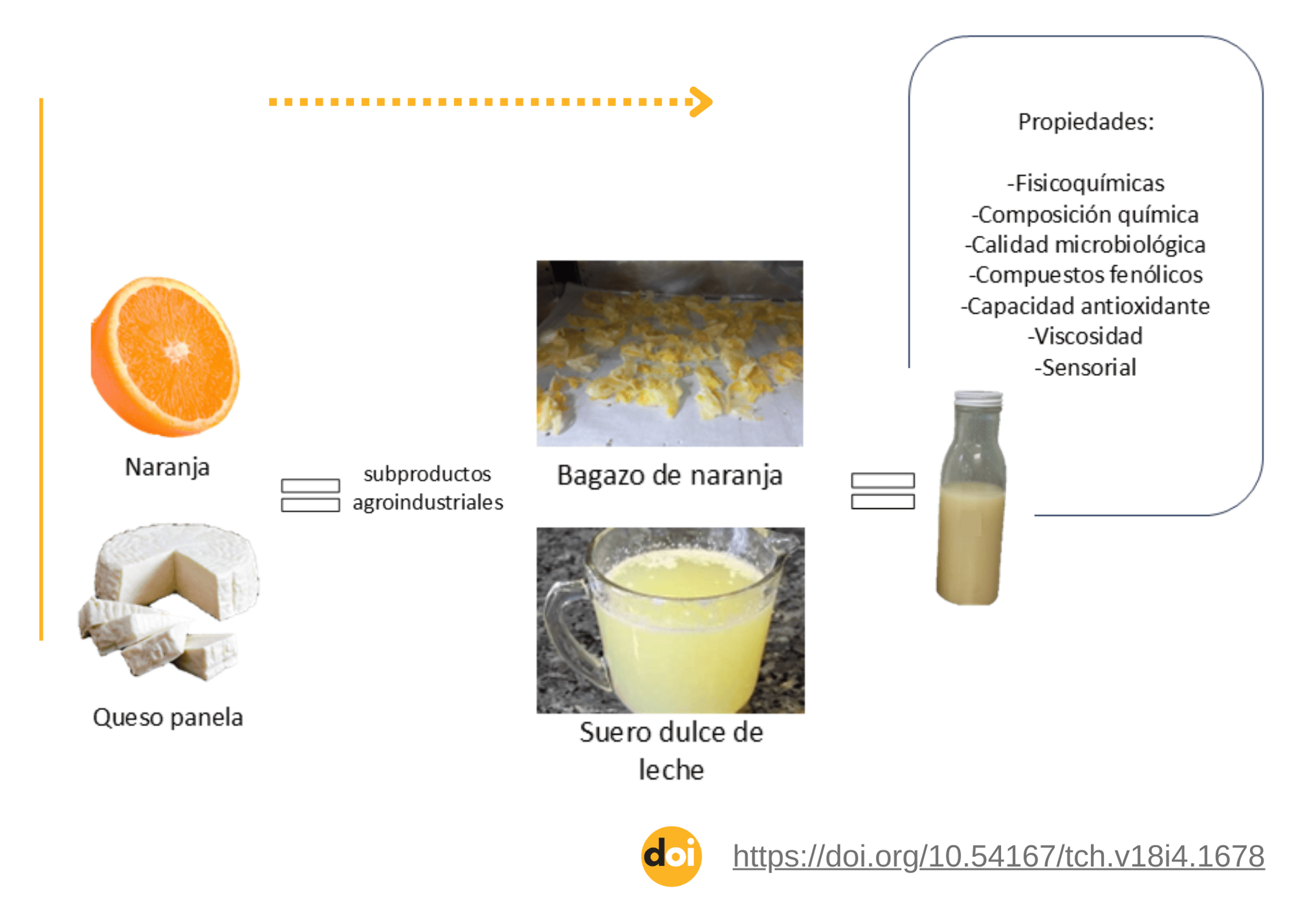
Currently, the cheese and juice agribusiness produce by-products such as whey and orange bagasse that are discarded and wasted, causing environmental pollution. Due to the above, the objective of this research was to develop a drink from sweet whey and orange bagasse. Physicochemical parameters (pH, acidity, density and °Brix), nutraceutical quality (total phenolic compounds, total flavonoids, DPPH and ABTS), chemical composition (protein, fat, fiber), microbiological quality (aerobic mesophiles, coliforms, lactic acid bacteria, psychrophilic bacteria, fungi and yeasts) rheological properties and sensory quality were evaluated. The results obtained of density (1.05 g mL-1), °Brix (13.6), pH (4.8) and acidity (0.79 g L-1), microbiological and viscosity remained constant; the values obtained in the chemical composition were shown in low percentages. The average content of total phenols (2611.46 mg EAG L-1), antioxidant capacity DPPH (573.59 µmol ET L-1) and ABTS (5288.78 µmol ET L-1) decreased during storage. Likewise, the beverage in terms of color, flavor, smell, texture and appearance obtained a medium sensory acceptability. Sweet whey and the byproduct of orange juice can be used as economic raw materials to develop new food products.
Downloads
References
AOAC. 2006. Official methods of analysis of the association of official analytical chemists (17th ed.).
Baba, W. N., Din, S., Punoo, H. A., Wani, T. A., Ahmad, M., & Masoodi, F. A. (2016). Comparison of cheese and paneer whey for production of a functional pineapple beverage: Nutraceutical properties and Shelf life. Journal of Food Science and Technology, 53: 2558-2568. https://doi.org/10.1007/s13197-016-2218-8
Caristi, C., Bellocco, E., Gargiulli, C., Toscano, G., & Leuzzi, U. (2006). Flavone-di-C-glycosides in citrus juices from Southern Italy. Food Chemistry, 95(3): 431-437. https://doi.org/10.1016/j.foodchem.2005.01.031
Chavan, P., Singh, A. K., & Kaur, G. (2018). Recent progress in the utilization of industrial waste and by-products of citrus fruits: A review. Journal of Food Process Engineering, 41(8): e12895. https://doi.org/10.1111/jfpe.12895
Del Caro, A., Piga, A., Vacca, V., & Agabbio, M. (2004). Changes of flavonoids, vitamin C and antioxidant capacity in minimally processed citrus segments and juices during storage. Food Chemistry, 84(1): 99-105. https://doi.org/10.1016/S0308-8146(03)00180-8
Durán-Mendoza, T., González-Pérez, M., Cruz-Leyva, M. C. de la, Cruz, J. U. G.- de la, Cuenca-Soria, C. A., Guzmán-Ceferino, J., Angulo-Guerrero, J. O., & Pérez-Sánchez, C. del C. (2018). Análisis Del Efecto De La Adición De Fibra Cítrica Del Bagazo De La Naranja En Las Propiedades Nutrimentales Y Sensoriales De Un Embutido Y Determinación De La Calidad Microbiológica. European Scientific Journal, 14(18): 14. https://doi.org/10.19044/esj.2018.v14n18p14
Faisal, S., Chakraborty, S., Devi, W. E., Hazarika, M. K., & Puranik, V. (2017). Sensory evaluation of probiotic whey beverages formulated from orange powder and avor using fuzzy logic. International Food Research Journal 24(2): 703-710. https://shorturl.at/xgIpG
FAO 2023. Producción y productos lácteos: Composición de la leche [en linea]. https://www.fao.org/dairy-production-products/products/milk-composition/es
Favela-Hernández, J. M. J., González-Santiago, O., Ramírez-Cabrera, M. A., Esquivel-Ferriño, P. C., & Camacho-Corona, M. D. R. (2016). Chemistry and Pharmacology of Citrus sinensis. Molecules, 21(2): 247. https://doi.org/10.3390/molecules21020247
Fernández‐López, J., Sendra‐Nadal, E., Navarro, C., Sayas, E., Viuda‐Martos, M., & Alvarez, J. A. P. (2009). Storage stability of a high dietary fibre powder from orange by‐products. International Journal of Food Science & Technology, 44(4): 748-756. https://doi.org/10.1111/j.1365-2621.2008.01892.x
Gallardo-Rivera, C., Báez-González, J.G., García-Alanís, K.G., Torres-Alvarez, C., Dares-Sánchez, K., Szymanski, A., Amaya-Guerra, C.A., & Castillo, S. (2021). Effect of Three Types of Drying on the Viability of Lactic Acid Bacteria in Foam-Mat Dried Yogurt. Processes, 9(12): 2123. https://doi.org/10.3390/pr9122123
Gattuso, G., Barreca, D., Gargiulli, C., Leuzzi,, U., & Caristi, C. (2007). Flavonoid composition of citrus juices. Molecules, 12(8): 1641-1673. https://doi.org/10.3390/12081641
Gavilanes, L. P. I., Zambrano, Z. A. M., Romero, R. C. F., & Moro, P. A. (2018). Evaluación de una bebida láctea fermentada novel a base de lactosuero y harina de camote. La Técnica. Revista de agrociencias. 19: 47-60. https://doi.org/10.33936/la_tecnica.v0i19.734
Gupta, C., & Prakash, D. (2017). Therapeutic potential of milk whey. Beverages, 3(3): 31. https://doi.org/10.3390/beverages3030031
Ilame, S. A., & Singh, S. V. (2018). Physico-chemical properties of ultrafiltered kinnow (mandarin) fruit juice. Journal of food science and technology, 55: 2189-2196. http://doi.org/10.1007/s13197-018-3136-8
Kumar, K., Yadav, A. N., Kumar, V., Vyas, P., & Dhaliwal, H. S. (2017). Food waste: A potential bioresource for extraction of nutraceuticals and bioactive compounds. Bioresources and Bioprocessing, 4: 18. https://doi.org/10.1186/s40643-017-0148-6
Mammen, D., & Daniel, M. (2012). A critical evaluation on the reliability of two aluminum chloride chelation methods for quantification of flavonoids. Food chemistry, 135(3): 1365-1368. https://doi.org/10.1016/j.foodchem.2012.05.109
NORMA Oficial Mexicana NOM-092-SSA1-1994. Bienes y servicios. Método para la cuenta de bacterias aerobias en placa.
https://dof.gob.mx/nota_detalle.php?codigo=4886029&fecha=12/12/1995#gsc.tab=0
NORMA Oficial Mexicana NOM-111-SSA1-1994. Bienes y servicios. Método para la cuenta de mohos y levaduras en alimentos.
https://dof.gob.mx/nota_detalle.php?codigo=4881226&fecha=13/09/1995#gsc.tab=0
NORMA Oficial Mexicana NOM-113-SSA1-1994. Bienes y servicios. Método para la cuenta de microorganismos coliformes totales en placa.
http://www.ordenjuridico.gob.mx/Documentos/Federal/wo69536.pdf
NORMA Oficial Mexicana NOM-155-SCFI-2012, Leche-Denominaciones, especificaciones fisicoquímicas, información comercial y métodos de prueba.
https://www.dof.gob.mx/normasOficiales/4692/seeco/seeco.htm
NORMA Oficial Mexicana NOM-173-SE-2021, Jugos, agua de coco, néctares, bebidas no alcohólicas con contenido de vegetal o fruta u hortaliza y bebidas saborizadas no alcohólicas preenvasadas-Denominaciones-Especificaciones-Información comercial y métodos de prueba.
https://www.dof.gob.mx/nota_detalle.php?codigo=5643986&fecha=28/02/2022#gsc.tab=0
NORMA Oficial Mexicana NOM-218-SSA1-2011, Productos y servicios. Bebidas saborizadas no alcohólicas, sus congelados, productos concentrados para prepararlas y bebidas adicionadas con cafeína. Especificaciones y disposiciones sanitarias. Métodos de prueba.
https://dof.gob.mx/normasOficiales/4643/salud/salud.htm
NORMA Oficial Mexicana "Determinación de pH en Alimentos" NOM-F-317-S-1978.
https://dof.gob.mx/nota_detalle.php?codigo=4704689&fecha=23/05/1978#gsc.tab=0
Pacheco, V. M. M., Porras, A. O. O., Velasco, E., Morales-Valencia, E. M., & Navarro, A. (2017). Effect of the milk-whey relation over physicochemical and rheological properties on a fermented milky drink. Ingeniería y competitividad, 19(2): 80-88. https://doi.org/10.25100/iyc.v19i2.5295
Pacheco, M. T., Moreno, F. J., & Villamiel, M. (2018a). Chemical and physicochemical characterization of orange by‐products derived from industry. Journal of the Science of Food and Agriculture, 99(2): 868-876. https://doi.org/10.1002/jsfa.9257
Pacheco, M. T., Vezza, T., Diez-Echave, P., Utrilla, P., Villamiel, M., & Moreno, F. J. (2018b). Anti-inflammatory bowel effect of industrial orange by-products in DSS-treated mice. Food & function, 9(9): 4888-4896. https://doi.org/10.1039/C8FO01060A
Parra-Huertas, R. A. (2009). Lactosuero: importancia en la industria de alimentos. Revista Facultad Nacional de Agronomía Medellín, 62(1): 4967-4982.
https://www.redalyc.org/articulo.oa?id=179915377021
Pires, A.F., Marnotes, N.G., Rubio, O.D., Garcia, A.C., & Pereira, C.D. (2021). Dairy By-Products: A Review on the Valorization of Whey and Second Cheese Whey. Foods, 10: 1067. https://doi.org/10.3390/foods10051067
Rai, P., Rai, C., Majumdar, G. C., Dasgupta, S., & De, S. (2008). Storage study of ultrafiltered mosambi (Citrus sinensis (L.) Osbeck) juice. Journal of food processing and preservation, 32(6): 923-934. https://doi.org/10.1111/j.1745-4549.2008.00222.x
Rodríguez-González, D., Colominas Aspuro, A. M., Rodríguez Fuertes, W. S., & Hernández Monzón, A. (2020). Bebida fermentada de suero con la adición de salvado de trigo y pulpa de guayaba (Psidium guava L.). Tecnología Química, 40(2), 428-441. https://shorturl.at/rV72W
Rodríguez-Basantes, A. I., Abad Basantes, C. A., Pérez Martínez, A., & Diéguez Santana, K. (2020). Elaboración de una bebida a base de suero lácteo y pulpa de Theobroma grandiflorum. Biotecnología en el sector agropecuario y agroindustrial, 18(2): 166–175. https://doi.org/10.18684/BSAA(18)166-175
Rodríguez-Salinas, P. A., Urías-Orona, V., Muy-Rangel, D., Basilio-Heredia, J., Suarez-Jacobo, A., Báez-González, J. G., Zavala-García, F., & Niño-Medina, G. (2021). Efecto de termosonicación y pasteurización sobre propiedades fisicoquímicas, microbiológicas y nutracéuticas en bebidas de maíz. Biotecnia, 23(1): 92-101. https://doi.org/10.18633/biotecnia.v23i1.1204
Sady, M., Jaworska, G., Grega, T., Bernas, E., & Domagala, J. (2013). Application of acid whey in orange drink production. Food Technology and Biotechnology, 51(2): 266. https://www.ftb.com.hr/archives/1096-application-of-acid-whey-in-orange-drink-production
Singh, B., Singh, J. P., Kaur, A., & Singh, N. (2020). Phenolic composition, antioxidant potential and health benefits of citrus peel. Food Research International, 132: 109114. https://doi.org/10.1016/j.foodres.2020.109114
Skryplonek, K., Dmytrów, I., & Mituniewicz-Małek, A. (2019). Probiotic fermented beverages based on acid whey. Journal of Dairy Research. 102 (9): 7773-7780. https://doi.org/10.3168/jds.2019-16385
Souza, H. F. D., Borges, L. A., Lopes, J. P. A., Carvalho, B. M. A. D., Santos, S. H. S., Almeida, A. C. D., Lima, W. J. N., & Brandi, I. V. (2020). Elaboration, evaluation of nutritional information and physical-chemical stability of dairy fermented drink with caja-mango pulp. Food Technology. Ciência Rural, 50(1). https://doi.org/10.1590/0103-8478cr20190644
Wedamulla, N. E., Fan, M., Choi, Y. J., & Kim, E. K. (2022). Citrus peel as a renewable bioresource: Transforming waste to food additives. Journal of Functional Foods, 95: 105163. https://doi.org/10.1016/j.jff.2022.105163
Yadav, J. S. S., Yan, S., Pilli, S., Kumar, L., Tyagi, R. D., & Surampalli, R. Y. (2015). Cheese whey: A potential resource to transform into bioprotein, functional/nutritional proteins and bioactive peptides. Biotechnology advances, 33(6): 756-774. https://doi.org/10.1016/j.biotechadv.2015.07.002
Downloads
Published
Issue
Section
License
Copyright (c) 2024 TECNOCIENCIA Chihuahua

This work is licensed under a Creative Commons Attribution-NonCommercial 4.0 International License.