Margaritasite: an exclusive Chihuahuan mineral
DOI:
https://doi.org/10.54167/tch.v19i1.1675Keywords:
Margaritasite, Chihuahua, synchrotron, EXAFS.Abstract
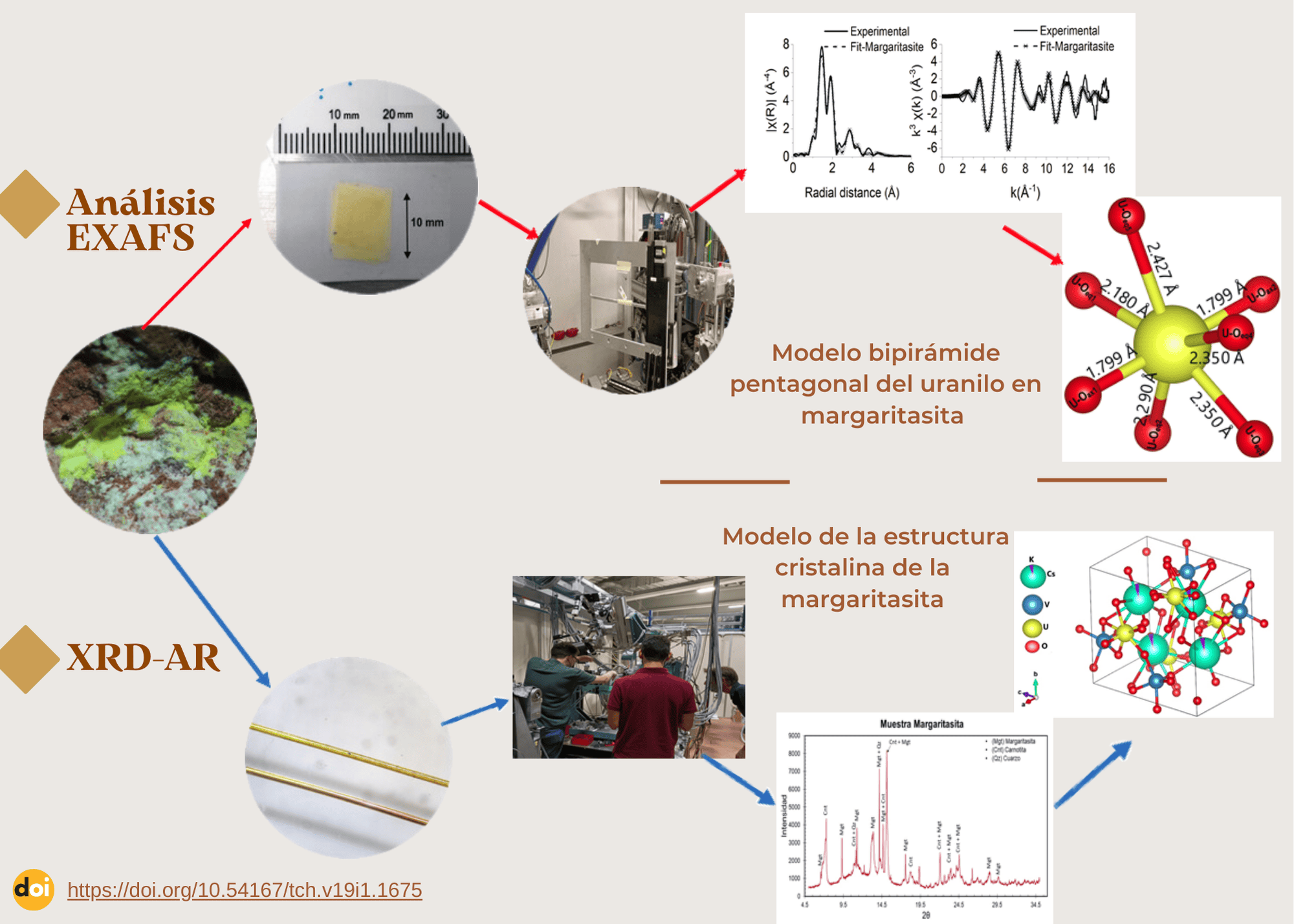
Margaritasite [Cs2(UO2)2(VO4)2-nH2O] is, to date, a uranovanadate exclusive of the Sierra Peña Blanca, Chihuahua. In this work we share the results obtained by the characterization of margaritasite, employing the techniques of high-resolution X-ray diffraction (HRXRD) and fine structure X-ray absorption (EXAFS) using synchrotron light. The characterization was performed at the Diamond Light Source Synchrotron station B18 (United Kingdom) and at the high precision diffractometer of Elettra in Triestre (Italy).
The margaritasite, with micrometric tabular habit (1 - 3 μm), presents the phases pure margarite and carnotite in disordered solid solution K-Cs in 1:1 ratio, accompanied by quartz, montmorillonite, potassium feldspar and calcite. X-ray absorption near edge structure (XANES) and EXAFS were used to determine the association of vanadium and cesium with uranium in the margaritasite phase. The study characterized the structure of the uranyl pentagonal prism by determining the U-O bond distances, characteristic of uranovanadates.
DOI: https://doi.org/10.54167/tch.v19i1.1675
Downloads
References
Alba, L.A., & Chávez, R. (1974). K-Ar ages of volcanics rocks from the central Sierra Peña Blanca, Chihuahua, México. Isochron/West, Bulletin of Isotopic Geochronology 10: 21–23. https://geoinfo.nmt.edu/publications/periodicals/isochronwest/home.cfml?Issue=10
Appleman, D.E., Evans, J., & Howard, T. (1965). The crystal structures of synthetic anhydrous carnotite, K2(UO2)2V2O8, and its cesium analogue, Cs2(UO2)2V2O8. Am. Mineral., 50: 825–843. https://rruff.geo.arizona.edu/AMS/result.php?key=_database_code_amcsd+0000135&viewing=html
Faudoa, F., Fuentes, L., Esparza, H., Canche, J., Reyes, I., Fuentes, M., Eichert, D., Rodríguez, Y., & Montero, M. (2024). Geological and Crystallochemical Characterization of the Margaritasite–Carnotite Mineral from the Uranium Region of Peña Blanca, Chihuahua, Mexico. Minerals, 14(4): 431. https://doi.org/10.3390/min14040431
Goodell, P., Trentham, R., & Carroway, K. (1978). Geologic Setting of the Pena Blanca Uranium Deposits. In Formation of Uranium Ores by Diagenesis of Volcanic Sediments: Grand Junction, US Dept. of Energy Report GJBX. In: Henry, C.D., Walton, A.W. (Eds.), Formation of Uranium Ores by Diagenesis of Volcanic Sediments. US Bureau of Economic Geology: The University of Texas at Austin, TX, USA; pp. 22–79. https://hdl.handle.net/2152/123912
Goodell, P.C. (1985). Chihuahua City Uranium Province, Chihuahua Mex. In Proceedings of the Technical Committee Meeting on Uranium Deposits in Volcanic Rocks, El Paso, TX, USA, 2–5 April 1984; IAEA: El Paso, TX, USA; pp. 97–124. https://inis.iaea.org/records/z73ve-sqe42
Instituto Nacional de Investigaciones Nucleares (ININ), (2023). https://goo.su/PqnVzm
Keith, T.E.C., Thompson, J.M., & Mays, R.E.(1983). Selective concentration of cesium in analcime during hydrothermal alteration, Yellowstone National Park, Wyoming. Geochim. et Cosmochim. Acta, 47(4): 795–804. https://doi.org/10.1016/0016-7037(83)90113-8
Newville, M. (2014). Fundamentals of XAFS. Reviews in Mineralogy and Geochemistry 78 (1): 33–74. https://doi.org/10.2138/rmg.2014.78.2
Parson, T. (2006). Chapter 7 The basin and Range province. In: Osen, K.H. (Ed.) Developments in Geotectonics, Elsevier, Vol. 25, pp. 277-XV. https://doi.org/10.1016/S0419-0254(06)80015-7
Ravel, B., & Newville, M. (2005). ATHENA, ARTEMIS, HEPHAESTUS: Data analysis for X-ray absorption spectroscopy using IFEFFIT. J. Synchrotron Radiat. 12: 537–541. https://doi.org/10.1107/S0909049505012719
Rehr, J.J.; Albers, R.C. (2000) Theoretical approaches to X-ray absorption fine structure. Rev. Mod. Phys., 72: 621. https://doi.org/10.1103/RevModPhys.72.621
Rodríguez-Carvajal, J. (1993). Recent advances in magnetic structure determination by neutron powder diffraction. Phys. B: Condens. Matter, 192(1-2): 55–69. https://doi.org/10.1016/0921-4526(93)90108-I
Salas, G.P., & Nieto, F.C. (1991). Geology of uranium deposits in Mexico. In Economic Geology, Mexico; Geological Society of America: Boulder, CO, USA; Volume P-3, pp. 161–166. https://goo.su/ds7HL4c
Shanks, W.C.P., Morgan, L., Balistrieri, L.S., & Alt, J.C. (2005). Hydrothermal vent fluids, siliceous hydrothermal deposits, and hydrothermally altered sediments in Yellowstone Lake. In: Proceedings of the Thermal Biology Institute Workshop, Yellowstone National Park, WY, USA; pp. 53–72. USGS Publications Warehouse. https://pubs.usgs.gov/publication/70203380
Walker, G.W. (1981). Uranium, Thorium, and Other Metal Associations in Silicic Volcanic Complexes of the Northern Basin and Range, a Preliminary Report. US Geological Survey: Denver, CO, USA. USGS Numbered Series 2331-1258. https://doi.org/10.3133/ofr811290
Wenrich, K.J., Modreski, P.J., Zielinski, R.A.Z., & Seeley, J.L. (1982). Margaritasite: A new mineral of hydrothermal origin from the Pena Blanca Uranium District, Mexico. Am. Mineral., 67, 1273–1289. https://pubs.usgs.gov/publication/70011893
Downloads
Published
Issue
Section
License
Copyright (c) 2025 TECNOCIENCIA Chihuahua

This work is licensed under a Creative Commons Attribution-NonCommercial 4.0 International License.