Growth, yield and quality of habanero chili grown under shade nets of different colors
DOI:
https://doi.org/10.54167/tch.v19i1.1662Keywords:
Capsicum chinense Jacq., antioxidant capacity, flavonoids, phenols, total soluble sugarsAbstract
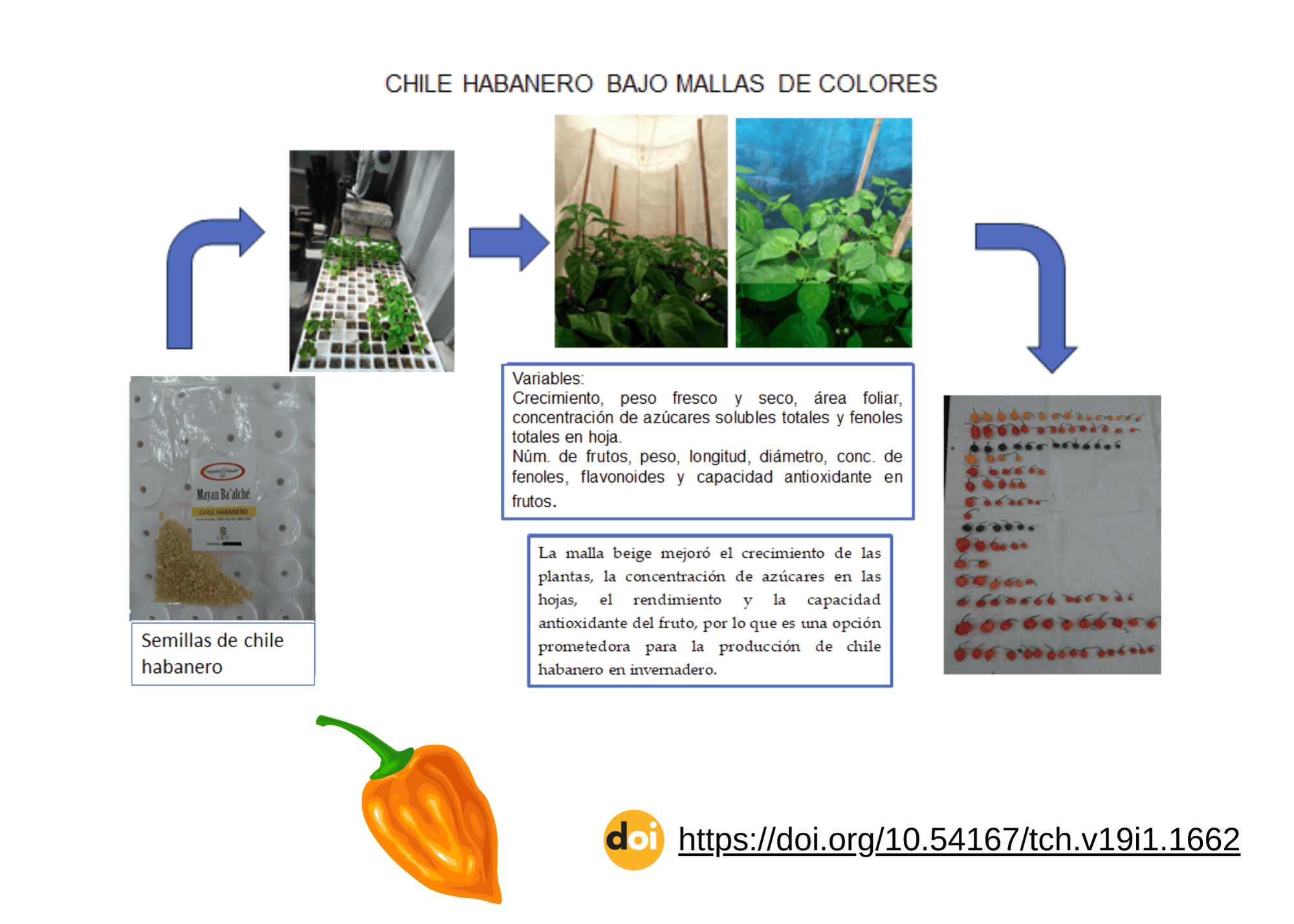
Habanero pepper (Capsicum chinense Jacq.) outstands for its high level of pungency and high content of antioxidant compounds. The aim of this study was to evaluate the effect of nets of different colors on vegetative growth, yield, and fruit quality, in order to determine the best option for an alternative production system for habanero peppers under greenhouse. The crop was established in a glass greenhouse with an open hydroponic system. Seeds of the ‘Mayan Ba'alché’ habanero pepper were utilized. Treatments consisted on the use of green, beige, blue, and black nets, and without a net (control). The study assessed the fresh and dry weight of the aerial part, roots, and fruits, foliar area, specific weight, concentration of total soluble sugars and phenolic compounds in the leaves. The concentration of phenolic compounds, total flavonoids, and antioxidant capacity were determined in fruits. The use of the beige net resulted in a 22 % increase in the dry weight of the aerial part, as compared to the control. The control treatment presented a 37 % increase in dry root weight and a 25 % increase in specific leaf weight compared to the treatment with the colored nets. The foliar area of plants under all colored nets, was larger than the control. Fruits treated with the beige net yielded a 15 % increase in quantity, a 16 % increase in weight, and a 40 % increase in flavonoid content; therefore, it can be an alternative for production of habanero chili in greenhouse.
DOI: https://doi.org/10.54167/tch.v19i1.1662
Downloads
References
Basile, B., Giaccone, M., Cirillo, C., Ritieni, A., Graziani, G., Shahak, Y., & Forlani, M. (2012). Photo-selective hail nets affect fruit size and quality in Hayward kiwifruit. Scientia Horticulturae 141: 91-97. https://doi.org/10.1016/j.scienta.2012.04.022
Benzie, I. F. F., & Strain, J. J. (1996). The ferric reducing ability of plasma (FRAP) as a measure of "antioxidant power": the FRAP assay. Analytical Biochemistry Journal 239(1): 70-76. https://doi.org/10.1006/abio.1996.0292
Buthelezi, M. N. D., Soundy, P., Jifon, J., & Sivakumar, D. (2016). Spectral quality of photo-selective nets improves phytochemicals and aroma volatiles in coriander leaves (Coriandrum sativum L.) after postharvest storage. Journal of Photochemistry and Photobiology B: Biology 161: 328-334. https://doi.org/10.1016/j.jphotobiol.2016.05.032
Carballo-Bautista, M. A., Moguel-Salazar, F., Brito-Argáez, L., Cristóbal-Alejo, J., & Islas-Flores, I. (2010). Breve descripción morfológica de un pequeño fruto interno que crece en el fruto principal del chile habanero (Capsicum chinense Jacq.). Revista Fitotecnia Mexicana 33(4): 281-285. https://doi.org/10.35196/rfm.2010.4.281
Casal, J. J. (2013). Photoreceptor signaling networks in plant responses to shade. Annual Review of Plant Biology 64: 403–427. https://doi.org/10.1146/annurev-arplant-050312-120221
Cázares-Sánchez., E., Ramírez-Vallejo., P., Castillo-González., F., Soto-Hernández., R. M., Rodríguez-González, M. T., & Chávez-Servia., J. L. (2005). Capsaicinoides y preferencia de uso en diferentes morfotipos de chile (Capsicum annumm L.) del centro-oriente de Yucatán. Agrociencia 39(6): 627–638. https://www.redalyc.org/articulo.oa?id=30239606
Chang, C. C., Yang, M. H., Wen, H. M., & Chern, J. C. (2002). Estimation of total flavonoid content in propolis by two complementary colorimetric methods. Journal of Food and Drug Analysis 10(3): 178-182. https://doi.org/10.38212/2224-6614.2748
Crang, R., Lyons-Sobaski, S., & Wise, R. (Eds.). (2018). Plant Anatomy A Concept-Based Approach to the Structure of Seed Plants. Springer Nature. https://doi.org/10.1007/978-3-319-77315-5
Duduzile, B. M. N., Soundy, P., Jifon, J., & Sivakumar, D. (2016). Spectral quality of photo-selective nets improves phytochemicals and aroma volatiles in coriander leaves (Coriandrum sativum L.) after postharvest storage. Journal of Photochemistry and Photobiology B: Biology 161: 328-334. https://doi.org/10.1016/j.jphotobiol.2016.05.032
Heredia, J. B., & Cisneros-Zevallos, L. (2009). The effects of exogenous ethylene and methyl jasmonate on the accumulation of phenolic antioxidants in selected whole and wounded fresh produce. Food Chemistry 115(4): 1500-1508. https://doi.org/10.1016/j.foodchem.2009.01.078
Heuvelink, E., & Kõrner, O. (2001). Parthenocarpic fruit growth reduces yield fluctuation and blossom end rot in sweet pepper. Annals of Botany 88(1): 69–74. https://doi.org/10.1006/anbo.2001.1427
Ilić, Z.S., Milenković, L., Stanojević, L., Cvetković, D., & Fallik, E. (2012). Effects of the modification of light intensity by color shade nets on yield and quality of tomato fruits. Sci. Hort. 139: 90–95. https://doi.org/10.1016/j.scienta.2012.03.009
Latournerie, L., Chávez, J. L., Pérez, M., Castañón, G., Rodríguez, S. A., Arias, L. M., & Ramírez, P. (2002). Valoración in situ de la diversidad morfológica de chiles (Capsicum annum L. y Capsicum chinense Jacq.) en Yaxcabá, Yucatán. Revista Fitotecnia Mexicana 25(1): 25-33. https://revfitotecnia.mx/index.php/RFM/article/view/1342
Lobos, G. A., Retamales, J. B., Hancock, J. F., Flore, J. A., Romero-Bravo, S., & del Pozo, A. (2013). Productivity and fruit quality of Vaccinium corymbosum cv. Elliott under photo-selective shading nets. Scientia Horticulturae 153: 143-149. https://doi.org/10.1016/j.scienta.2013.02.012
Macías-Rodríguez, H., Muñoz-Villalobos, J. A., Velásquez-Valle, M. A., Potisek-Talavera, M. C., & Villa-Castorena, M. M. (2013). Chile habanero: Descripción de su cultivo en la Península de Yucatán. Revista Chapingo Serie Zonas Áridas 12 (2): 37-43. https://www.redalyc.org/articulo.oa?id=455545057001
Mahmood, A., Hu, Y., Tanny, J., & Asante, E. A. (2018). Effects of shading and insect-proof screens on crop microclimate and production: A review of recent advances. Scientia Horticulturae 241: 241-251. https://doi.org/10.1016/j.scienta.2018.06.078
Morales, I., Martínez-Gutiérrez, G. A., Escamirosa-Tinoco, C., Nájera, C., da Cunha-Chiamolera, T. P. L., & Urrestarazu, M. (2018). Production and Quality of Physalis ixocarpa Brot. Fruit under Colored Shade Netting. HortScience 53(6): 823-828. https://doi.org/10.21273/HORTSCI13100-18
Retamales, J. B., Montecino, J. M., Lobos, G. A., & Rojas, L. A. (2008). Colored shading nets increase yields and profitability of highbush blueberries. XXVII International Horticultural Congress - IHC2006: International Symposium on Cultivation and Utilization of Asian, Sub-tropical, and Underutilized Horticultural Crops. Acta Horticulturae 770: 193-198. https://www.actahort.org/books/770/770_22.htm
SAS Institute inc. (2006). Base SAS 9.1.3 Procedures Guide. 2a edition. Volumes 1, 2, 3 y 4. Cary, NC: SAS Institute Inc.
Sasidharan, R., Chinnappa, C. C., Staal, M., Elzenga, J. T., Yokoyama, R., Nishitani, K., Voesenek, L. A., & Pierik, R. (2010). Light quality-mediated petiole elongation in Arabidopsis during shade avoidance involves cell wall modification by xyloglucan endotransglucosylase/hydrolases. Plant Physiology 154(2): 978-990. https://doi.org/10.1104/pp.110.162057
Shahak, Y., Ratner, K., Giller, Y. E., Zur, N., Or, E., Gussakovsky, E. E., Stern, R., Sarig, P., Raban, E., Harcavi, E., Doron, I., & Greenblat-Avron, Y. (2008). Improving solar energy utilization, productivity and fruit quality in orchards and vineyards by photoselective netting. XXVII International Horticultural Congress - IHC2006: International Symposium on Enhancing Economic and Environmental Sustainability of Fruit Production in a Global Economy. Acta Horticulturae 772: 65-72. https://www.actahort.org/books/772/772_7.htm
SIAP. (2023). Servicio de Información Agroalimentaria y Pesquera https://www.gob.mx/siap/acciones-y-programas/produccion-agricola-33119
Steiner, A. A. (1984). The universal nutrient solution. In: Proceedings 6th International Congress on Soilless Culture. Wageningen, The Netherlands. International Society for Soilless Culture. pp. 633-650. CABI Record Number: 19851996315.
Taiz, L., Zeiger, E., Møller, I. M., & Murphy, A. (Eds.). (2015). Plant Physiology and Development. Sixth Ed. Sinauer Associates, Sunderland, CT. Inc.٠Publishers.
Tinyane, P. P., Sivakumar, D., & Soundy, P. (2013). Influence of photo-selective netting on fruit quality parameters and bioactive compounds in selected tomato cultivars. Scientia Horticulturae 161: 340-349. http://dx.doi.org/10.1016/j.scienta.2013.06.024
Wallace, R.W., Wszelaki, A. L., Miles, C. A., Cowan, J. S., Martin, J., Roozen, J., Gundersen, B., & Inglis, D. A. (2012). Lettuce yield and quality when grown in high tunnel and open-field production systems under three diverse climates. HortTechnology 22(5): 659–668. https://doi.org/10.21273/HORTTECH.22.5.659
Waterman, P. G., & Mole, S. (Eds.). (1994). Analysis of Phenolic Plant Metabolites. Methods in Ecology. Black Well Scientific Publications, Oxford, 73-99.
Witham, F. H., Blaydes, D. F., & Devlin, R. M. (Eds.). (1971). Experiments in Plant Physiology. Van Nostrand Reinhold Company. New York, 245.
Zhou, K., Jerszurki, D., Sadka, A., Shlizerman, L., Rachmilevitch, S., & Ephrath, J. (2018). Effects of photoselective netting on root growth and development of young grafted orange trees under semi-arid climate. Scientia Horticulturae 238: 272-280. https://doi.org/10.1016/j.scienta.2018.04.054
Downloads
Published
Issue
Section
License
Copyright (c) 2025 TECNOCIENCIA Chihuahua

This work is licensed under a Creative Commons Attribution-NonCommercial 4.0 International License.