Phenolic compounds and antioxidant capacity of extracts from calyces of (Hibiscus sabdariffa L.) varieties of different origins
DOI:
https://doi.org/10.54167/tch.v18i4.1594Keywords:
Hibiscus sabdariffa L., solvent, Chlorogenic acids, anthocyaninsAbstract
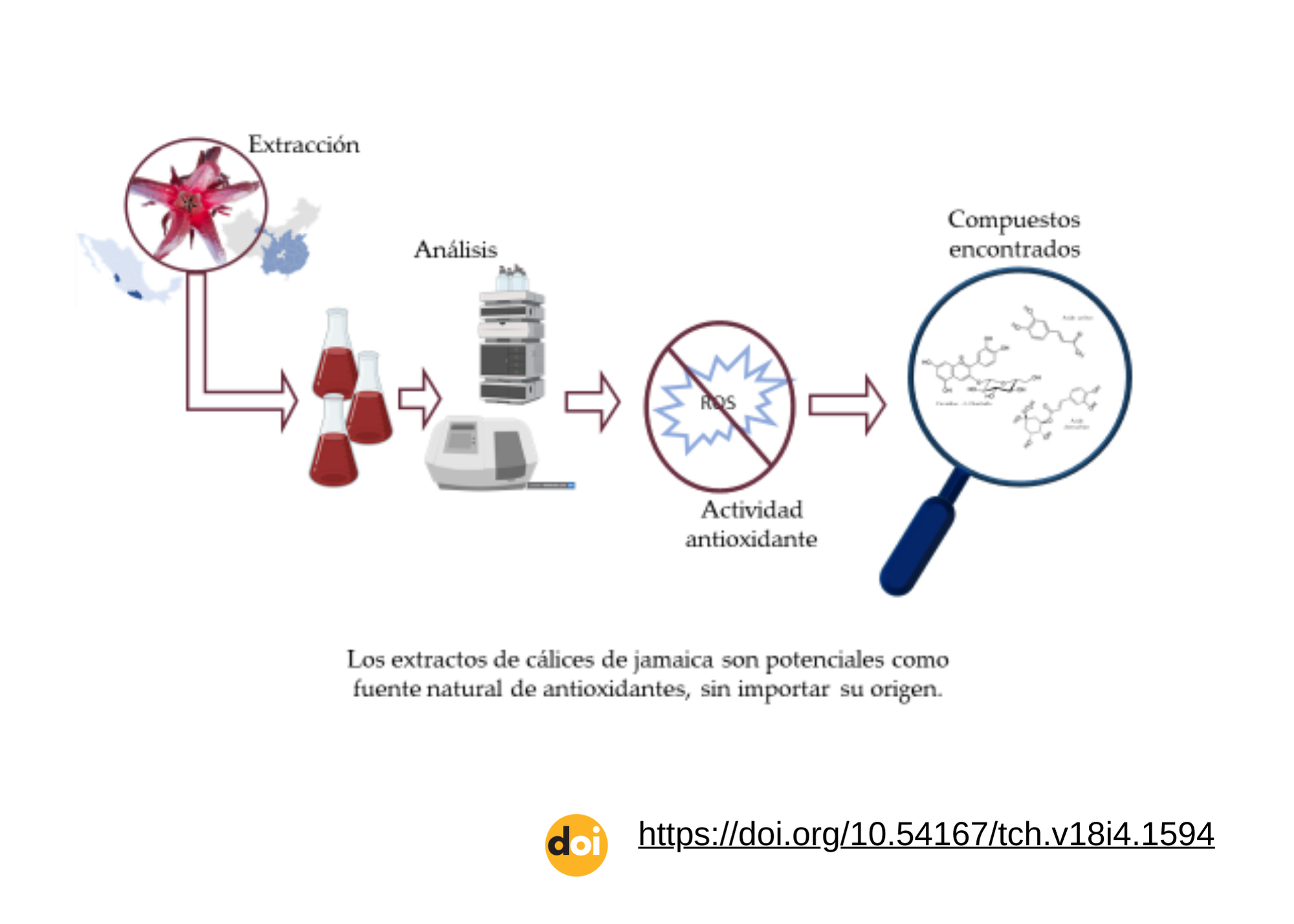
Hibiscus sabdariffa L. calyces are a source of bioactive compounds with applications in the food, pharmaceutical, and cosmetic industries. This study aimed to analyze the content of anthocyanins (CAT) and fractions of phenolic acids (PA) in hibiscus calyx extracts and to determine their antioxidant capacity (AC). Three hibiscus varieties were used: two of national origin with light-colored calyces and one imported (dark-colored calyces). Two solvents were used individually: water (~95 °C) and acidified methanol (at room temperature). CAT and fractionated phenolic acids (free, glycosylated, and esterified) were quantified using spectrophotometry and analyzed by HPLC. AC was determined using the DPPH (2, 2-diphenyl-1-picrylhydrazyl) radical assay. The aqueous extract showed 51 % AC, compared to 63.7 % in the methanolic extract. However, the anthocyanin profile remained unchanged across extraction methods. In the aqueous extracts, esterified phenolic acids were the most prominent, while free phenolic acids were the least. Chlorogenic and caffeic acids were the most abundant phenolic acids identified. Furthermore, the highest AC was found in the aqueous extract of Chinese roselle, due to its high CAT. However, in the analysis of the samples standardized to 100 μg/mL CAT, the Chinese roselle extract presented the lowest AC. The bioactive yield of hibiscus calyces is influenced by both the extraction method and the variety used. The extraction of bioactives from hibiscus calyxes is higher in methanol than in aqueous extract. Imported hibiscus has a higher anthocyanin content compared to domestic hibiscus.
DOI: https://doi.org/10.54167/tch.v18i4.1594
Downloads
References
Abou-Arab, A. A., Abu-Salem, F. M., & Abou-Arab, E. A. (2011). Physico-chemical properties of natural pigments (anthocyanin) extracted from Roselle calyces (Hibiscus subdariffa). Journal of American Science 7(7): 445-456. http://www.americanscience.org/
Alañón, M. E., Ivanović, M., Pimentel-Mora, S., Borrás-Linares, I., Arráez-Román, D., & Segura-Carretero, A. (2020). A novel sustainable approach for the extraction of value-added compounds from Hibiscus sabdariffa L. calyces by natural deep eutectic solvents. Food Research International, 137: 109646. https://doi.org/10.1016/j.foodres.2020.109646
Amaya-Cruz, D., Peréz-Ramírez, I. F., Pérez-Jiménez, J., Nava, G. M., & Reynoso-Camacho, R. (2019). Comparison of the bioactive potential of Roselle (Hibiscus sabdariffa L.) calyx and its by-product: Phenolic characterization by UPLC-QTOF MSE and their anti-obesity effect in vivo. Food Research International, 126: 108589. https://doi.org/10.1016/j.foodres.2019.108589
Babenko, L. M., Smirnov, O. E., Romanenko, K. O., Trunova, O. K., & Kosakivska, I. V. (2019). Phenolic compounds in plants: Biogenesis and functions. Ukr. Biochem. J, 91(3): 5-18. https://doi.org/10.15407/ubj91.03.005
Bakan, B., Bily, A. C., Melcion, D., Cahagnier, B., Regnault-Roger, C., Philogène, B. J., & Richard-Molard, D. (2003). Possible role of plant phenolics in the production of trichothecenes by Fusarium graminearum strains on different fractions of maize kernels. Journal of agricultural food chemistry, 51(9): 2826-2831. https://doi.org/10.1021/jf020957g
Brouillard, R. (1982). Chemical structure of anthocyanins. In: Markakis P, editor. Anthocyanins as food colors. New York: Academic Press. p. 1–40. https://www.sciepub.com/reference/160959
Carvajal-Zarrabal, O., Barradas-Dermitz, D. M., Orta-Flores, Z., Hayward-Jones, P. M., Nolasco-Hipólito, C., Aguilar-Uscanga, M. G., Miranda-Medina, A., & Bujang, K. B. (2012). Hibiscus sabdariffa L., roselle calyx, from ethnobotany to pharmacology. Journal of experimental pharmacology, 4: 25-39. https://doi.org/https://doi.org/10.2147/JEP.S27974
Cassol, L., Rodrigues, E., & Zapata-Noreña, C. P. (2019). Extracting phenolic compounds from Hibiscus sabdariffa L. calyx using microwave assisted extraction. Industrial crops products, 133: 168- https://doi.org/10.1016/j.indcrop.2019.03.023
Chisomo-Chatepa, L. E., Masamba, K. G., Sanudi, T., Ngwira, A., Tanganyika, J., & Chamera, F. (2023). Effects of aqueous and methanolic solvent systems on phytochemical and antioxidant extraction from two varieties of Roselle (Hibiscus sabdariffa L.) var. sabdariffa plant from Central Malawi. Food and Humanity, 1: 1172-1179. https://doi.org/https://doi.org/10.1016/j.foohum.2023.09.006
Cid-Ortega, S., & Guerrero-Beltrán, J. (2015). Roselle calyces (Hibiscus sabdariffa), an alternative to the food and beverages industries: a review. Journal of Food Science Technology, 52(11): 6859-6869. http://dx.doi.org/10.1007/s13197-015-1800-9
Debelo, H., Fiecke, C., Terekhov, A., Reuhs, B., Hamaker, B., & Ferruzzi, M. G. (2023). Compositional analysis of phytochemicals and polysaccharides from Senegalese plant ingredients: Adansonia digitata (baobab), Moringa oleifera (moringa) and Hibsicus sabdariffa (hibiscus). NFS Journal, 32: 100144. https://doi.org/https://doi.org/10.1016/j.nfs.2023.100144
Escobar‐Ortiz, A., Castaño‐Tostado, E., Rocha‐Guzmán, N. E., Gallegos‐Infante, J. A., & Reynoso‐Camacho, R. (2021). Anthocyanins extraction from Hibiscus sabdariffa and identification of phenolic compounds associated with their stability. Journal of the Science of Food and Agriculture, 101(1): 110-119. https://doi.org/10.1002/jsfa.10620
Enaru, B., Drețcanu, G., Pop, T. D., Stǎnilǎ, A., & Diaconeasa, Z. (2021). Anthocyanins: Factors affecting their stability and degradation. Antioxidants, 10(12): 1967. https://doi.org/10.3390/antiox10121967
Fossen, T., Slimestad, R., & Andersen, Ø. M. (2001). Anthocyanins from Maize (Zea mays) and Reed Canarygrass (Phalaris arundinacea). Journal of Agricultural and Food Chemistry, 49(5): 2318-2321. https://doi.org/10.1021/jf001399d
Galicia-Flores, L. A., Salinas-Moreno, Y., Espinoza-García, B. M., & Sánchez-Feria, C. (2008). Caracterización fisicoquímica y actividad antioxidante de extractos de jamaica (Hibiscus sabdariffa L.) nacional e importada. Revista Chapingo. Serie horticultura, 14(2): 121-129. https://www.redalyc.org/articulo.oa?id=60911556003
Głowniak, K., Zgórka, G., & Kozyra, M. (1996). Solid-phase extraction and reversed-phase high-performance liquid chromatography of free phenolic acids in some Echinacea species. Journal of Chromatography A, 730(1-2): 25-29. https://doi.org/https://doi.org/10.1016/0021-9673(95)00877-2
Huang, C.-N., Chan, K.-C., Lin, W.-T., Su, S.-L., Wang, C.-J., & Peng, C.-H. (2009). Hibiscus sabdariffa Inhibits Vascular Smooth Muscle Cell Proliferation and Migration Induced by High Glucose—A Mechanism Involves Connective Tissue Growth Factor Signals. Journal of Agricultural and Food Chemistry, 57(8): 3073-3079. https://doi.org/10.1021/jf803911n
Ifie, I., Ifie, B. E., Ibitoye, D. O., Marshall, L. J., & Williamson, G. (2018). Seasonal variation in Hibiscus sabdariffa (Roselle) calyx phytochemical profile, soluble solids and α-glucosidase inhibition. Food Chemistry, 261: 164-168. https://doi.org/https://doi.org/10.1016/j.foodchem.2018.04.052
Li, N., Simon, J. E., & Wu, Q. (2024). Determination of anthocyanins, organic acids and phenolic acids in hibiscus market products using LC/UV/MS. Journal of Food Science, 89(2): 1098-1113. https://doi.org/10.1111/1750-3841.16909
Maciel, L. G., do Carmo, M. A. V., Azevedo, L., Daguer, H., Molognoni, L., de Almeida, M. M., ... & Rosso, N. D. (2018). Hibiscus sabdariffa anthocyanins-rich extract: Chemical stability, in vitro antioxidant and antiproliferative activities. Food and Chemical Toxicology, 113: 187-197. https://doi.org/10.1016/j.fct.2018.01.053
Mejía, J. J., Sierra, L. J., Ceballos, J. G., Martínez, J. R., & Stashenko, E. E. (2023). Color, antioxidant capacity and flavonoid composition in Hibiscus rosa-sinensis cultivars. Molecules, 28(4): 1779. https://doi.org/10.3390/molecules28041779
Marques, V., & Farah, A. (2009). Chlorogenic acids and related compounds in medicinal plants and infusions. Food Chemistry, 113(4): 1370-1376. https://doi.org/https://doi.org/10.1016/j.foodchem.2008.08.086
Morales-Cabrera, M., Hernández-Morales, J., Leyva-Rúelas, G., Salinas-Moreno, Y., Soto-Rojas, L., & Castro-Rosas, J. (2013). Influence of variety and extraction solvent on antibacterial activity of roselle (Hibiscus sabdariffa L.) calyxes. Journal of Medicinal Plants Research, 7(31): 2319-2322. https://doi.org/10.5897/JMPR12.1242
Piovesana, A., & Zapata-Noreña, C. P. (2019). Study of acidified aqueous extraction of phenolic compounds from . calyces. The Open Food Science Journal, 11: 25-34. https://benthamopenarchives.com/abstract.php?ArticleCode=TOFSJ-11-25
Prenesti, E., Berto, S., Daniele, P. G., & Toso, S. (2007). Antioxidant power quantification of decoction and cold infusions of Hibiscus sabdariffa flowers. Food Chemistry, 100(2): 433-438. https://doi.org/https://doi.org/10.1016/j.foodchem.2005.09.063
Prior, R. L., Wu, X., & Schaich, K. (2005). Standardized Methods for the Determination of Antioxidant Capacity and Phenolics in Foods and Dietary Supplements. Journal of Agricultural and Food Chemistry, 53(10): 4290-4302. https://doi.org/10.1021/jf0502698
Reyes-Luengas, A., Salinas-Moreno, Y., Ovando-Cruz, M. E., Arteaga-Garibay, R. I., & Martínez-Peña, M. D. (2015). Análisis de ácidos fenólicos y actividad antioxidante de extractos acuosos de variedades de jamaica (Hibiscus sabdariffa L.) con cálices de colores diversos. Agrociencia, 49(3): 277-290. https://www.redalyc.org/articulo.oa?id=30238027004
Riaz, G., & Chopra, R. (2018). A review on phytochemistry and therapeutic uses of Hibiscus sabdariffa L. Biomedicine & Pharmacotherapy, 102: 575-586. https://doi.org/https://doi.org/10.1016/j.biopha.2018.03.023
Şahin, S., Pekel, A. G., & Toprakçı, İ. (2020). Sonication-assisted extraction of Hibiscus sabdariffa for the polyphenols recovery: application of a specially designed deep eutectic solvent. Biomass Conversion Biorefinery, 12: 4959–4969. https://doi.org/10.1007/s13399-020-00837-4
Salinas-Moreno, Y., Salas-Sánchez, G., Rubio-Hernández, D., & Ramos-Lobato, N. (2005). Characterization of anthocyanin extracts from maize kernels. Journal of Chromatographic Science, 43(9): 483-487. https://doi.org/10.1093/chromsci/43.9.483
Salinas-Moreno, Y., Zúñiga-Hernández, A. R. E., Jiménez-De la Torre, L. B., Serrano-Altamirano, V., & Sánchez-Feria, C. (2012). Color en cálices de jamaica (Hibiscus sabdariffa L.) y su relación con características fisioquímicas de sus extractos acuosos. Revista Chapingo. Serie horticultura, 18(3): 395-407. https://www.redalyc.org/articulo.oa?id=60926213012
Segura‐Carretero, A., Puertas‐Mejía, M. A., Cortacero‐Ramírez, S., Beltrán, R., Alonso‐Villaverde, C., Joven, J., Dinelli, G., & Fernández‐Gutiérrez, A. (2008). Selective extraction, separation, and identification of anthocyanins from Hibiscus sabdariffa L. using solid phase extraction‐capillary electrophoresis‐mass spectrometry (time‐of‐flight/ion trap). Electrophoresis, 29(13): 2852-2861. https://doi.org/10.1002/elps.200700819
Singleton, V. L., Orthofer, R., & Lamuela-Raventós, R. M. (1999). [14] Analysis of total phenols and other oxidation substrates and antioxidants by means of folin-ciocalteu reagent. In L. Packer (Ed.) Methods in Enzymology (Vol. 299, pp. 152-178). Academic Press. https://doi.org/https://doi.org/10.1016/S0076-6879(99)99017-1
Sridhar, A., Ponnuchamy, M., Kumar, P. S., Kapoor, A., Vo, D.-V. N., & Prabhakar, S. (2021). Techniques and modeling of polyphenol extraction from food: a review. Environmental Chemistry Letters, 19(4): 3409-3443. https://doi.org/10.1007/s10311-021-01217-8
Sukwattanasinit, T., Burana-Osot, J., & Sotanaphun, U. (2007). Spectrophotometric method for quantitative determination of total anthocyanins and quality characteristics of roselle (Hibiscus sabdariffa). Planta medica, 73(14): 1517-1522. https://doi.org/10.1055/s-2007-990262
Yagi, S., Uba, A. I., Sinan, K. I., Piatti, D., Sagratini, G., Eltigani, S. M., Caprioli, G., Lazarova, I., & Zengin, G. (2023). Comparative Study on the Chemical Profile, Antioxidant Activity, and Enzyme Inhibition Capacity of Red and White Hibiscus sabdariffa Variety Calyces. ACS Omega, 8(45): 42511-42521. https://doi.org/10.1021/acsomega.3c05217
Yang, M.-Y., Peng, C.-H., Chan, K.-C., Yang, Y.-S., Huang, C.-N., & Wang, C.-J. (2010). The hypolipidemic effect of Hibiscus sabdariffa polyphenols via inhibiting lipogenesis and promoting hepatic lipid clearance. Journal of agricultural food chemistry, 58(2): 850-859. https://doi.org/10.1021/jf903209w
Zhang, W., Lin, M., Jia, D., Zhang, Q., Zhang, D., Gu, Y., Peng, Q., & Zheng, S. (2024). Inhibition of TNF-α/IFN-γ-induced inflammation in HaCaT Cell by roselle (Hibiscus sabdariffa L.) extractions. Food Bioscience, 60: 104432. https://doi.org/https://doi.org/10.1016/j.fbio.2024.104432
Downloads
Published
Issue
Section
License
Copyright (c) 2024 TECNOCIENCIA Chihuahua

This work is licensed under a Creative Commons Attribution-NonCommercial 4.0 International License.