Removal of phenolic compounds contained in mezcal vinasse using polyelectrolytes (PAM and PAC) and UV/H2O2 photolysis
DOI:
https://doi.org/10.54167/tch.v18i3.1582Keywords:
Vinasse, Coagulation/Flocculation, Polyelectrolytes, UV/H2O2 PhotolysisAbstract
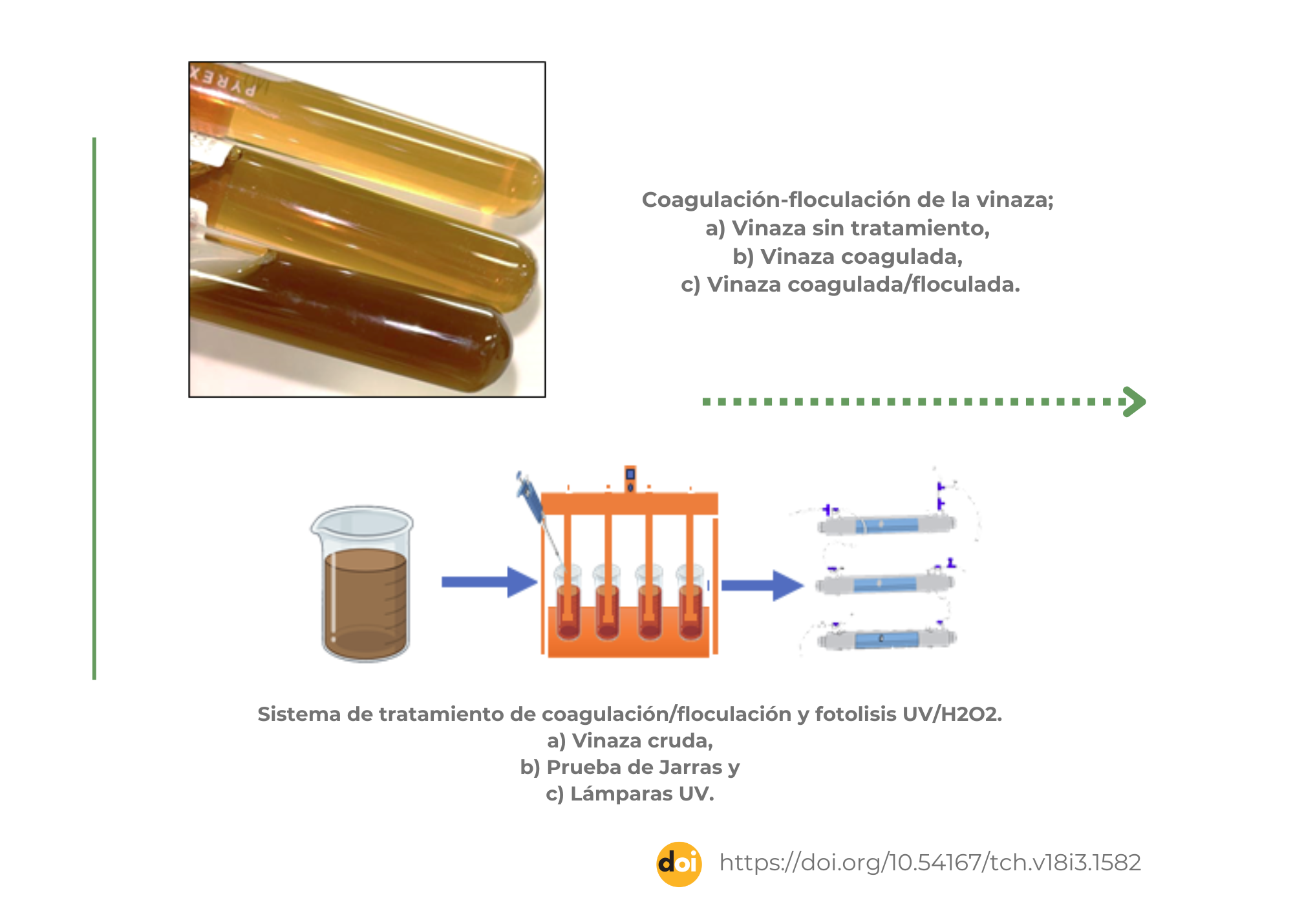
Vinasses are highly polluting residues that are generated in the mezcal production process. These effluents are characterized by a high organic load, a brown color, acid pH and a high content of recalcitrant compounds, such as phenolic compounds. To investigate the reduction of these compounds, present in the mezcal vinasse, a treatment train was implemented where, first, the effluent was characterized, followed by a physicochemical pretreatment (coagulation/flocculation) and then an advanced oxidation process (UV/H2O2 photolysis) was applied. The results of the characterization of the mezcal vinasse showed high chemical oxygen demand (COD) values of 45,730 mg O2/L, pH of 3.4 and total phenol content of 3,000 mg AG/L. For pretreatment, aluminum polychloride (PAC) was used as a coagulant and polyacrylamide (PAM) as a flocculant. Color removal of 67 %, turbidity of 95 %, total phenols of 40 % and COD of 56 % were achieved at pH 5 and PAC dosages of 10 mg/L and PAM of 3 mg/L. For the UV/H2O2 photolysis tests, the raw and coagulated stillage was used, obtaining phenol removals close to 60 % in a retention time of 35 min and a H2O2 concentration of 0.99 g/L.
https://doi.org/10.54167/tch.v18i3.1582Downloads
References
AWT (2018), https://ferisa.com.mx/wp-content/uploads/2024/01/Catalogo-America-Water-Treatment_compressed.pdf
CRM, Consejo Regulador del Mezcal. (2023). El Mezcal. La cultura líquida de México. Número 2. Oaxaca de Juárez. http://www.crm.org.mx/periodico/PDF/Revista_El_Mezcal2.pdf.
Cuero Viejo. (2024). https://cueroviejomezcal.com/proceso/
Chávez-Parga M. D. C., Pérez-Hernández E. & González-Hernández J. C. (2016). Revisión del agave y mezcal. Revista Colombiana de Biotecnología 18(1), 148-164. https://doi.org/10.15446/rev.colomb.biote.v18n1.49552
Díaz-Barajas, S., Moreno-Andrade, I., & Garzón-Zúñiga, M. A. (2024). Mezcal vinasses treatment: A review of assessed processes. Tecnología Y Ciencias Del Agua 15(2), 164–206. https://doi.org/10.24850/j-tyca-15-02-04
García-Becerra, M. (2019). Efecto de la disminución de compuestos fenólicos de vinazas tequileras sobre la producción de hidrógeno. (Tesis de maestría. Centro de investigación y asistencia en tecnología y diseño del estado de Jalisco). http://ciatej.repositorioinstitucional.mx/jspui/handle/1023/597
Gómez-Martínez, J.J. (2017). Degradación de los principales compuestos recalcitrantes presentes en las vinazas tequileras mediante fotofenton heterogéneo. (Tesis de maestría. Universidad de Guadalajara). https://hdl.handle.net/20.500.12104/90620
Iñiguez, G. & Hernández, R. (2010). Estudio para la rehabilitación de una planta de tratamiento de vinazas tequileras mediante un floculante polimérico de poliacrilamida (PAM). Rev. Int. Contam. Ambient. 26(4): 299-311. http://www.scielo.org.mx/scielo.php?script=sci_arttext&pid=S0188-49992010000400005&lng=es&nrm=iso
López-Maldonado, E. A., Oropeza-Guzmán, M. T., Jurado-Baizaval, J. L., & Ochoa-Terán, A. J. J. O. H. M. (2014). Coagulation–flocculation mechanisms in wastewater treatment plants through zeta potential measurements. Journal of hazardous materials, 279: 1-10. http://dx.doi.org/10.1016/j.jhazmat.2014.06.025
Pérez-Hernández, E., Chávez-Parga, M. C. & González-Hernández, J. C. (2016). Revisión del agave y el mezcal. Revista Colombiana de Biotecnología 18(1):148-164. https://doi.org/10.15446/rev.colomb.biote.v18n1.49552.
Robles-González V., Poggi-Varaldo H.M., Galíndez-Mayer J. & Ruiz-Ordaz N. (2018) Combined treatment of mezcal vinasses by ozonation and activated sludge. Water Environment Research 90: 1985-1996. https://doi.org/10.2175/106143017X15054988926433
Rodríguez-Arreola, A. (2019). Tratamiento de vinaza de tequila por medio de coagulación-floculación y fotocatálisis heterogénea empleando nanopartículas de TiO2. (Tesis Doctoral. Universidad de Guadalajara). https://hdl.handle.net/20.500.12104/98309
Rodríguez-Cortés, A. (2016). Fermentación anaerobia de la vinaza mezcalera para la obtención de productos de valor industrial. (Tesis Maestría. BUAP). https://hdl.handle.net/20.500.12371/9309
Rodríguez-Félix E., Contreras-Ramos S., Davila-Vazquez G, Rodríguez-Campos J, & Marino-Marmolejo E.N. (2018) Identification and quantification of volatile compounds found in vinasses from two different processes of Tequila production. Energies 11: 490. https://doi.org/10.3390/en11030490
Yao B., Zhao D., Guo J., Yan Ch., & Zheng C. (2022) Preparation and performance evaluation of hybrid polymer flocculants (PAC-PAM), and comparison experiments with other flocculants. Environmental progress & Sustainable energy. 41(4). https://doi.org/10.1002/ep.13829
Downloads
Published
Issue
Section
License
Copyright (c) 2024 TECNOCIENCIA Chihuahua

This work is licensed under a Creative Commons Attribution-NonCommercial 4.0 International License.