Terapia antibacteriana: de los antibióticos convencionales a los metalofármacos frente a la resistencia bacteriana
DOI:
https://doi.org/10.54167/tch.v20i1.2312Palabras clave:
antibiótico, complejo metálico, resistencia bacteriana, antibacteriano, bacteriasResumen
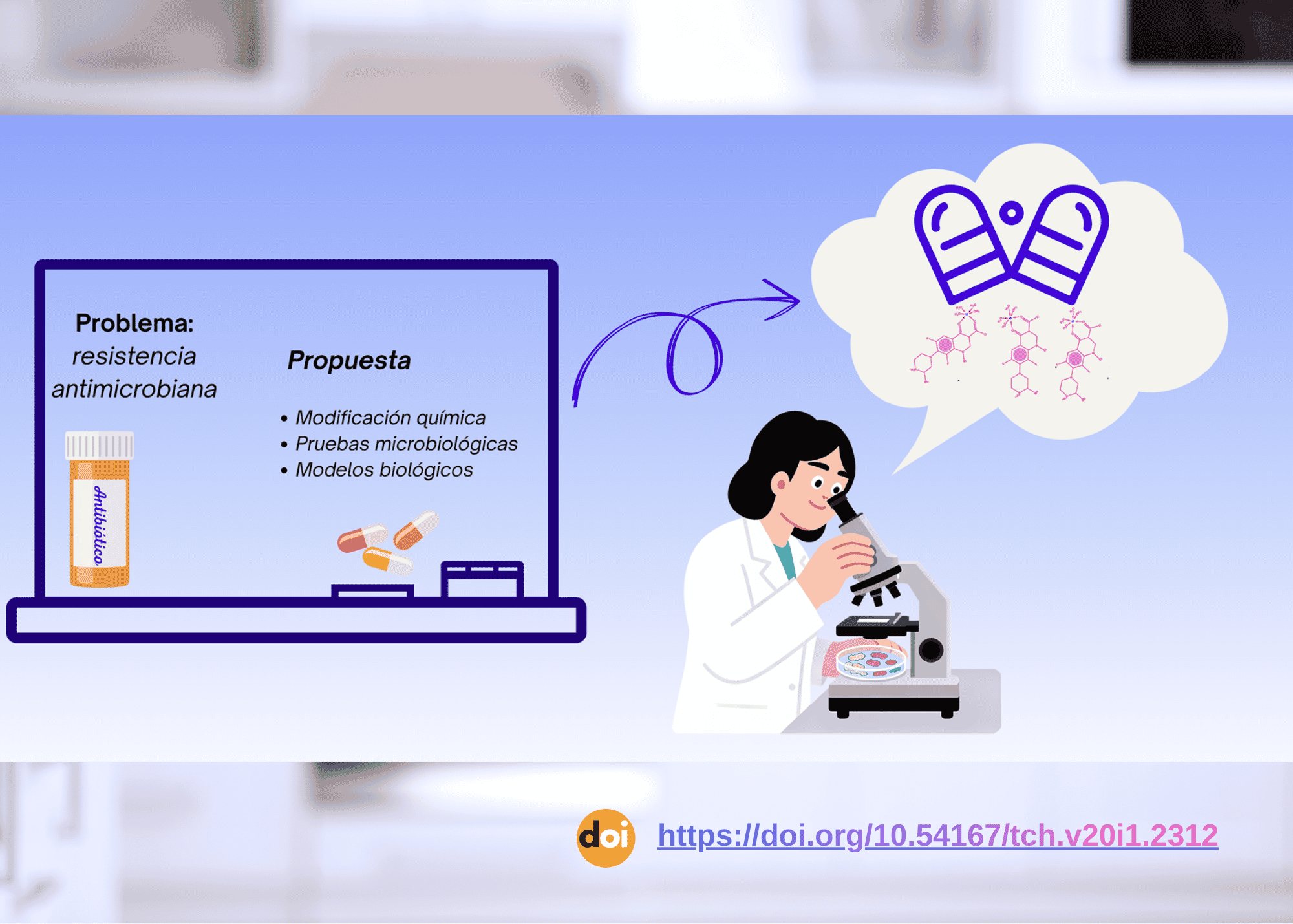
Este artículo de revisión aborda la evolución de los antibióticos y las estrategias actuales para enfrentar la resistencia bacteriana. Se sitúa el tema desde el uso histórico de sustancias antimicrobianas hasta la consolidación del concepto moderno de antibiótico. Se describe su clasificación por estructura y por mecanismo de acción, haciendo énfasis en blancos esenciales: pared celular, síntesis de ácidos nucleicos, vías metabólicas y síntesis de proteínas. Se revisan brevemente los mecanismos de resistencia intrínseca, adquirida y adaptativa, como modificaciones del blanco, reducción de permeabilidad, bombas de eflujo, inactivación enzimática y biofilms. Finalmente, se compendian investigaciones donde antibióticos convencionales se coordinan con centros metálicos (p. ej., Cu(II), Zn(II), Co(II), Ni(II), entre otros), con el objetivo de mejorar solubilidad, estabilidad y, en algunos casos, potenciar la actividad frente a bacterias Gram positivas y negativas. En conjunto, estos enfoques buscan reposicionar fármacos conocidos mediante química de coordinación y formulación avanzada, con evaluación rigurosa de eficacia.
Descargas
Referencias
Abd El-Halim, H.F., Mohamed, G.G., El-Dessouky, M.M.I., & Mahmoud, W.H. (2014). Ligational behaviour of lomefloxacin drug towards Cr(III), Mn(II), Fe(III), Co(II), Ni(II), Cu(II), Zn(II), Th(IV) and UO2(VI) ions: synthesis, structural characterization and biological activity studies. Spectrochimica Acta Part A: Molecular and Biomolecular Spectroscopy. 82(1), 8-19. https://doi.org/10.1016/j.saa.2011.05.089
Al-Thubaiti, E.H., El-Megharbel, S.M., Albogami, B., & Hamza, R.Z. (2022). Synthesis, spectroscopic, chemical characterizations, anticancer capacities against HepG-2, antibacterial and antioxidant activities of Cefotaxime metal complexes with Ca(II), Cr(III), Zn(II), Cu(II) and Se(IV). Antibiotics. 11(7), 967. https://doi.org/10.3390/antibiotics11070967
Balouiri, M., Sadiki, M., & Ibnsouda, S. K. (2016). Methods for in vitro evaluating antimicrobial activity: a review. Journal of Pharmaceuticals Analysis 6(2), 71–79. https://doi.org/10.1016/j.jpha.2015.11.005
Belloso, W. H. (2009). Historia de los antibióticos. Revista del Hospital Italiano de Buenos Aires. 29(2), 102-111. https://doi.org/10.51987/Rev.Hosp.Ital.B.Aires.v29i2.1048
Božic Cvijan, B., Kora’c Jacic, J., & Bajcetic, M. (2023). The Impact of Copper Ions on the Activity of Antibiotic Drugs. Molecules, 28(13), 5133. https://doi.org/10.3390/molecules28135133
Bubna, A.K. (2025). Bacitracin. In: Therapeutics in Dermatology - Essentials for Clinical Practice. Springer, Singapore. https://doi.org/10.1007/978-981-95-3803-4_19
Camacho Silvas, L.A. (2023). Resistencia bacteriana, una crisis actual. Revista Española de Salud Pública. 97: e 202302013. https://ojs.sanidad.gob.es/index.php/resp/article/view/93
Chohan, Z.H., Supuran, C.T., & Scozzafava, A. (2005). Metal binding and antibacterial activity of ciprofloxacin complexes. Journal of Enzyme Inhibition and Medicinal Chemistry. 20(3), 303-307. https://doi.org/10.1080/14756360310001624948
Dowling, A., O’Dwyer, J., & Adley, C. C. (2017). Antibiotics: Mode of action and mechanisms of resistance. In: Méndez-Vilas, A. (Ed.) Antimicrobial Research: Novel bioknowledge and educational programs. Microbiology Laboratory, School of Natural Sciences, University of Limerick. Formatex Research Center. https://www.researchgate.net/publication/317381477_Antibiotics_Mode_of_action_and_mechanisms_of_resistance
Durán, L. (2018). Antimicrobial resistance and implications for urinary tract infection treatment. Revista médica clínica los condes, 29(2), 213-221. https://doi.org/10.1016/j.rmclc.2018.01.002
Elasala, G.S., Fyala, S.S., & Ali, A.E. (2023). Spectroscopic studies, thermal analysis and molecular docking of Amikacin metal complexes. Chemistry Research Journal. 8(2), 32-41. https://chemrj.org/download/vol-8-iss-2-2023/chemrj-2023-08-02-32-41.pdf
Elasala, G.S., Ali, A.E., Gad, W.A., & Kolkaila, S.A. (2024). Synthesis, molecular docking as anti-prostate cancer, and biological evaluation of Ceftazidime transition metal complexes. Chemistry Research Journal. 9(3), 190-201. https://chemrj.org/download/vol-9-iss-3-2024/chemrj-2024-09-03-202-209.pdf
El-Megharbel. S.M., Qahl, S.H., Alaryani, F.S., & Hamza, R.Z. (2022). Synthesis, spectroscopic studies for five new Mg(II), Fe(III), Cu(II), Zn(II) and Se(IV) Ceftriaxone antibiotic drug complexes and their possible hepatoprotective and antioxidant capacities. Antibiotics. 11(5), 547. https://doi.org/10.3390/antibiotics11050547
Elshobary, M. E., Badawy, N. K., Ashraf, Y., Zatioun, A.A., Masriya, H.H., Ammar, M.M., Mohamed, N.A., Mourad, S., & Assy, A.M., (2025). Combating antibiotic resistance: mechanism, multidrug-resistance pathogens, and novel therapeutic approaches: an updated review. Pharmaceuticals 18(3), 402. https://doi.org/10.3390/ph18030402
El-Shwiny, W.H., El-Attar, M.S., & Sadeek, S.A. (2013). Metal complexes of enrofloxacin Part I: preparation, spectroscopic, thermal analyses studies and antimicrobial evaluation. Journal of the Korean Chemical Society. 57(1), 52-62. https://doi.org/10.5012/jkcs.2013.57.1.52
Etebu, E., & Arikekpar, I. (2016). Antibiotics: Classification and mechanisms of action with emphasis on molecular perspectives. International Journal of Applied Microbiology and Biotechnology Research, 4, 90-101. https://www.researchgate.net/publication/338357904_Antibiotics_Classification_and_mechanisms_of_action_with_emphasis_on_molecular_perspectives
Frei, A., Verderosa, A.D., Elliott, A.G., Zuegg, J., & Blaskovich, M.A.T. (2023). Metals to Combat Antimicrobial Resistance. Nature Reviews Chemistry. 7, 202–224. https://doi.org/10.1038/s41570-023-00463-4
Foti, C., Piperno, A., Scala, A., & Giuffre, O. (2021). Oxazilidinone antibiotics: chemical, biological and analytical aspects. Molecules, 26(14), 4280. https://doi.org/10.3390/molecules26144280
Giono- Cerezo, S., Santos-Preciado, J.I., Morfín-Otero, M., Torres-López, F.J., & Alcantar-Curie, M.D. (2020). Resistencia antimicrobiana. Importancia y esfuerzos por contenerla. Gaceta Médica de México. 156, 172-180. https://doi.org/10.24875/gmm.20005624
Ho, C. S., Wong, C. T. H., Aung, T. T., Lakshminarayanan, R., Mehta, J.S., Rauz, S., Macnally, A., Kintses, B., Peacock, S.J., Fuentes-Nunez, C., Hancock, R.E.W., & Ting, D.S.J. (2025). Antimicrobial resistance: a concise update. The Lancet Microbe 6(1), 100947. https://doi.org/10.1016/j.lanmic.2024.07.010
Hooper, D.C., & Jacoby, G.A. (2016). Topoisomerase Inhibitors: Fluoroquinolone Mechanisms of Action and Resistance. Cold Spring Harbor Perspectives in Medicine. 6(9), a025320. https://doi.org/10.1101/cshperspect.a025320
Horozić, E., Cipurković, A., Ademović, Z., Bjelosević, D., Zukić, A., Kolarević, L., Husejnagić, D., & Hodzić, S. (2018). Synthesis, spectral characterization and antimicrobial activity of some M(II) complexes with Ciprofloxacin. Journal of Engineering and Processing Management. 10(2), 16-22. https://jepm.tfzv.ues.rs.ba/article/id/157/
House J.E., & House K.A. (2016). Inorganics substances in biochemical applications. In: Descriptive inorganic chemistry. Chapter 23. pp 395-409. 3 edición. Elsevier In. All.
Kapoor, G., Saigal, S., & Elongavan, A. (2017). Action and resistance mechanisms of antibiotics: A guide for clinicians. Journal of Anaesthesiology Clinical Pharmacology, 33(3), 300-305. https://pubmed.ncbi.nlm.nih.gov/29109626/
Kırmusaoğlu, S., Gareayaghi, N., & Kocazeybek, B. S. (2019). Introductory chapter: The action mechanisms of antibiotics and antibiotic resistance. In: S. Kırmusaoğlu (Ed.), Antibiotics and Antimicrobial Resistance Genes. IntechOpen. https://doi.org/10.5772/intechopen.85211
Magallon, J., Vu, C., Reeves, C., Kwan, S., Phan, K., Oakley-Havens, C.L., Rocha, K., Jimenez, V., Ramirez, M.S., & Tolmasky, M.E. (2022). Amikacin potentiator activity of zinc complexed to a pyrithione derivative with enhanced solubility. Scientific Reports. 12:285. https://doi.org/10.1038/s41598-021-04724-4
Masters, P. A., O'Bryan, T. A., Zurlo, J., Miller, D. Q., & Joshi, N. (2003). Trimethoprim-sulfamethoxazole revisited. JAMA Internal Medicine, 163(4), 402–410. https://doi.org/10.1001/archinte.163.4.402
Mohamed, A.A., Ahmed, F.M., Zordok, W.A., El-Shwiny, W.H., Sadeek, S.A., & Elshafie, H.S. (2023). Novel Enrofloxacin Schiff base metal complexes: synthesis, spectroscopic characterization, computational simulation and antimicrobial investigation against some food and phyto-pathogens. Inorganics. 10(11), 177. https://doi.org/10.3390/inorganics10110177
PAHO (2021) https://www.paho.org/es/noticias/4-3-2021-patogenos-multirresistentes-que-son-prioritarios-para-oms
Panigrahi, S.D., Klebba, K.C., Rodriguez, E.N., Mayhan, C.M., Kotagiri, N., & Kumari, H. (2024). Enhancing antibacterial efficacy through macrocyclic host complexation of fluoroquinolone antibiotics for overcoming resistance. Scientific Reports. 14:24637. https://doi.org/10.1038/s41598-024-73568-5
Pontoriero, A., Mosconi, N., Monti, L., Bellu, S., Williams, P.A.M., Raimondi, M. Lima, B., Feresin, G.E., Nerli B., & Rizzotto, M. (2017). Synthesis, characterization and biological studies of a cobalt(III) complex of sulfathiazole. Chemico-Biological Interactions. 278, 152-161. https://doi.org/10.1016/j.cbi.2017.10.004
Prajapati, N., & Chaturvedi, S. (2023). Preparation, structures, and antimicrobial activity of Ni(II) complexes on the base of Enrofloxacin with dicumarol derivative. Indian Journal of Science and Technology. 16(12) 931-940. https://doi.org/10.17485/IJST/v16i12.2445
Regupathy, S., & Nair, S. (2014). Studies on the mixed ligand complexes of Copper(II) involving a sulfa drug and some potentially bi or tridentate ligands under physiologically conditions. Arabian Journal of Chemistry. 7(6), 1003-1012. https://dx.doi.org/10.1016/j.arabjc.2010.12.027
Sethuvel, D.P.M., Bakthavatchalam, Y.D., Karthik, M., Irulappan, M., Shrivastava, R., Periasamy, H., & Veeraraghavan, B. (2023). β-Lactam Resistance in ESKAPE Pathogens Mediated Through Modifications in Penicillin-Binding Proteins: An Overview. Infectious Diseases and Therapy. 12(3), 829–841. https://doi.org/10.1007/s40121-023-00771-8
Suárez, D.F., Consuegra, J., Trajano V.C., Gontijo, S.M.L., Guimarães, P.P.G., Cortés, M.E., Denadai, A.L., & Sinisterra, R.D. (2014). Structural and thermodynamic characterization of doxycycline/β-cyclodextrin supramolecular complex and its bacterial membrane interactions. Colloids and Surfaces B: Biointerfaces. 118, 194-201. https://doi.org/10.1016/j.colsurfb.2014.01.028
Szabó, Z.I., Deme, R., Mucsi, Z., Rusu, A., Mare, A.D., Fiser, B., Toma, F., Sipos, E., & Tóth, G. (2018). Equilibrium, structural and antibacterial characterization of moxifloxacin-β-cyclodextrin complex. Journal of Molecular Structure. 1166, 228-236. https://doi.org/10.1016/j.molstruc.2018.04.045
Torrence, M. E., & Isaacson, R. E. (Eds.). (2003). Microbial food safety in animal agriculture: Current topics. Iowa State Press. https://doi.org/10.1002/9780470752616
Van Bambeke, F., Glupczynski, Y., Mingeot-Leclercq, M.-P., & Tulkens, P. M. (2010). Mechanisms of action. In J. Cohen (Ed.), Infectious Diseases (3.ª ed., pp. 1288-1307). Elsevier/Mosby. https://doi.org/10.1016/B978-0-7020-6285-8.00137-4
Waters, J.E., Stevens-Cullinane, L., Siebenmann, L., & Hess, J. (2023). Recent Advances in the Development of Metal Complexes as Antibacterial Agents with Metal-Specific Modes of Action. Current Opinion in Microbiology. 75, 102347. https://doi.org/10.1016/j.mib.2023.102347
WHO (2026) https://www.who.int/es/news-room/fact-sheets/detail/antibiotic-resistance
WHO Bacterial Priority Pathogens List, (2024). Bacterial pathogens of public health importance to guide research, development and strategies to prevent and control antimicrobial resistance. Geneva: World Health Organization; Licence: CC BY-NC-SA 3.0 IGO. https://www.who.int/publications/i/item/9789240093461
Wu, X.Y., Liu, Q.Y., Jiang, S., Pan, Z.Y., Dong, J.H., Chen, B.H., Li, J.H., Liu, Y., & He, L. (2024). Copper(II) aromatic heterocyclic complexes of Gatifloxacin with multi-targeting capabilities for antibacterial therapy and combating antibiotic resistance. Bioorganic Chemistry. 153, 107938 https://doi.org/10.1016/j.bioorg.2024.107938
Publicado
Número
Sección
Licencia
Derechos de autor 2026 TECNOCIENCIA Chihuahua

Esta obra está bajo una licencia internacional Creative Commons Atribución-NoComercial 4.0.