Impacto de la sustitución parcial de harina de trigo refinada por harinas extruidas de grano entero de lenteja y sorgo rojo sobre la textura y composición proximal de galletas
DOI:
https://doi.org/10.54167/tch.v19iEspecial.1980Palabras clave:
proteína, lenteja, sorgo, composición proximal, galleta, extrusiónResumen
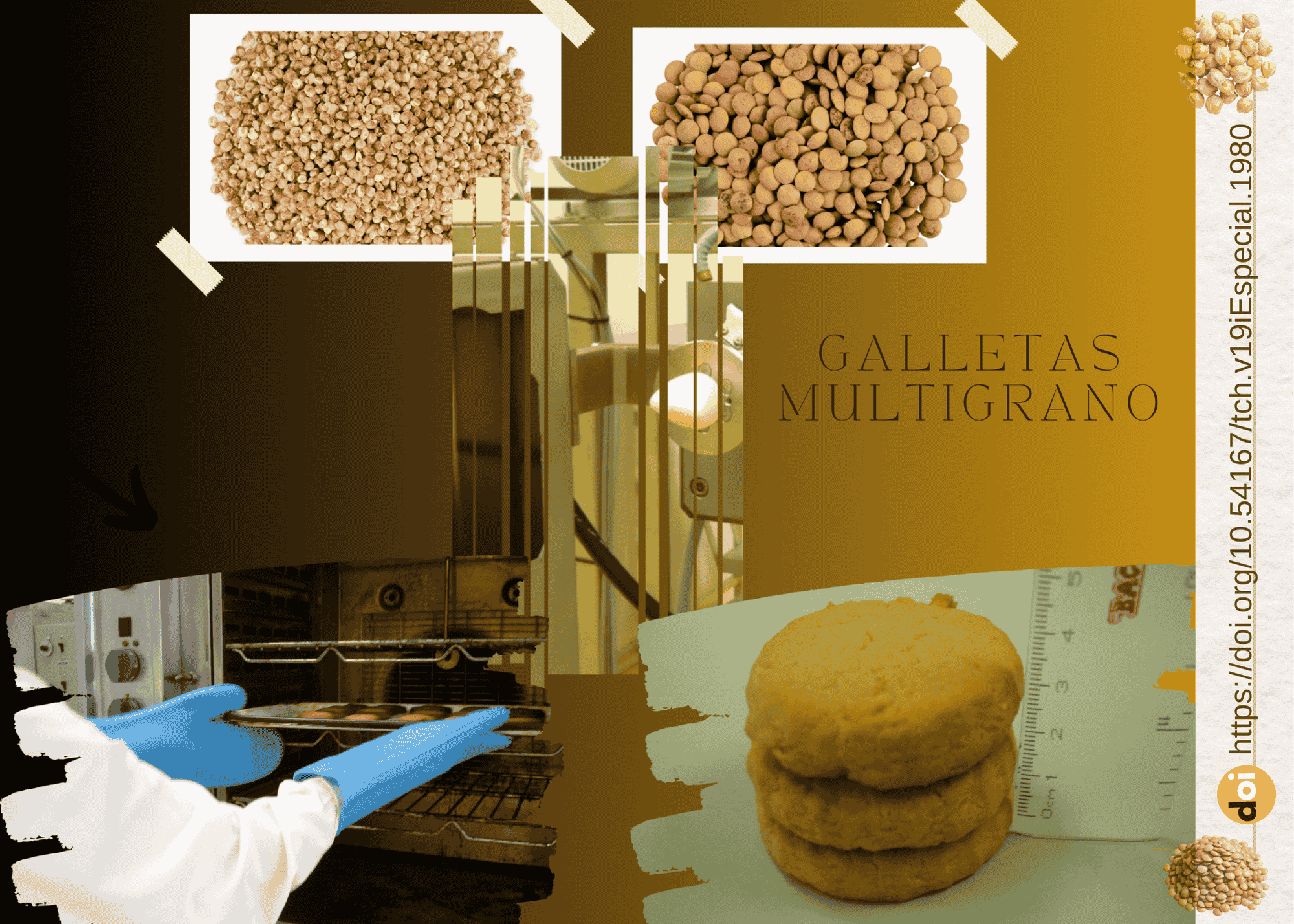
El objetivo de esta investigación fue evaluar el efecto de sustituir la harina de trigo por harinas de lenteja y sorgo extruidas, en la composición proximal, digestibilidad in vitro de la proteína, color, actividad de agua, perfil de análisis de viscosímetro rápido (RVA) y propiedades texturales de galletas durante un período de almacenamiento de 7 días a 25 °C. Se evaluaron cuatro formulaciones: 100 % harina de trigo (Tratamiento 00), 80 % harina de trigo con 20 % de harina de lenteja extruida (Tratamiento 01), 60 % harina de trigo con 40 % de harina de lenteja extruida (Tratamiento 02) y 30 % harina de trigo, 40 % de harina de lenteja extruida y 30 % de harina de sorgo extruida (Tratamiento 03). Los resultados revelaron que la sustitución parcial de harina de trigo por harinas de lenteja y sorgo extruidas (Tratamiento 03) genera una galleta con tonalidad más rojiza, menor actividad de agua que el control, con una mejora significativa del contenido de proteína, cenizas, así como el índice de expansión de las galletas. En cuanto a textura dentro de los primeros días, esta galleta es la que presenta menos cambios en dureza y fracturabilidad, lo que indica que es más estable. Estos resultados sugieren que la incorporación de harinas de lenteja y sorgo extruidas puede ser una alternativa para incrementar la entrega de proteína de calidad a través de productos de alto consumo como son las galletas.
Descargas
Referencias
AACC International. (2010). AACC International Approved Methods of Analysis, (11th ed.). Method 10–31.03 (St. Paul, MN). https://www.cerealsgrains.org/resources/methods/Pages/default.aspx
AOAC. (2000). Official Methods of Analysis of the Association of Official Analytical Chemistry, (17th ed.). Gaithersburg MD, USA.
Arepally, D., Reddy, R. S., Coorey, R., & Goswami, T. K. (2023). Evaluation of functional, physicochemical, textural and sensorial properties of multi-millet-based biscuit. International Journal of Food Science and Technology, 58(5), 2437-2447. https://doi.org/10.1111/ijfs.16381
Aruna, C., Meena, K., Visarada, K. B. R. S., Hariprasanna, K., Deepika, C., Venkateswarlu, R., Venkateswarly, R., Das, I.K., Meena, D.K., Madhusudhana, R. & Satyavathi, C. T. (2025). Red sorghum variety: A dual solution for functional food and grain mold resistance. Journal of Cereal Science, 123, 104150. https://doi.org/10.1016/j.jcs.2025.104150
Aslan Türker, D. (2024). Determination of the physical quality, structural characteristics, and sensory acceptability of biscuits prepared from einkorn-based lentil composite flours. Harran Tarım Ve Gıda Bilimleri Dergisi, 28(3), 430-443. https://doi.org/10.29050/harranziraat.1477200
Balestra, F., Verardo, V., Tappi, S., Caboni, M. F., Dalla Rosa, M., & Romani, S. (2019). Chemical and physical changes during storage of differently packed biscuits formulated with sunflower oil. Journal of food science and technology, 56(10), 4714-4721. https://doi.org/10.1007/s13197-019-03918-z
Becerril-Ibarra, O. A., Sosa-Morales, M. E., Rodriguez-Hernández, G., & Gómez-Salazar, J. A. (2019). Efecto de la concentración de harina de garbanzo en las propiedades fisicoquímicas de salchicha tipo frankfurt durante su almacenamiento. Investigación y Desarrollo en Ciencia y Tecnología de Alimentos, 4(686-694). http://www.fcb.uanl.mx/IDCyTA/files/volume4/4/7/96.pdf
Camara, F., Coulibaly, W. H., Mian, T. M. A. S., Ahoussi, K. J. B., Coulibaly, S., Varadarajan, V., Diguta, C., & Matei, F. (2025). Household production of cookies from sorghum (Sorghum bicolor) with a low glycaemic index in prevention and management of type 2 diabetes in Côte d’Ivoire. Current Nutrition & Food Science, 21(3), 341-349. http://dx.doi.org/10.2174/0115734013307493240627033411
de Almeida Marques, G., de São José, J. F. B., Silva, D. A., & da Silva, E. M. M. (2016). Whey protein as a substitute for wheat in the development of no added sugar cookies. LWT-Food Science and Technology, 67, 118-126. https://doi.org/10.1016/j.lwt.2015.11.044
Dewan, M. F., Shams, S. N. U., & Haque, M. A. (2024). A review of the health benefits of processed lentils (Lens culinaris L.). Legume Science, 6(2), e232. https://doi.org/10.1002/leg3.232
Espinosa-Ramírez, J., Rodríguez, A., De la Rosa-Millán, J., Heredia-Olea, E., Pérez-Carrillo, E. & Serna-Saldívar, S. O. (2021). Shear-induced enhancement of technofunctional properties of whole grain flours through extrusion. Food Hydrocolloids 111, 106400. https://doi.org/10.1016/j.foodhyd.2020.106400
Felisiak, K., Przybylska, S., Tokarczyk, G., Tabaszewska, M., Słupski, J., & Wydurska, J. (2024). Effect of chickpea (Cicer arietinum L.) flour incorporation on quality, antioxidant properties, and bioactive compounds of shortbread cookies. Foods, 13(15), 2356. https://doi.org/10.3390/foods13152356
Flores-Quintanilla, R.D., & Pérez-Carrillo, E. (2022). Evaluation of the effect of replacing shortening for sesame paste (Sesamum indicum) in nixtamalized maize cookies. Food Research, 6(5):365-369. https://doi.org/10.26656/fr.2017.6(5).602
Iacovino, S., Garzon, R., Rosell, C. M., Marconi, E., Albors, A., & Martín-Esparza, M. E. (2025). Evaluation of the technological performance of soft wheat flours for fresh-pasta production as affected by industrial refining degree. Food and Bioprocess Technology, 18, 2854–2866. https://doi.org/10.1007/s11947-024-03638-z
Imran, A., Suleria, H. A., Arshad, M. U., Wei, C. R., Zarikian, N. A., Afzaal, M., & Islam, F. (2024). Unleashed protein power: redefining baked goods with legume flour mixtures. Cogent Food & Agriculture, 10(1), 2407652. https://doi.org/10.1080/23311932.2024.2407652
Jarpa-Parra, M. (2018). Lentil protein: A review of functional properties and food application. An overview of lentil protein functionality. International Journal of Food Science and Technology, 53(4), 892-903. https://doi.org/10.1111/ijfs.13685
Liberal, Â., Almeida, D., Fernandes, Â., Pereira, C., Ferreira, I. C. F. R., Vivar‐Quintana, A. M., & Barros, L. (2024). Nutritional, chemical, and antioxidant screening of selected varieties of lentils (Lens culinaris spp.) from organic and conventional agriculture. Journal of the Science of Food and Agriculture, 104(1), 104-115. https://doi.org/10.1002/jsfa.12896
Maache-Rezzoug, Z., Bouvier, J. M., Allaf, K., & Patras, C. (1998). Effect of principal ingredients on rheological behaviour of biscuit dough and on quality of biscuits. Journal of Food Engineering, 35(1), 23-42. https://doi.org/10.1016/S0260-8774(98)00017-X
Masatcioglu, M.T., & Koksel, F. (2019). Functional and thermal properties of yellow pea and red lentil extrudates produced by nitrogen gas injection assisted extrusion cooking. Journal of the Science of Food and Agriculture, 99(15), 6796-6805. https://doi.org/10.1002/jsfa.9964
Mba, J. C., Paes, L. T., Viana, L. M., Ferreira, A. J. C., Queiroz, V. A. V., Martino, H. S. D., Azevedo, L., de Carbalho, C. W. P., Felisberto, M. H. F., & de Barros, F. A. R. (2023). Evaluation of the physical, chemical, technological, and sensorial properties of extrudates and cookies from composite sorghum and cowpea flours. Foods, 12(17), 3261. https://doi.org/10.3390/foods12173261
Moin, A., Hosseini, E., Smaoui, S., & Varzakas, T. (2025). Research progress on lentil-based composite flours: physicochemical, techno-functional properties, and high-performance food applications. Quality Assurance and Safety of Crops & Foods, 17(2), 232-250. https://doi.org/10.15586/qas.v17i2.1540
Pareyt, B., Finnie, S. M., Putseys, J. A., & Delcour, J. A. (2011). Lipids in bread making: sources, interactions, and impact on bread quality. Journal of Cereal Science, 54(3), 266-279. https://doi.org/10.1016/j.jcs.2011.08.011
Qiu, C., Hu, H., Chen, B., Lin, Q., Ji, H., & Jin, Z. (2024). Research progress on the physicochemical properties of starch-based foods by extrusion processing. Foods, 13(22), 3677. https://doi.org/10.3390/foods13223677
Rahman, S., Kumar Dubey, P., & Singh, H. (2025). Development of a cost-effective and protein-enhanced germinated cereal–legume–millet flour based multigrain cookie: a step towards sustainable goals. International Journal of Food Science and Technology, 60(1), vvae064. https://doi.org/10.1093/ijfood/vvae064
Ragaee, S., & Addel-Aal, E. A. (2006) Pasting properties of starch and protein in selected cereals and quality of their food products. Food Chemistry, 95(1), 9–18. https://doi.org/10.1016/j.foodchem.2004.12.012
Sahni, P., & Sharma, S. (2023). Quality characteristics, amino acid composition, and bioactive potential of wheat cookies protein-enriched with unconventional legume protein isolates. Quality Assurance and Safety of Crops & Foods, 15(2), 1-10. https://doi.org/10.15586/qas.v15i2.1160
Sharma, S., Singh, N., & Katyal, M. (2016). Effect of gelatinized-retrograded and extruded starches on characteristics of cookies, muffins and noodles. Journal of Food Science and Technology, 53, 2482–2491. https://doi.org/10.1007/s13197-016-2234-8
Şeren, E., & Çelekli, A. (2025). Functional biscuits with alternative protein sources. Proceeding Book of 4th International Conference on Contemporary Academic Research ICCAR 2025. pp. 355-360. Published by: All Science Academy. Konya, Turkey. https://aperta.ulakbim.gov.tr/record/274323
Taipe-Lucas, C., Espinoza-Calderón, G. A., Ruiz-Rodríguez, A., & Salazar-Silvestre, E. (2021). Principios metodológicos fundamentales para las mezclas alimenticias instantáneas con harina de haba, quinoa y maíz. Polo del Conocimiento: Revista científico-profesional, 6(5), 1128-1154. https://polodelconocimiento.com/ojs/index.php/es/article/view/2734/5762
Usman, S., Suhartono, M. T., Purwani, E. Y., Sitanggang, A. B., & Trisnawati, W. (2024). Characteristics of sorghum flour modified with physical and enzymatic treatments. Emirates Journal of Food and Agriculture, 36, 1-9. https://doi.org/10.3897/ejfa.2024.119095
Publicado
Número
Sección
Licencia
Derechos de autor 2025 TECNOCIENCIA Chihuahua

Esta obra está bajo una licencia internacional Creative Commons Atribución-NoComercial 4.0.