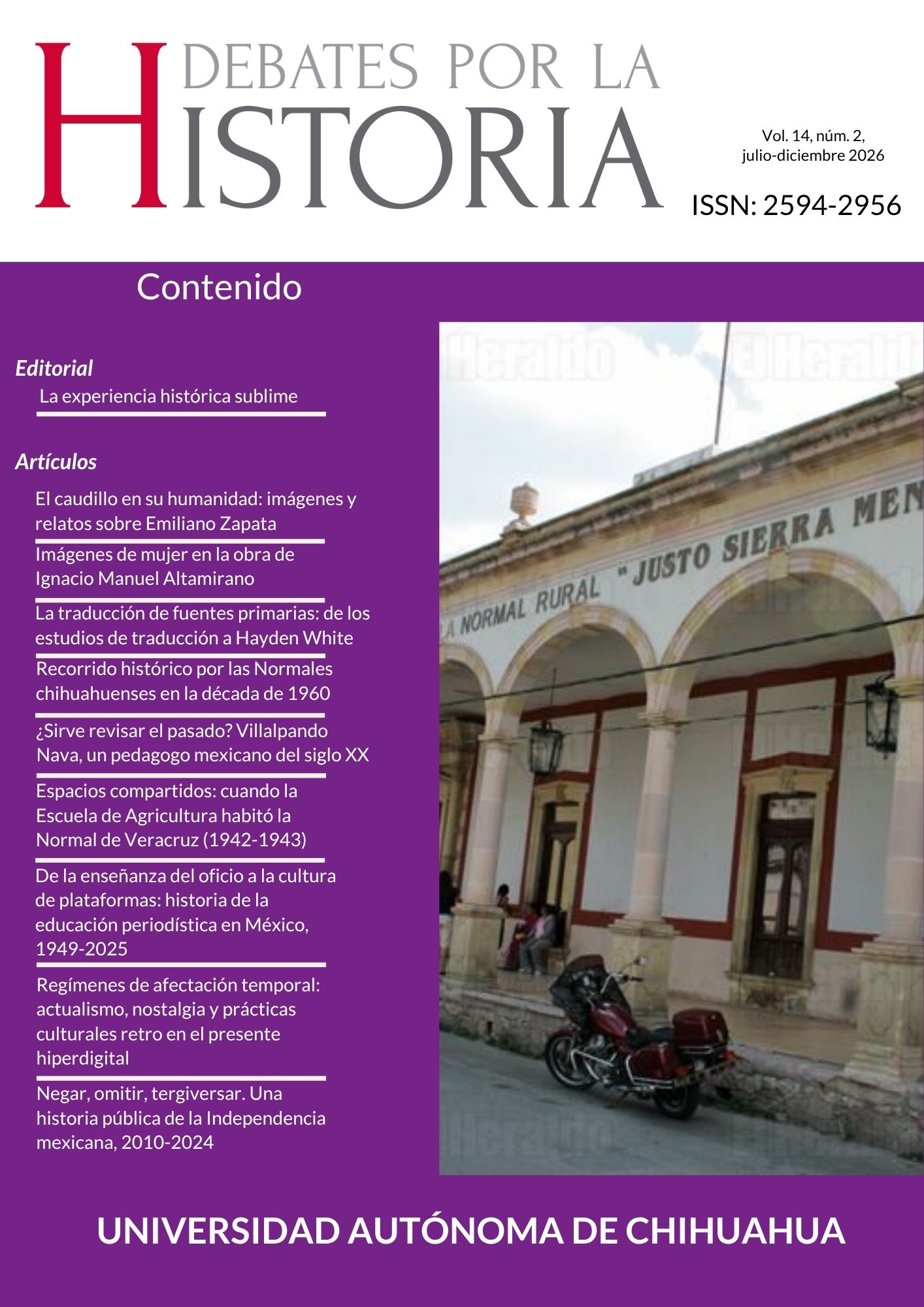
The Caudillo in His Humanity: Images and Narratives of Emiliano Zapata
DOI:
https://doi.org/10.54167/debates-por-la-historia.v14i2.2167Keywords:
Emiliano Zapata, biography, cultural history, popular representations, Mexican RevolutionAbstract
This article proposes an approach to the figure of Emiliano Zapata that, without separating him from his political and revolutionary context, focuses on the human, every day, and symbolic dimensions associated with the construction of his leadership. Drawing on oral testimonies, historical documents, accounts by contemporaries, and Zapatista corridos, the study analyzes different representations of Zapata’s public and private life, with particular attention to the years before and after the beginning of the Mexican Revolution. From perspectives associated with cultural history and the history of emotions, the article revisits episodes related to land dispossession, agrarian conflicts, and the community dynamics of Anenecuilco, examining how these events have been connected, both by contemporaries and in later narratives, to the construction of Zapata as a figure of authority and a reference point for agrarian justice. It also analyzes how chronicles, testimonies, memories, and popular expressions, particularly corridos, contributed to shaping and sustaining a symbolic image of the Caudillo of the South. Rather than merely reconstructing events, these narratives attributed qualities, values, and meanings to Zapata that helped portray him as a defender of the land and a spokesperson for peasant demands. From this perspective, the article argues that the study of Zapata and Zapatismo may be enriched by considering not only the political and social processes in which they participated, but also the affective, cultural, and narrative dimensions through which his figure has been interpreted, appropriated, and resignified over time.
Downloads
References
Alfaro viuda de Mejía, L. (1984). Entrevista a la señora Leonor Alfaro viuda de Mejía. Archivo de la Palabra del Instituto de Investigaciones Históricas José María Luis Mora.
Álvarez, A. (1982). Entrevista con Arturo Álvarez Sánchez. Archivo de la Palabra del Instituto de Investigaciones Históricas José María Luis Mora.
Ávila, F. (2021). Las compañeras de Zapata. Crítica.
Barreto Mark, C. (2002). Corridos zapatistas: corridos de la Revolución (6ª ed.). INAH.
Corrido de Zapata niño. (s.f.). Bibliotecas TV. http://web.archive.org/web/20210624183904/https://bibliotecas.tv/zapata/corridos/corr01.html
De María y Campos, A. (1962). La Revolución Mexicana a través de los corridos populares (Tomo I). INEHRM.
Díaz Soto y Gama, A. (2011). La revolución agraria del sur y Emiliano Zapata. INEHRM.
Frye, N. (1991). Anatomía de la crítica. Monte Ávila Editores.
García, F. (1915). Al heroico y valiente caudillo, general Emiliano Zapata. Bibliotecas TV. http://web.archive.org/web/20210621165402/https://bibliotecas.tv/zapata/corridos/corr135.html
Granados, B. (2018). Emiliano Zapata. Vida y virtudes según cuentan en Morelos. UNAM.
Machillot, D. (2013). Machos y machistas. Paidós.
Osorno, F. (2014). Las cartas de Emiliano Zapata. [Version Kinddle].
Padilla, P. (1982). Entrevista a Petra Padilla. Archivo de la Palabra del Instituto Mora.
Paz, O. (1934, 11 de febrero). Un opíparo banquete. El Porvenir. El periódico de la frontera. Hemeroteca Nacional de México.
Rodríguez, X. I. (2018). El corrido zapatista y la construcción de masculinidades revolucionarias (Tesis de maestría). Universidad Autónoma de Aguascalientes.
Sotelo Inclán, J. (1970). Raíz y razón de Zapata. Comisión Federal de Electricidad.
Womack, J. (2017). Zapata y la Revolución mexicana. Fondo de Cultura Económica.
Downloads
Published
Issue
Section
License
Copyright (c) 2026 Xóchitl Ixchel Rodríguez Velázquez

This work is licensed under a Creative Commons Attribution-NonCommercial 4.0 International License.
Todos los contenidos de la revista Debates por la Historia se publican bajo una licencia Creative Commons Atribución No Comercial 4.0 Internacional, que permite compartir (copiar y redistribuir el material en cualquier medio o formato) y adaptar (remezclar, transformar y construir a partir del material) para fines no comerciales, dando los créditos a los autores y a la revista, tal como lo establece la licencia.
La política de acceso abierto y de licencias con “algunos derechos reservados” no niega la propiedad intelectual ni los derechos de los autores respecto a sus artículos, pues ellos son los titulares y la revista Debates por la Historia no los reserva para sí ni para la institución editora, ya que se apega a movimientos de acceso abierto como los Principios y Valores del Sistema de Información Científica Redalyc - Red de Revistas Científicas de América Latina y el Caribe, que pugnan por la eliminación de las políticas de embargo para que el autor retenga los derechos de su obra (principio número 8).
Los autores podrán distribuir su propio material en cualquier otro medio o soporte, siempre y cuando sea para fines no comerciales, informando a los editores que el trabajo será publicado nuevamente y dando el crédito correspondiente a la revista Debates por la Historia.
La publicación en la revista Debates por la Historia, por su carácter gratuito, no da derecho a remuneración económica alguna a los autores, ni a los dictaminadores.
Los lectores podrán reproducir (copiar), comunicar, distribuir o hacer obras derivadas de los artículos o colaboraciones publicados en la revista Debates por la Historia en los siguientes casos:
- Para fines públicos.
- Sin fines comerciales.
- Que se reconozca la autoría de la obra y se cite su origen con información completa: Apellido/s del autor, inicial/es del nombre/s. (año de publicación). Título del artículo. Nombre de la revista, volumen (número de ejemplar), página inicial del artículo-página final del artículo. DOI: numero de identificador o Recuperado de: URL exacto del documento citado (formato sugerido).
El cuerpo editorial de la revista Debates por la Historia asumirá el compromiso de notificar oportunamente a los autores sobre cualquier cambio de ubicación de los artículos en el sitio (cambio de dirección URL o de conexiones para identificar el artículo).
Los autores, al enviar sus trabajos para su posible publicación, deberán tomar en cuenta los puntos anteriores, mismos que se contemplan en el Acuerdo entre autor y la revista Debates por la Historia.